
A content pipeline built to maximize output is manufacturing an asset whose market price just fell to zero. AI made drafts free, answer engines took the clicks that generic drafts used to earn, and the only pipeline worth building now is one organized around quality gates most teams skip: an information-gain check before the brief, an evidence standard, a stance requirement, senior review, and a revenue scoreboard. Everything else in this article is the case for that claim and the working version of that pipeline.
The numbers behind the claim are not close. In the Content Marketing Institute’s 2026 B2B research, published in October 2025 from a survey of 1,015 B2B marketers, 97% say they have a content strategy. Only 12% rate their marketing as highly effective. Nearly everyone has a pipeline. Almost no one has a pipeline that wins. The difference is not the number of stages on the whiteboard. It is what each stage refuses to let through.
Production Is Free Now, and It Bought Almost Nothing
The clearest evidence that output stopped being the constraint comes from the teams that solved output. Per the same 2026 CMI survey, 89% of B2B marketers now use AI tools for content creation, and their reported gains form a funnel that should worry every team celebrating its publishing cadence: 87% say productivity improved, 80% say operational efficiency improved, 65% say creative capabilities improved, 58% say content quality improved, and just 39% say content performance improved. Another 34% saw no performance change at all, and 12% say AI made their content quality worse.
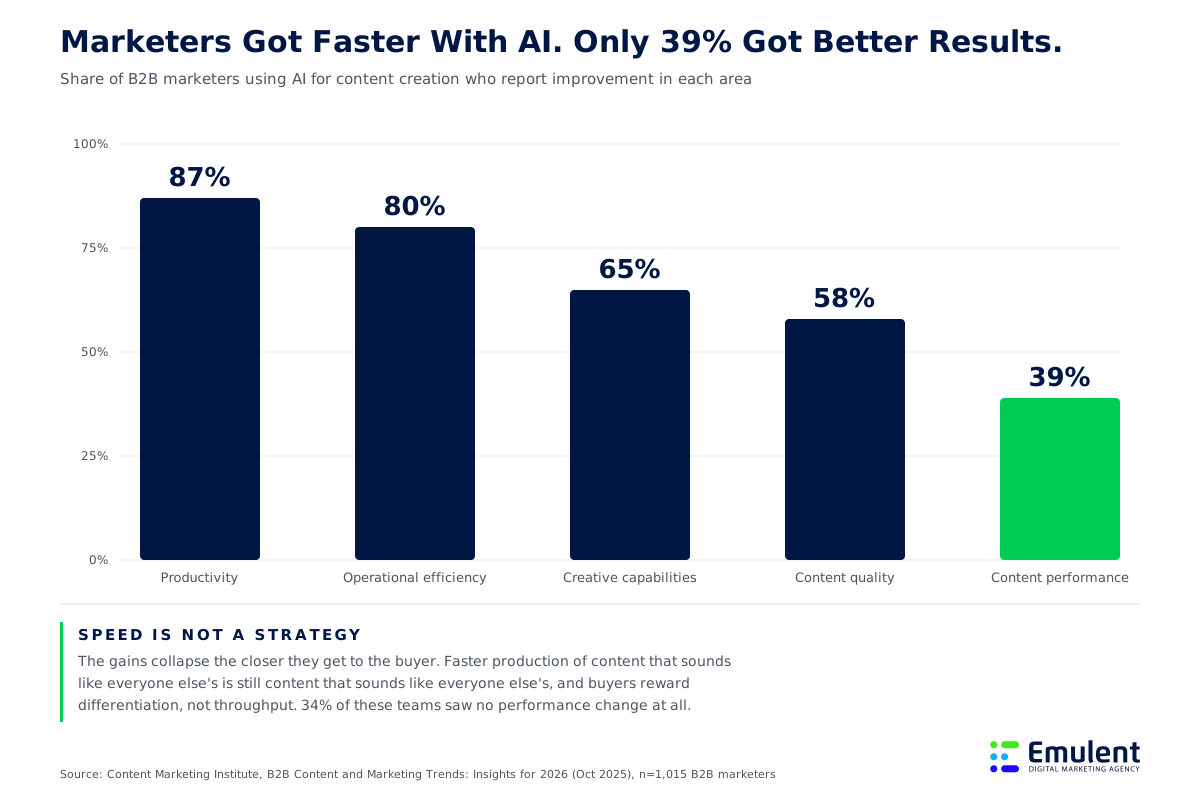
Read that funnel from left to right and it tells one story: the gains collapse the closer they get to the buyer. Faster production of content that sounds like everyone else’s is still content that sounds like everyone else’s. When every competitor gets the same 87% speed boost, speed stops being an advantage and becomes the ante. The scarce input moved from production capacity to judgment, and judgment is the one thing a pipeline stage labeled “draft” cannot supply.
This is why we tell clients that authentic content requires senior expertise, not outsourcing. The pre-AI pipeline hired for typing capacity because typing was expensive. Typing is now free, so a pipeline still staffed and structured around typing capacity is paying for the wrong scarcity.
The Teams That Improved Fixed the Plan, Not the Stack
The 2026 CMI data also shows exactly where improvement came from for the 61% of marketers whose content strategy results got better over the year. Asked what drove the gain, 74% named strategy refinement. New technology implementation came in second at 51%, followed by team restructuring and resources at 40%, measurement capabilities at 26%, budget adjustments at 16%, and market conditions at 14%. The plan beat the purchase, and it wasn’t close.
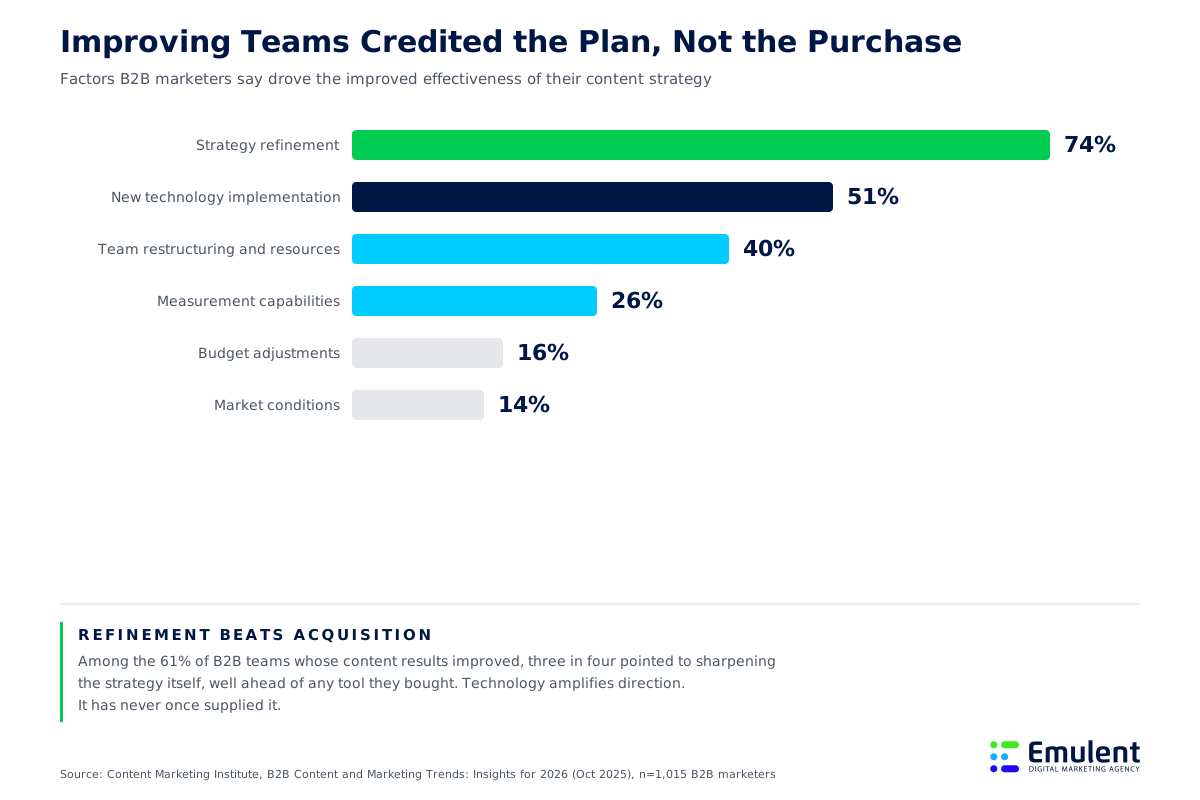
Budgets are pointed the other way. The same survey found 45% of B2B marketers plan to increase spending on AI-powered tools in 2026, while investment in people, meaning salaries, training, and development, ranked dead last at 9%. Teams are buying amplifiers for a signal they have not written yet. A tool multiplies direction. It has never once supplied direction, and the 74/51 split above is a thousand marketers saying so out loud.
“We have never audited a struggling content program and found the problem was typing speed. The problem is always upstream. Nobody decided what the content was for, so the pipeline produced more of nothing in particular, faster.” – The Strategy Team at Emulent
So before you add a single automation to your pipeline, refine the thing it automates. Our B2B content strategy checklist covers that upstream work: who the buyer is, which questions carry purchase intent, what the company is willing to argue, and what a piece must accomplish to justify its slot in the calendar.
The Click You Were Producing For Is Disappearing
The old pipeline’s economics assumed a payoff at the end: rank, get the click, earn the lead. That payoff is being repriced in real time. Pew Research Center’s July 2025 analysis of tracked browsing from 900 US adults, covering 68,879 Google searches made in March 2025, found that users clicked a result link on 8% of visits when an AI summary appeared on the page, against 15% when one did not. Links cited inside the summary itself were clicked on 1% of visits. Users also ended their browsing session outright more often after a summary page: 26% versus 16%.
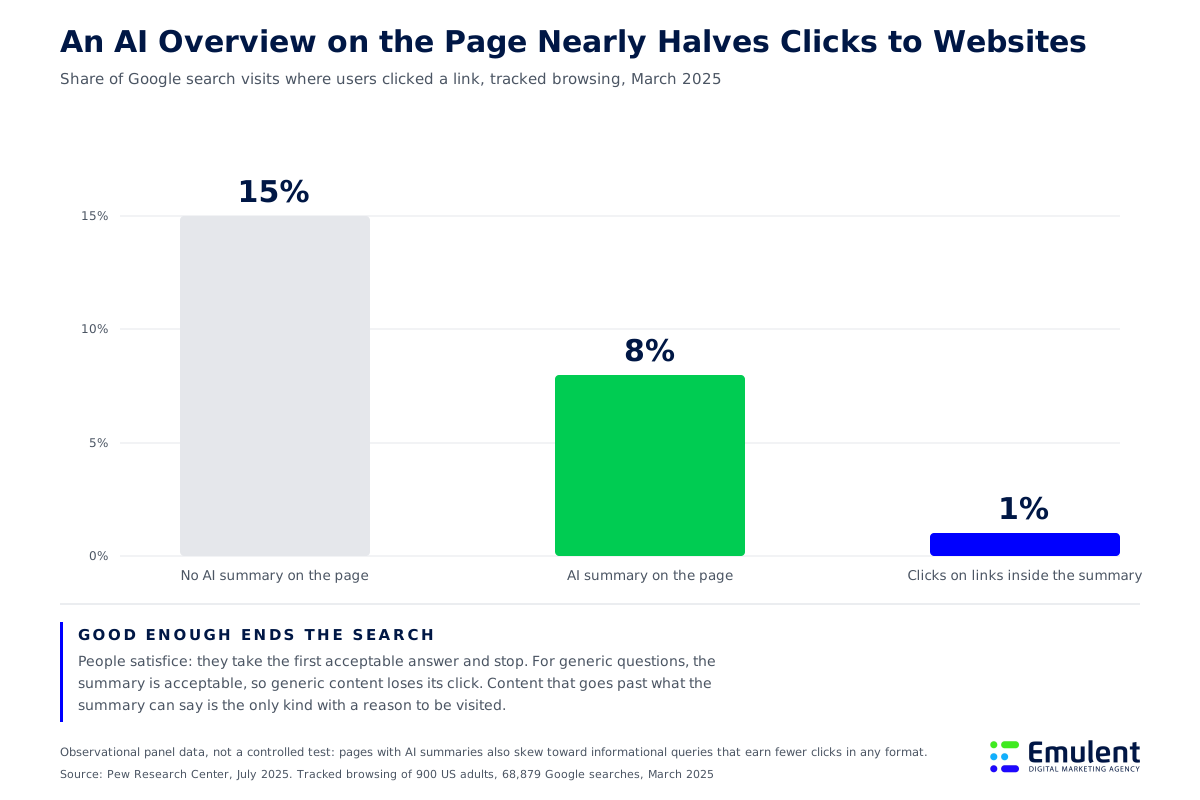
One honesty note the chart also carries: this is observational panel data, not a controlled test. AI summaries appear more often on informational queries, which earn fewer clicks in any format, so the 15-to-8 gap overstates the pure effect of the summary. The direction of the effect is hard to argue with; the exact size is not settled. Either way, the behavioral mechanism underneath it is the one that should reshape your pipeline: people satisfice. They take the first acceptable answer and stop looking. For a generic question, the machine summary is acceptable. Generic content has lost its click because it earned its click only when nothing faster existed.
“Buyers don’t reward effort. They reward certainty. When an answer engine hands them 80% certainty for free, the only content worth producing is the kind that closes the last 20%: the number, the mechanism, the judgment call a summary can’t make.” – Bill Ross, Founder of Emulent
We wrote a full breakdown of how AI Overviews affect SEO, and the practical conclusion belongs in your pipeline, not your monitoring dashboard: the information-gain question moves from a nice-to-have to the first gate a topic must pass. Content that only restates what the top results already say is now raw material for the summary that replaces it. Content that adds original data, a committed position, or numbers the summary cannot generate is the content the summary has to cite. That citation game is its own discipline, and it is the center of our AI SEO work.
How Much of Search the Answer Layer Will Take
The answer layer is not finished growing, and the growth is not a straight line. The Semrush AI Overviews study, which tracked more than 10 million US keywords through 2025, measured AI Overviews on 6.49% of queries in January 2025, a spike to nearly 25% by July, and a pullback to 15.69% in November. Underneath the volatility, the feature expanded into the queries that matter commercially: navigational searches triggering an AI Overview rose from 0.74% in January to 10.33% by late 2025, and the informational share of AI Overview queries fell from 91.3% to 57.1% as commercial and transactional queries took a bigger slice.
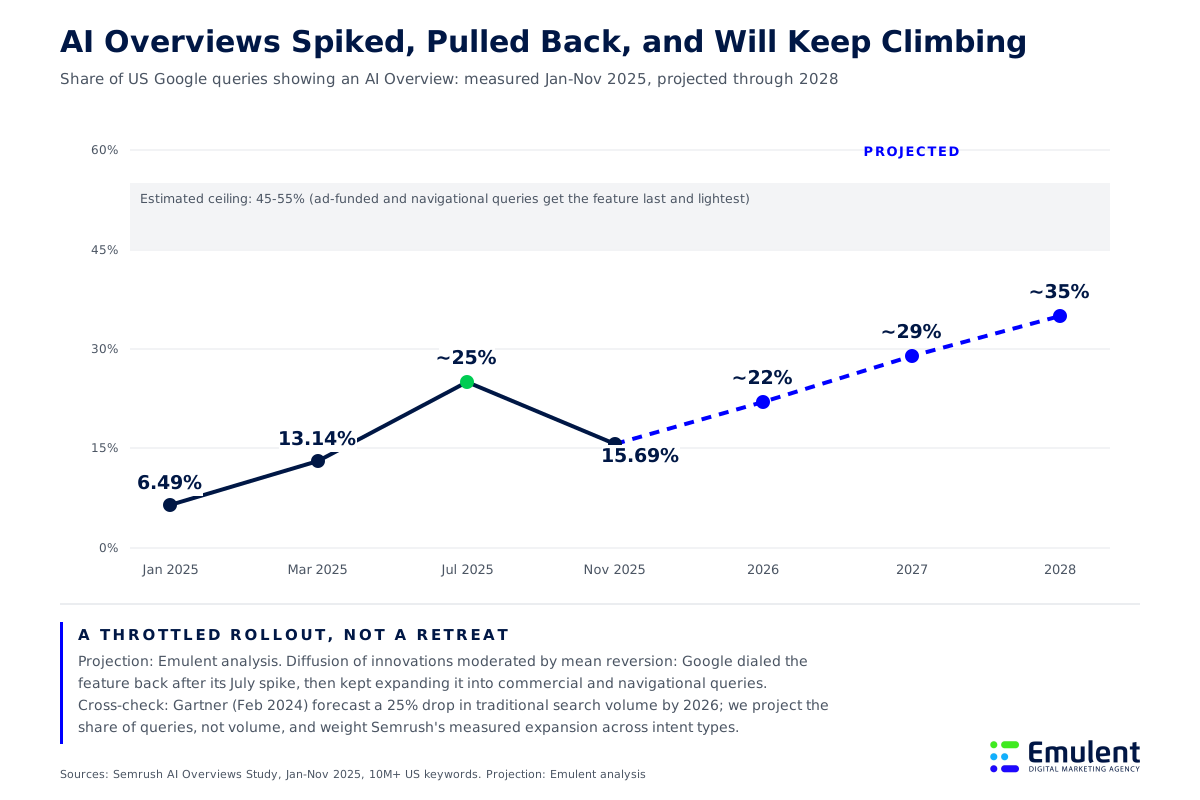
Projection: Emulent analysis based on diffusion of innovations moderated by mean reversion, since Google throttled the feature after its July 2025 spike and then re-expanded it across intent types, assuming a 45-55% ceiling because ad-funded and navigational queries get the feature last and lightest, cross-checked against Gartner’s February 2024 forecast of a 25% drop in traditional search volume by 2026.
Our read: roughly 22% of US queries carrying an AI Overview in 2026, 29% in 2027, and 35% in 2028, bending toward a 45-55% ceiling rather than 100%. The pullback from July’s peak was a throttle, not a retreat. Google trims where the answers embarrass it or threaten the ad auction, then expands again where they don’t. Gartner’s February 2024 forecast that traditional search engine volume would drop 25% by 2026 points the same direction from a different angle; we project the share of queries carrying an answer, not total volume, and we weight Semrush’s measured expansion across intent types over any single headline number. Add ChatGPT, Perplexity, and the rest of the answer engines on top of Google’s share and the planning assumption gets simple: build every piece for a world where a third or more of its potential searches never show a list of links. That is why search everywhere optimization now sits inside pipeline planning instead of after it.
The Five Gates of a High-Quality Content Pipeline
A pipeline is a series of stages. A high-quality pipeline is a series of gates, and a gate is a stage with a kill condition. Here is the version we run for clients through our content strategy services, with the thresholds that make each gate real instead of ceremonial.
Gate 1: Information gain, before the brief exists. Read the top eight to ten results for the target query and list what they collectively fail to give the searcher: the stale statistic with a current version, the claim asserted with no mechanism, the step described without a cost or a timeframe. If you cannot name three specific things your piece will contain that page one does not, the topic dies here. This gate does double duty, because the same gaps that win the human reader are what earn citations from answer engines. Your keyword research feeds this gate; it does not replace it, because a keyword tells you demand exists, not that you have anything new to meet it with.
Gate 2: Evidence. Every statistic traces to the party that produced it: the researcher, the platform, the agency-free analyst report, the government dataset. No number older than a few years, no figure whose citation chain dead-ends in another listicle, and every number carries its year in the sentence. This is the slowest gate and the highest-return one, because current primary-sourced data is the cheapest form of information gain available and page one is drowning in recycled 2019 figures.
Gate 3: Stance. Each piece commits to one claim a competitor could disagree with, and the claim appears in the first paragraph, not the conclusion. The test is blunt: would a competitor’s blog publish this sentence? If yes, sharpen it or cut it. We built this article on the stance that volume-first pipelines now manufacture a worthless asset. You may think we are wrong. That possibility is the point; a piece nobody could disagree with is a piece nobody needs. Write it for the humans making the purchase decision, the whole committee of them, which is the argument we laid out in stop writing B2B content for Google, start writing for the buying committee.
Gate 4: Senior review. A practitioner who has done the work reads the draft and answers two questions in writing: what would I tell a paying client to do differently after reading this, and what in here would I push back on? If the answers are “nothing” and “nothing,” the draft goes back. This gate costs senior hours, which is exactly why it works. Since drafts became free, review became the costly signal that separates firms that know from firms that generate. Our modern content creation checklist turns this review into a repeatable step instead of a personality-dependent one.
Gate 5: Revenue. Every piece ships with a named business job: source the lead, advance the deal, close the objection, retain the account. Ninety days later, someone checks whether it did that job, and the finding feeds the next quarter’s Gate 1 decisions. Traffic reports do not count as checking. We have watched programs celebrate readership for years while sales flatlined, and we wrote up the pattern in why your content gets read but never sells: content that informs without ever asking the reader to decide anything trains the reader to consume you and buy from someone else.
“If a topic survives the brief without naming three things the top ten results don’t say, kill it. You’re not writing an article at that point. You’re formatting a search result that already exists.” – The Strategy Team at Emulent
Notice what these gates cost. Gate 1 kills topics your calendar already promised. Gate 4 spends your most expensive people on editing. Gate 5 will prove some of your favorite content does nothing. A pipeline that costs you nothing is a pipeline that filters nothing, and in 2026 an unfiltered pipeline is a machine for producing the exact content the answer layer absorbs for free.
Automate the Handoffs, Keep the Judgment
None of this is an argument against automation. It is an argument about what to automate. In the 2026 CMI research, 28% of B2B marketers say they experiment with AI agents, 43% among the most mature teams, and 3% say agents are core to their strategy. We expect that experimenting share to roughly double within three years.
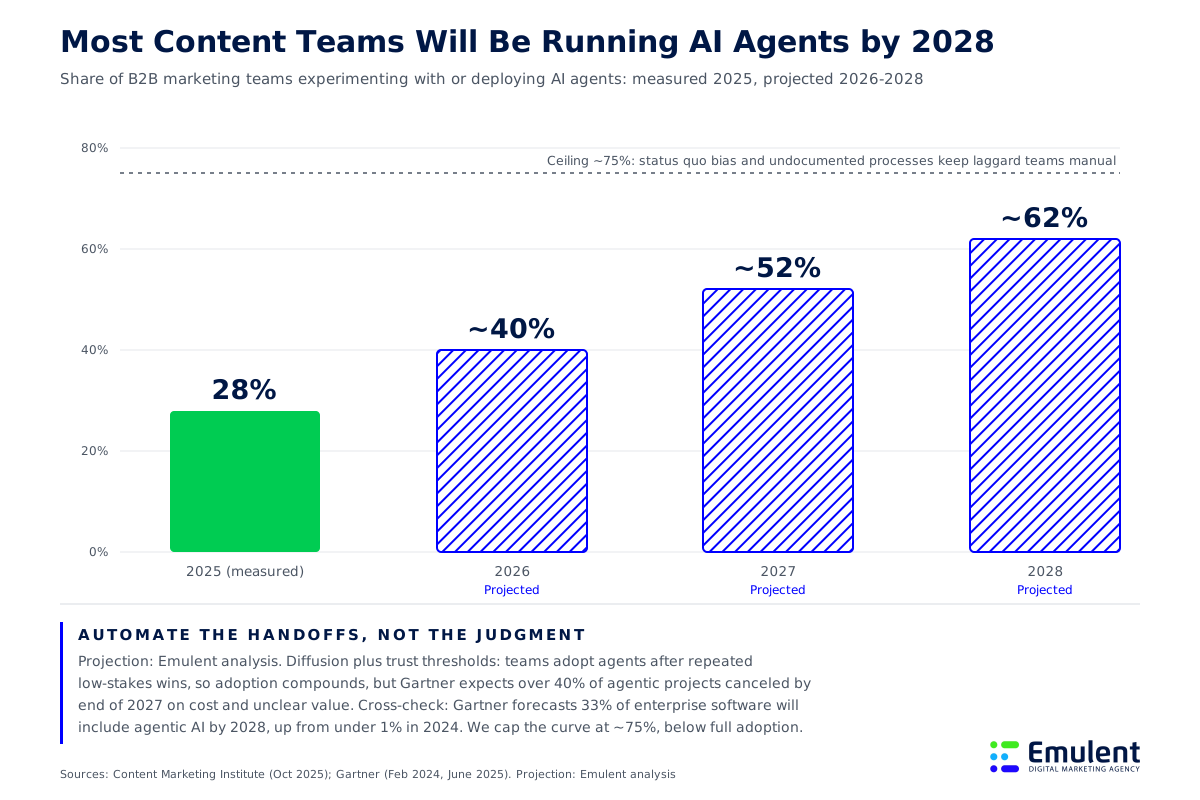
Projection: Emulent analysis based on diffusion of innovations plus trust thresholds, since teams adopt agents only after repeated low-stakes wins, assuming a ceiling near 75% because status quo bias and undocumented processes keep laggard teams manual, cross-checked against Gartner’s June 2025 forecast that 33% of enterprise software will include agentic AI by 2028, up from under 1% in 2024.
Two cautions travel with that curve. First, Gartner expects over 40% of agentic AI projects to be canceled by the end of 2027 on rising costs, unclear business value, or weak risk controls, which is why our ceiling sits near 75% instead of higher. Second, an agent automates whatever process you hand it, including a bad one. Point agents at the handoffs: source gathering for Gate 2, competitive reads for Gate 1, status tracking, formatting, distribution. Keep humans on the gates themselves, because the gates are where judgment lives, and judgment is the asset your buyers are actually paying for. A team that automates its judgment has automated its differentiation away.
Score the Pipeline on Customers, Not Output
The last structural change is the scoreboard. Posts per month, rankings, impressions, and traffic are production metrics, and production is the solved problem. The pipeline’s health metrics should be the ones a CFO would recognize: leads sourced or influenced per piece, deals where content appeared in the path, revenue per published piece per quarter, and the kill rate at Gate 1, because a pipeline killing zero topics is a pipeline with a dead first gate. This lines up with what the broader data now shows about where results come from, and we track those shifts quarter by quarter in our content marketing trends report. The CMI survey’s top challenge for 2026 says the same thing from the other side: the problem marketers named most often, at 40%, was creating content that prompts a desired action. Not creating content. Creating content that moves someone.
The Pipeline Is the Strategy Now
Volume-first pipelines made sense when production was the bottleneck and every published page could win a click. Neither condition survived 2025. Production is free, 39% is the share of AI-equipped teams seeing better performance, an AI summary cuts the click rate from 15% to 8% where it appears, and the answer layer is headed for a third of US queries on our projection. A pipeline built for that world runs fewer pieces through harder gates: prove the information gain, prove the evidence, take the stance, spend the senior hours, check the revenue. If your current pipeline would pass everything you published last quarter, it is not a pipeline. It is a conveyor belt, and the market for what it carries just closed. If you would rather build the gated version with people who run it daily, talk to a marketing agency that will tell you which half of your calendar to kill first.