
The subdomain vs subdirectory question usually gets treated as a technical preference, something for the dev team to settle. We treat it as a revenue decision. When a brand runs its blog on blog.example.com, its resources on a second domain, and a microsite for every campaign, each backlink, ranking signal, and AI citation gets divided across properties that all look smaller than the whole. Below, we walk through the math behind that split, the published results from companies that consolidated, a decision guide for merging vs staying separate, and the roadmap for combining sites without losing rankings.
Key takeaways from this article:
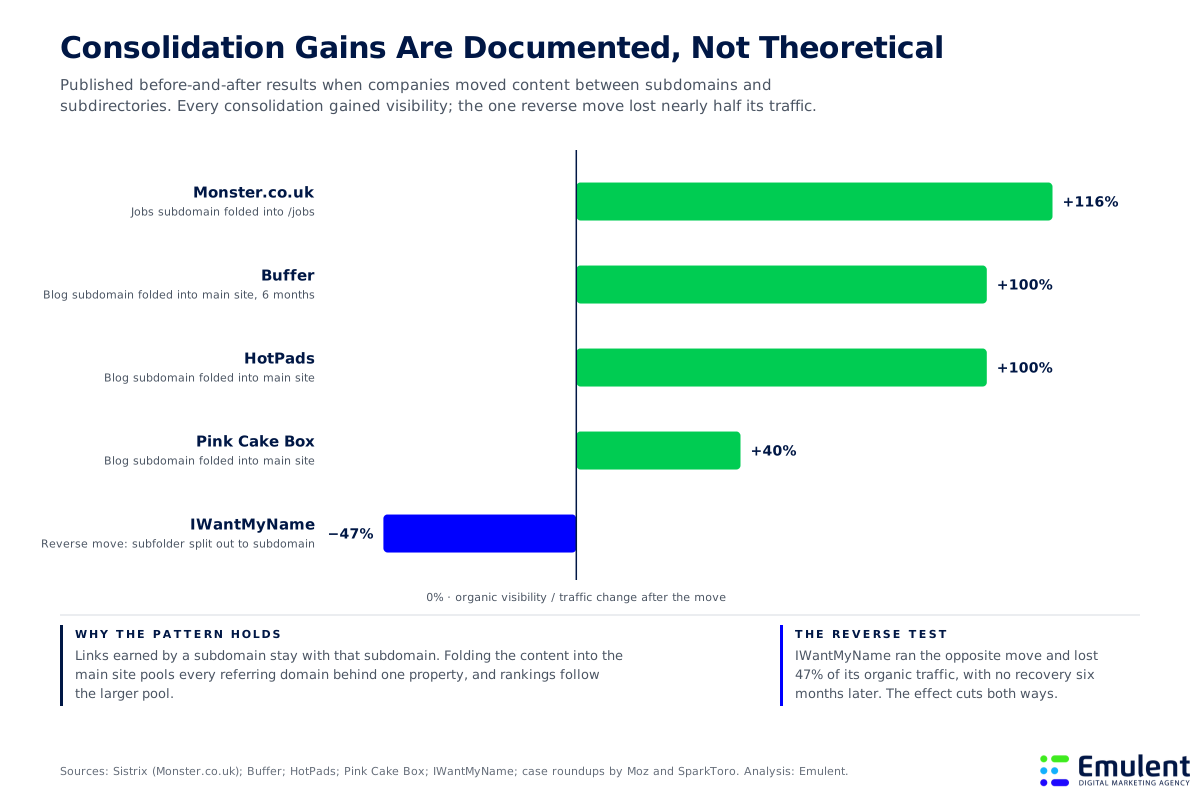
- Consolidation results are documented: Monster.co.uk gained 116% search visibility folding its jobs subdomain into a subdirectory, Buffer and HotPads roughly doubled organic traffic, and Pink Cake Box grew 40%.
- The reverse move costs traffic: IWantMyName lost 47% of its organic traffic after splitting its blog onto a subdomain, with no recovery six months later.
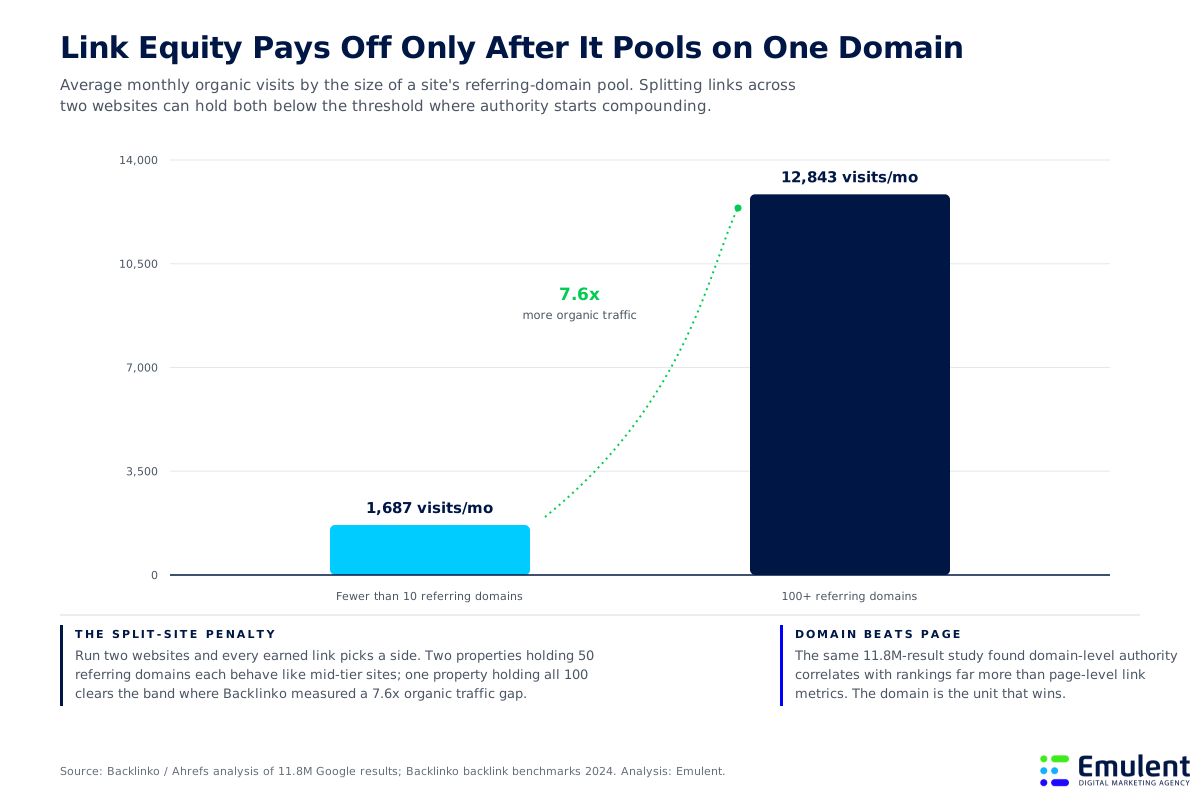
- Link equity compounds at the domain level: Backlinko found sites with 100+ referring domains average 12,843 monthly organic visits versus 1,687 for sites with fewer than 10.
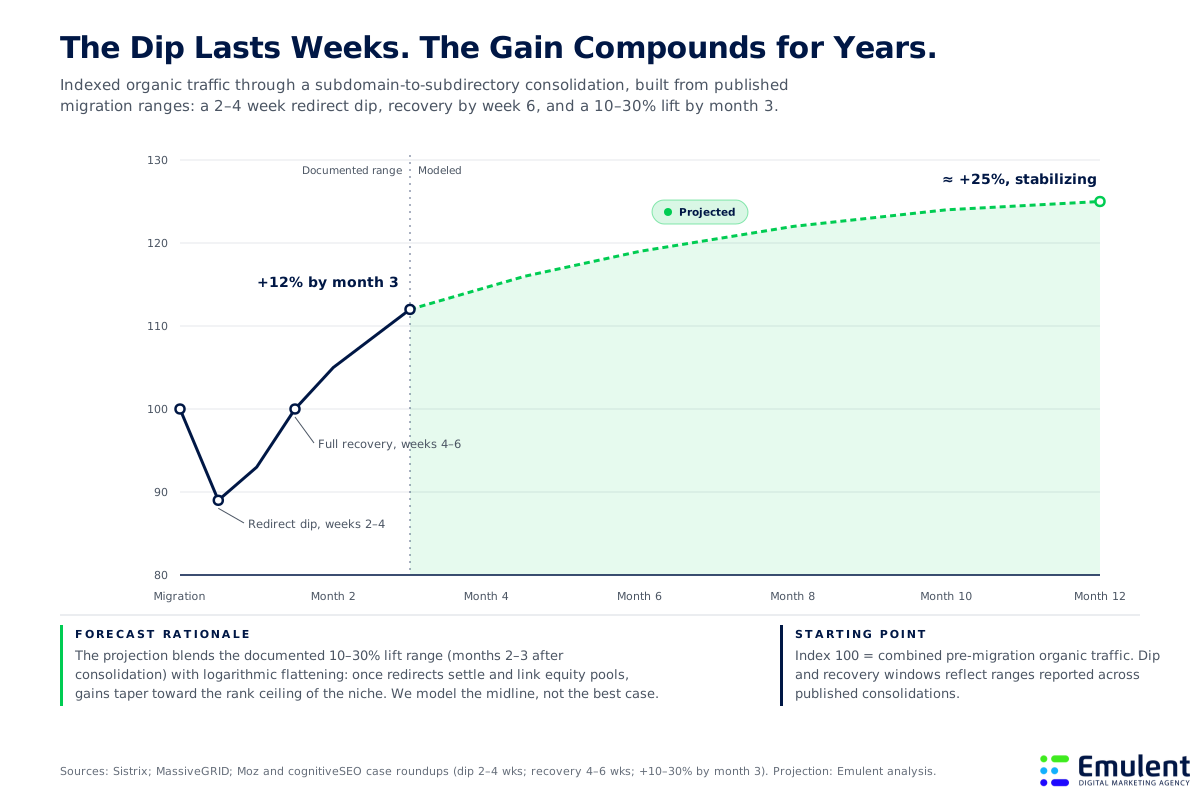
- The migration dip is short: published consolidations show a 2 to 4 week redirect dip, recovery by week 6, and a 10 to 30% lift within 2 to 3 months.
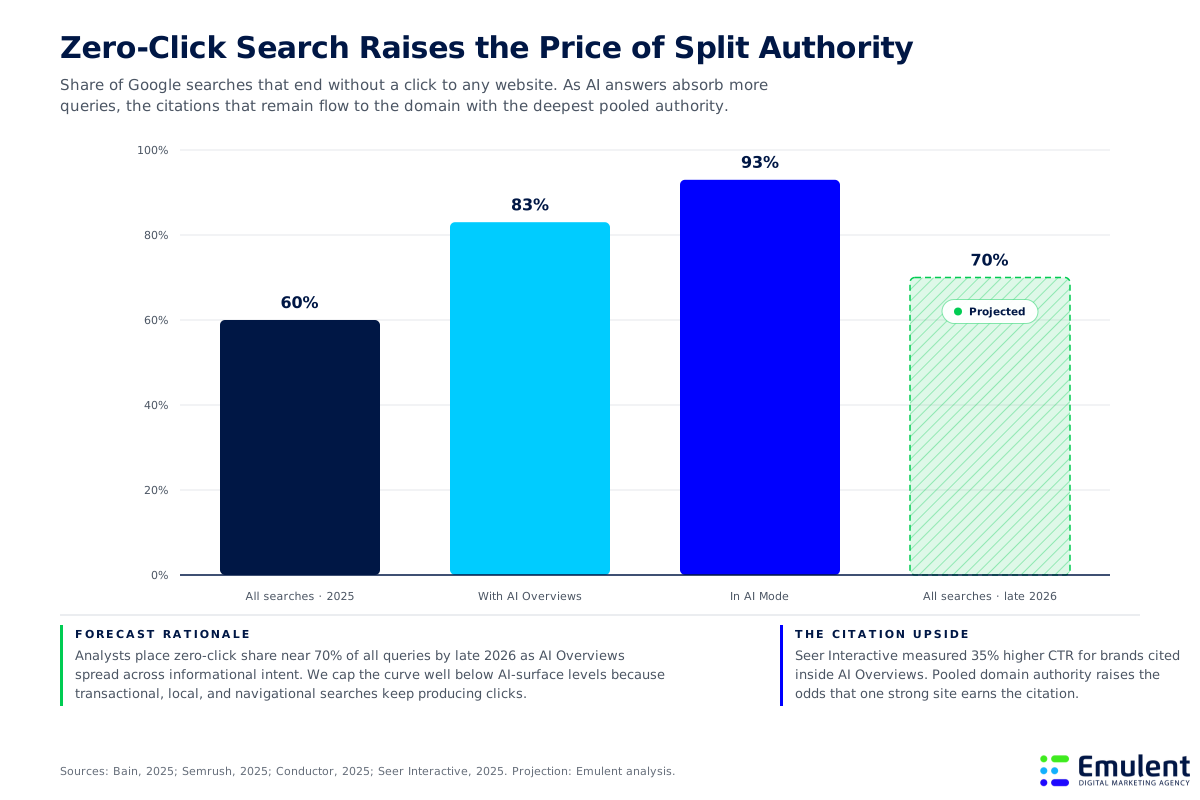
- AI search raises the stakes: with 60% of Google searches already ending without a click and 83% when AI Overviews appear, the remaining citations flow to domains with pooled authority.
- Separation still has a place: distinct brands, regulatory walls, and true product platforms can justify separate properties when the tradeoff is understood.
How Does Splitting Content Across Sites Divide Your Link Equity?
Google has said for years that it treats subdomains and subdirectories the same for crawling and ranking. The measured behavior of real websites tells a more useful story. The largest ranking study available, Backlinko and Ahrefs’ analysis of 11.8 million search results, found that a site’s domain-level link authority correlates with rankings far more strongly than the authority of any single page. The number one result in Google carries 3.8x more backlinks than positions two through ten. Rankings reward the domain that has pooled the most trust, which is why entity-based SEO work also concentrates on building one recognized entity rather than several thin ones.
Here is where the split hurts. Every link your content earns lands on one property. A company with 100 referring domains spread across two sites operates two mid-tier properties; the same links pooled behind one domain clear the band where Backlinko measured a 7.6x organic traffic gap. Two sites holding half the equity each do not perform like one site holding all of it. They perform like two weaker sites competing in the same results.
We have audited brands with six properties and the combined link profile of one strong website. The links were never the problem. The architecture spent them six different ways. – Emulent Strategy Team
The math explains why the split costs visibility. The published migrations show what happens when companies reverse it.
What Do Real Migrations Show About Subdomain vs Subdirectory?
This debate would stay theoretical if companies had not run the experiment in public. They have, repeatedly, and the direction of the result is consistent. When Monster.co.uk folded jobs.monster.co.uk into monster.co.uk/jobs, Sistrix measured a 116% gain in search visibility. Buffer consolidated its blog subdomain and reported organic traffic roughly doubling over six months. HotPads saw traffic double after the same kind of move, and Pink Cake Box grew organic traffic 40% after folding its blog into the main domain. Rand Fishkin compiled more than 14 case studies showing the same pattern.
The reverse experiment matters just as much. IWantMyName moved its blog off the root domain and onto a subdomain in 2014 and lost 47% of its organic traffic. The team waited for recovery; six months later it had not come, and they moved the content back. Traffic falls when equity gets split and grows when it gets pooled, in both directions.
One caution we share with every client: a few of these migrations shipped alongside better internal linking and cleaner templates, so the lift is not attributable to URL structure alone. The pattern across a dozen-plus cases still points one way. The honest question is not whether consolidation tends to win, but whether your situation is one of the exceptions.
Should You Merge Your Sites or Keep Them Separate?
We run every merge-or-separate call through the same five questions. If the answers lean toward overlap, we consolidate. If they lean toward genuine independence, we keep the wall and accept the cost knowingly.
The five decision criteria we apply before any consolidation:
- Topical overlap: Does the content on each property support the same buyer or the same subject area? Shared topics argue for one domain, because search engines and AI systems reward concentrated subject depth.
- Link profile distribution: Pull referring domains for each property. If the secondary site holds 20% or more of your total links, consolidation reclaims equity you already earned and paid for.
- Audience and brand architecture: Do customers see one brand or several? Forcing unrelated brands onto one domain confuses people and dilutes relevance, which is the one outcome worse than split equity.
- Technical constraints: A blog or docs platform that cannot live in a subdirectory is a solvable problem with reverse proxies, and the larger the site the more this becomes an enterprise SEO infrastructure question rather than a blocker.
- Measurement and team cost: Every extra property means another analytics view, another Search Console profile, and another place cannibalization hides. Fewer properties means cleaner attribution and faster decisions.
When Is Separation the Right Call?
Consolidation is the default, not a law. We keep properties separate when a genuinely distinct brand serves a different audience with its own positioning, when legal or regulatory requirements demand a wall (common in pharma, finance, and franchise agreements), when user-generated content or a community platform carries quality risk you do not want bleeding into the core domain, and when an application needs separate infrastructure for security or performance. The test is simple: separation should be a deliberate strategic choice with a named benefit, never a leftover from how the sites happened to get built.
Most multi-site setups we inherit were never decided. They accumulated. An acquisition here, a campaign microsite there, and five years later nobody can say why the structure exists. – Emulent Strategy Team
Once the decision points to merging, the fear that stops most teams is the migration itself. The data says that fear is overpriced.
How Do You Merge Sites Without Losing Rankings?
Published consolidations follow a predictable arc: a dip of 2 to 4 weeks while Google processes the redirects, full recovery around weeks 4 to 6, and a 10 to 30% organic lift within 2 to 3 months as the pooled equity takes effect. Google’s John Mueller has said signal transfer can take up to three months in full, so we plan against that window and avoid migrating during peak season. The chart below models the midline of those published ranges, with our projection flattening logarithmically as the site approaches the rank ceiling of its niche.
The consolidation roadmap we follow on every migration:
- Crawl and inventory every URL: Map each page on the property being merged, its traffic, its rankings, and its backlinks, so nothing valuable gets dropped silently.
- Build a one-to-one redirect map: Each old URL points to its single best equivalent, never a blanket redirect to the homepage, which Google treats as a soft 404 and discards.
- Implement and test 301 rules: Server-level redirects preserve equity best; our library of htaccess rules covers the common patterns for WordPress builds, and on managed hosts like WP Engine or Kinsta the same logic lives in their redirect engines.
- Update internal links and sitemaps: Point every internal link at the final URLs rather than through redirect chains, then submit fresh sitemaps in Search Console.
- Monitor for 8 weeks: Watch index coverage, rankings on the money pages, and crawl errors weekly; our website redesign checklist doubles as the QA list for this phase.
Run this way, a consolidation trades a few soft weeks for a compounding gain. And the value of that gain is rising, because the search results themselves are shrinking.
Why Does AI Search Make Consolidation More Urgent?
Bain measured that 60% of Google searches already end without a click to any website. When an AI Overview appears, Semrush puts the zero-click share at 83%, and in AI Mode it reaches 93%. Conductor found AI Overviews now show on roughly a quarter of searches. Fewer clicks exist to win, so the question becomes who gets cited inside the answers, and the citation economics favor concentration: Seer Interactive measured 35% higher click-through for brands cited in Google AI Overviews compared to brands left out.
AI systems cite sources the way Google ranks them, by trusting the domains with the deepest pooled signals on a topic. A brand whose expertise is scattered across three properties gives the model three weaker candidates instead of one obvious one. This is the core argument behind AI SEO services and search everywhere optimization: the same consolidated authority that wins blue links also wins citations in ChatGPT, Perplexity, and AI Overviews. Among the SEO trends we track, this shift from ranking pages to being cited as an entity is the one that most rewards getting your site architecture right now rather than later.
In a zero-click world, you are no longer competing for ten positions on a page. You are competing for two or three citations in an answer. Split-authority brands rarely make that cut. – Emulent Strategy Team
How Can the Emulent Team Help You Consolidate Your Search Visibility?
The Emulent Marketing Team has planned and executed site consolidations for brands ranging from small businesses to multi-property enterprises, handling the audit, the merge-or-separate decision, the redirect mapping, and the post-migration monitoring so rankings carry through intact. If multiple sites may be splitting your search visibility and you want a senior team to assess it, schedule a free digital marketing consultation and we will walk through your architecture with you, no pressure attached.