
Social media advertising trends in 2026 share one underlying signal: efficiency now matters more than reach. Global spend has tripled since 2020, but cost per impression keeps rising, attention budgets keep shrinking, and the formats that delivered cheap clicks five years ago no longer move the same numbers. We built this brief for marketing teams trying to spend smarter on paid social this year.
Five key takeaways from our 2026 social media advertising analysis:
- Global social ad spend will hit $338 billion in 2026 and cross $530 billion by 2030, with growth slowing to an 11.86% CAGR as mobile reach saturates.
- CPMs vary more than 2x across platforms. YouTube and TikTok lead at $4 to $5 per 1,000 impressions, while Snapchat and X carry premium rates near $9 to $11.
- Short-form video tops marketer ROI rankings. 77% call it their highest-ROI format, far ahead of static and long-form alternatives.
- US social commerce crosses $100 billion for the first time in 2026, driven by TikTok Shop and in-feed checkout that collapse the buying funnel.
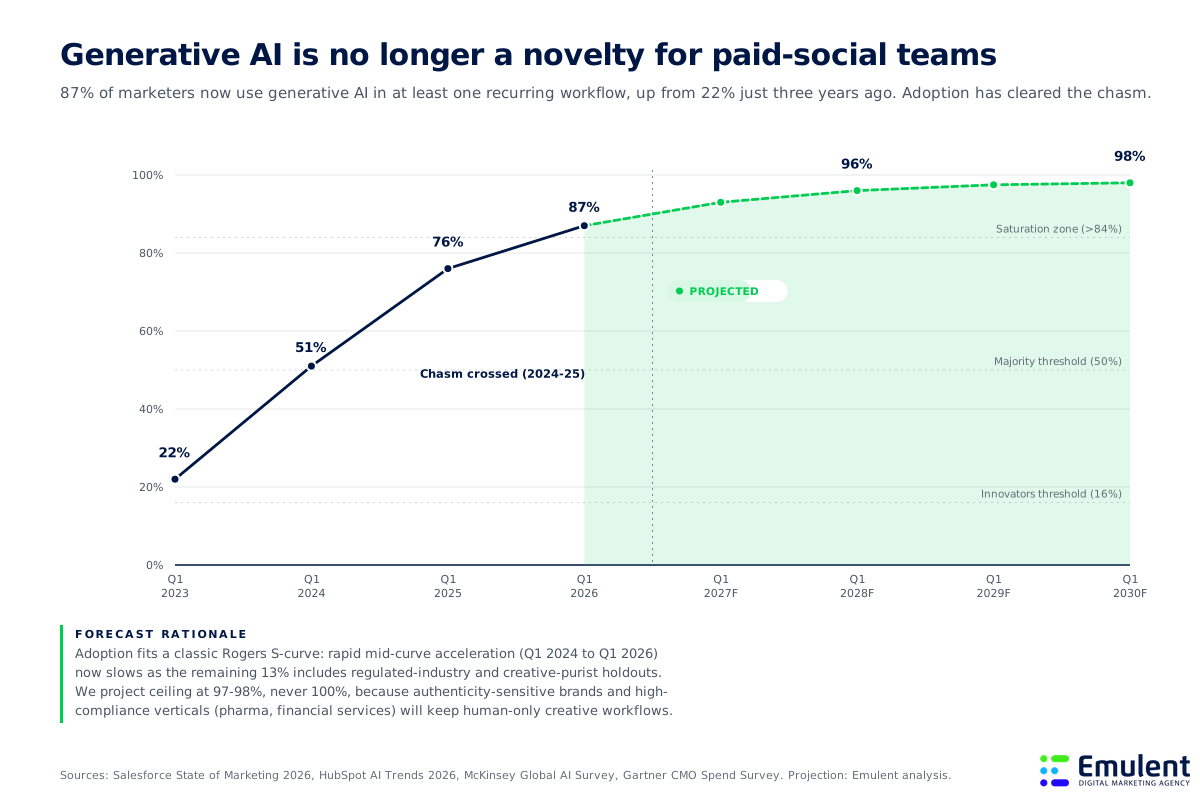
- 87% of marketers now use generative AI in paid social workflows, up from 22% three years ago, with personalization and audience research delivering the strongest returns.
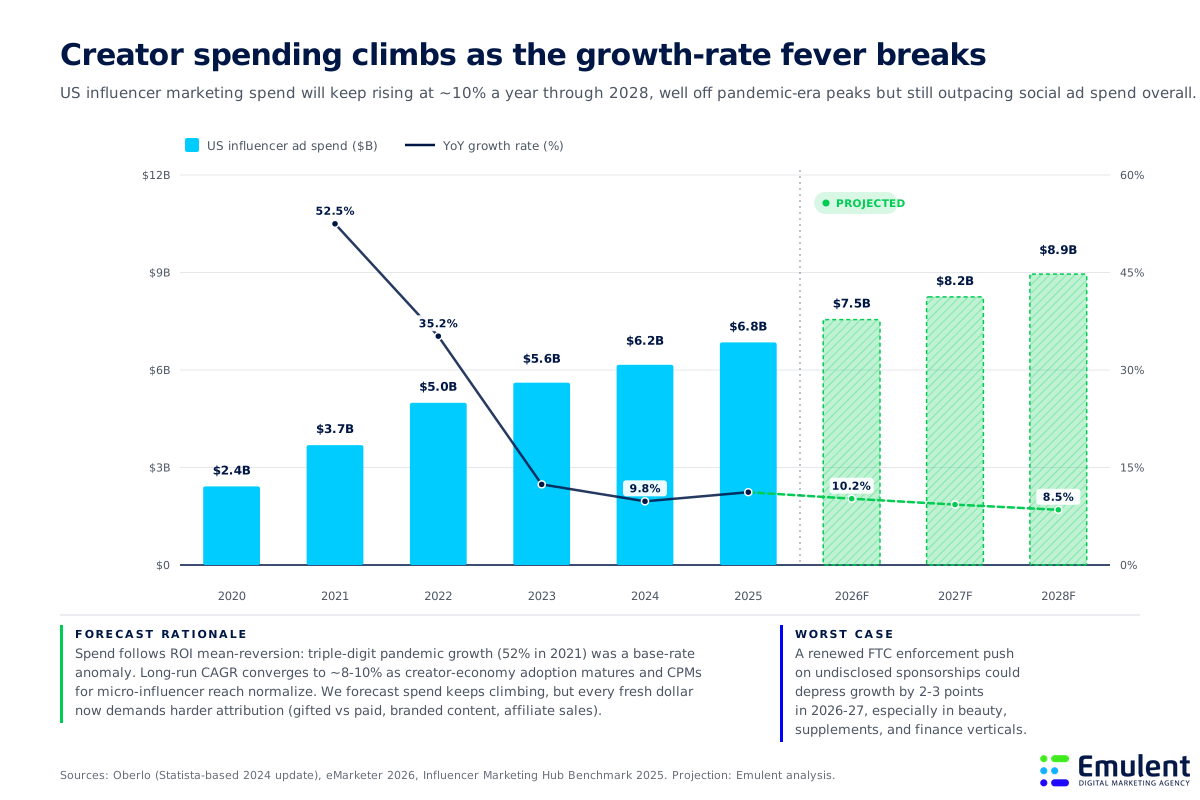
- US creator and influencer spend keeps outpacing overall social ad growth, projected at 8% to 10% annually through 2028.
How big does social media advertising actually get in 2026?
Statista’s market insights team projects global social media ad spending will hit $338.75 billion in 2026, with another 56% lift expected by 2030 at an 11.86% compound annual growth rate. That headline number sounds healthy until you compare it to 2020 and 2021, when spend grew more than 30% year over year. The deceleration is not a problem with social media. It is the natural shape of a maturing channel.
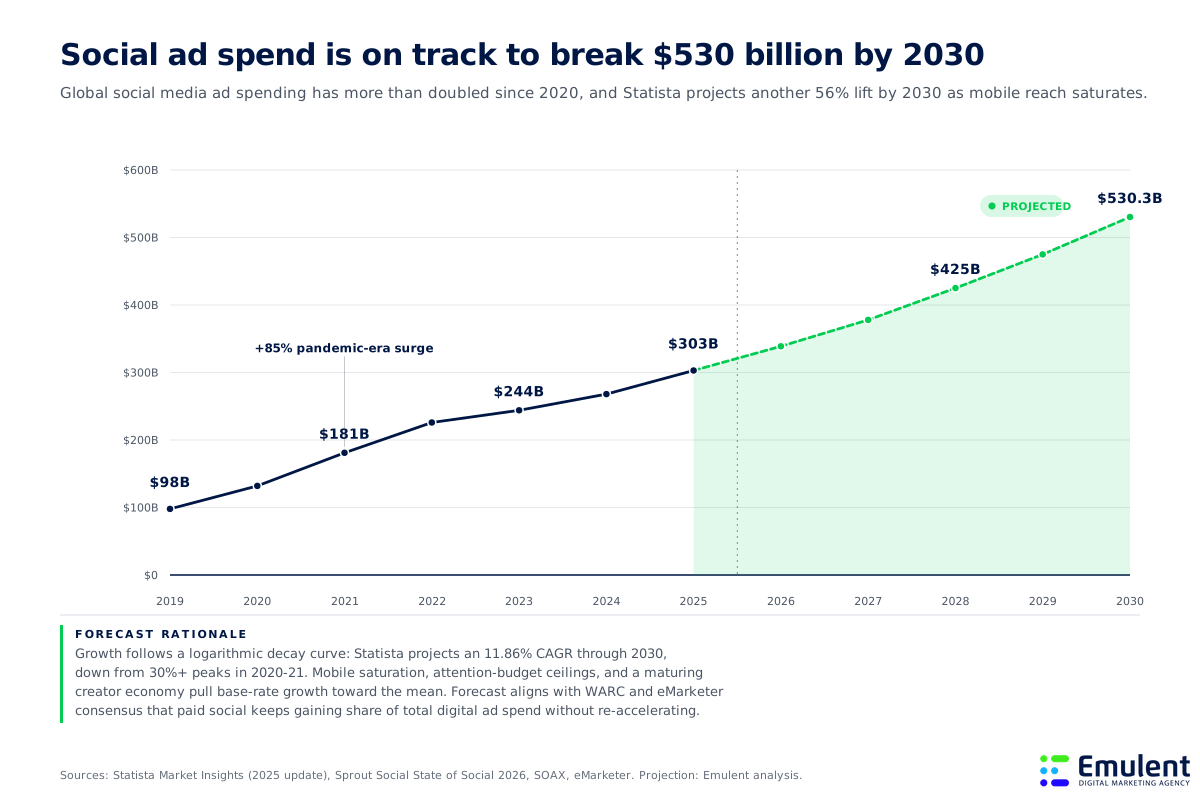
Three forces pull the curve down toward base-rate growth. Mobile saturation caps the audience reachable on phones. Attention budgets are finite. Auction competition raises CPMs even when demand stays flat. Average global CPM rose from $7.91 to $8.74 between 2024 and 2025, according to Sprout Social’s 2026 benchmarks. Bid auctions are more crowded, not because platforms changed their fees, but because more advertisers chase the same inventory.
That math forces a new question for every paid social budget. Where does the next marginal dollar work hardest? The answer in 2026 depends less on how much a brand spends and more on which platforms it picks. We dig into that platform-mix question in the next section, where the CPM gap explains a lot about why some brands quietly beat their category and others miss their cost-per-lead targets.
– Emulent Strategy Team
Which platforms deliver the lowest CPM in 2026?
Average CPM varies more than 2x across the major platforms, and the gap has structural causes. YouTube and TikTok sit at the cost-leader end because their ad inventory grew faster than advertiser demand for short-form video formats. Snapchat and X carry premium CPMs because their advertiser base is smaller, so the auction clears at higher prices for the same reach.
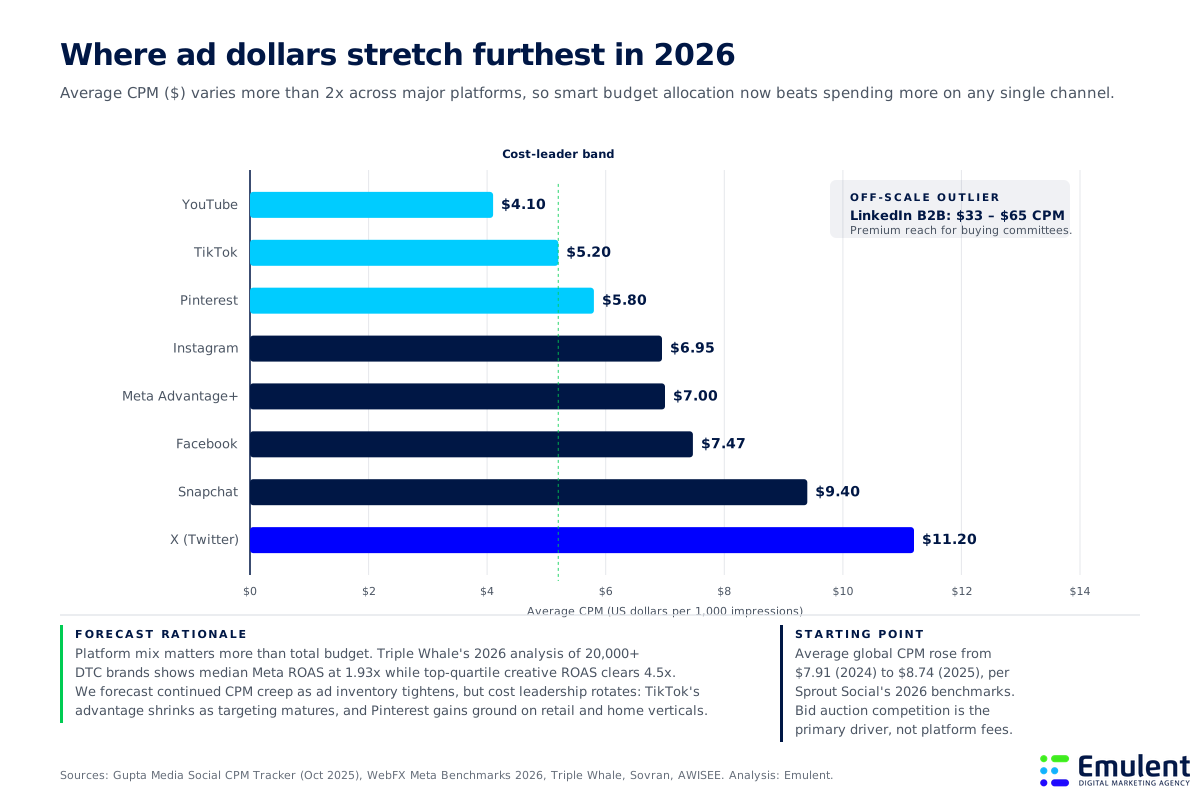
The 2026 CPM cost leaders break down like this:
- YouTube averages $4.10 CPM, lifted by Connected TV inventory expansion and Shorts.
- TikTok sits at $5.20, still cheaper than Meta but no longer by a wide margin.
- Pinterest runs $5.80, with home and retail verticals seeing the strongest ROAS lift.
- Instagram and Facebook cluster around $7.00, with Meta’s Advantage+ campaigns delivering 22% better ROAS than manual setups, per Marpipe’s 2025 analysis.
- LinkedIn sits in a different category entirely at $33 to $65 CPM, justified by B2B buying-committee reach that other channels cannot match. For most B2B marketing programs, that premium pays for itself.
CPM tells half the story. The other half is ROAS. Triple Whale’s 2026 benchmark across 20,000 direct-to-consumer brands shows median Meta ROAS at 1.93x and median CPM at $13.48 for that subset. Top-quartile creative on the same accounts clears 4.5x. Creative quality, not platform choice, drives most of the ROAS variation. Which means the format you ship matters more than the auction you enter, and the format winning paid social right now is short-form video.
Why has short-form video become the highest-ROI ad format?
Wyzowl’s 2026 Video Marketing Statistics survey found 77% of marketers rank short-form video as their highest-ROI format, compared to 22% for long-form and 18% for static image ads. That ranking holds even though static image ad adoption is higher overall at 84% while short-form video sits at 91%. The format closing in fastest on universal adoption is also the format clearing the highest ROI bar.
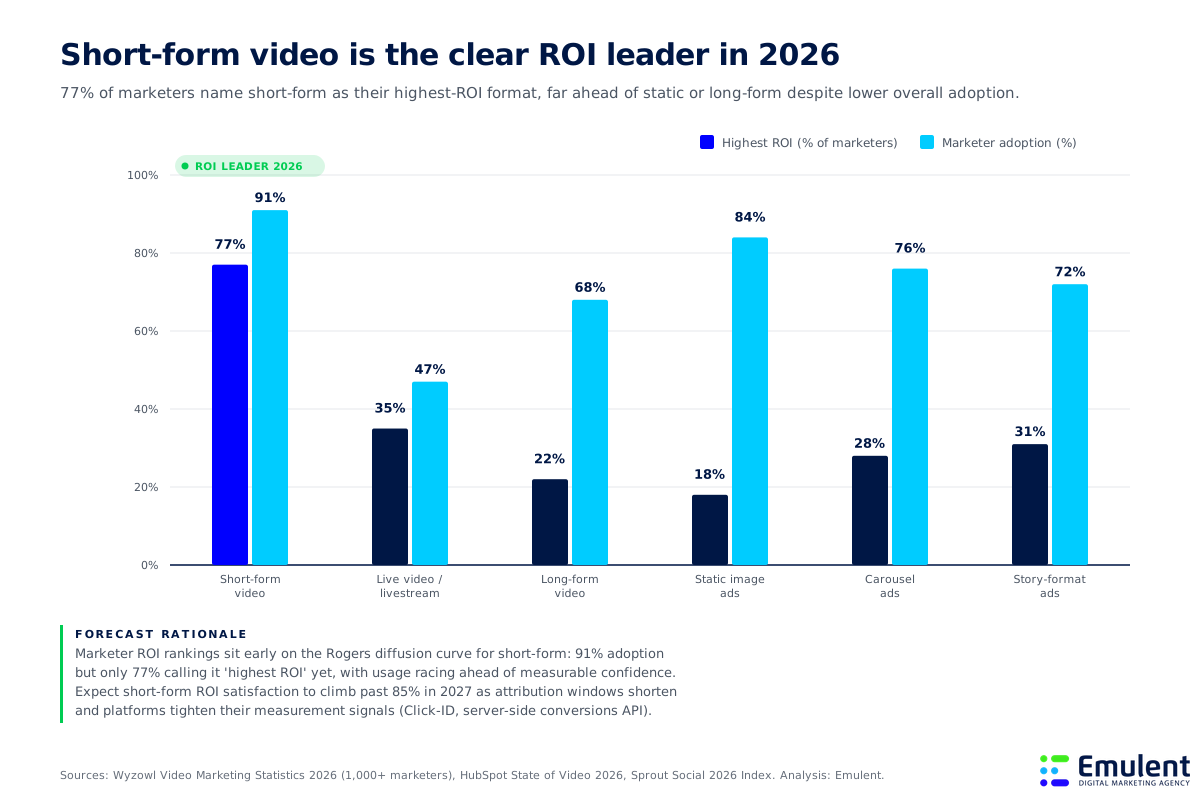
Three structural reasons explain the short-form ROI premium:
- Mobile-first attention. Vertical video accounts for 95% of all mobile video consumption. Format match drives completion.
- Algorithmic reach. Reels, Shorts, and TikTok videos collectively account for 58% of time spent on social media. Platform algorithms keep prioritizing them.
- Production cost compression. AI editing tools cut median production cost from $4,200 to $2,500 per finished minute since 2024, making short-form viable for budgets that could never justify a traditional shoot. Teams investing in brand video production are now stretching the same dollar across 4 to 10 finished cuts.
The risk in short-form is creative fatigue. Motion’s analysis of more than 550,000 ads found that only 5% to 8% of ads become real winners and roughly 50% never receive meaningful spend. The lever that matters most for paid social ROI in 2026 is not which platform you choose. It is how many creative variations you ship and how fast you kill the ones that fail. That production cadence problem is also what makes generative AI such a meaningful workflow upgrade, which we cover further down.
– Emulent Strategy Team
How is social commerce reshaping conversion attribution?
eMarketer’s 2026 forecast puts US social commerce sales at $100.99 billion in 2026, the first year the category crosses the $100 billion threshold. Growth accelerated to 26% in 2024 thanks to TikTok Shop’s US debut in September 2023, and is projected to stay in the high teens through 2028. By then, US social commerce will approach $137 billion.
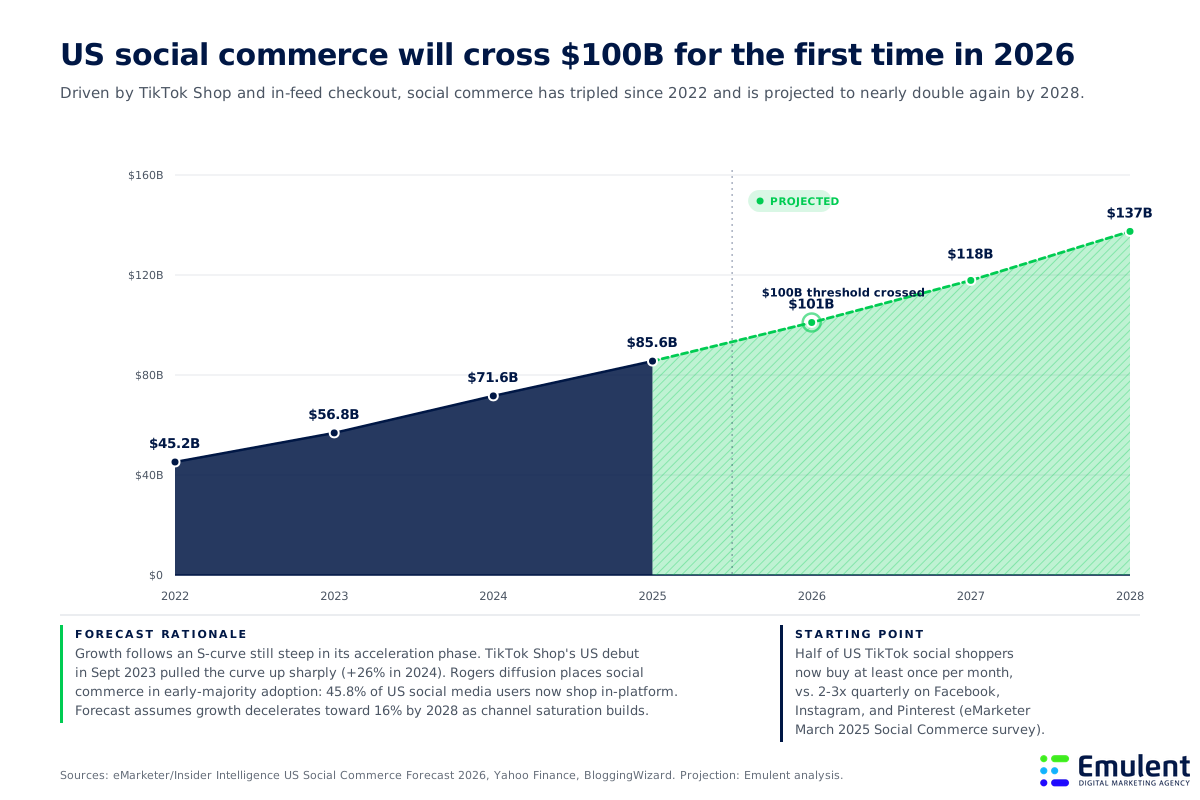
What changed is not just the channel size. It is where the conversion happens. In-feed checkout collapses the funnel. A user can see an ad, watch a creator demo a product, and buy without leaving the platform. That breaks the assumption that paid social only drives top-of-funnel awareness. For brands that previously credited social for clicks and Amazon for revenue, the attribution model now has to share credit across more nodes.
Three behavioral signals confirm the shift:
- Repeat purchase frequency on TikTok is roughly 49.7% monthly among social shoppers, far above the two to three times quarterly rate on Facebook, Instagram, and Pinterest.
- Discovery-to-purchase windows keep shrinking on platforms with native checkout, often measured in hours rather than days.
- Average order value is lower on TikTok Shop than on traditional e-commerce, suggesting impulse purchases sit at the heart of the channel.
The strategic implication is that paid social for product-led companies needs a conversion goal, not just an engagement goal, by 2026. Awareness budgets need new measurement frameworks that capture in-platform purchase intent. And that measurement upgrade is where AI starts paying for itself, because the data volume now exceeds what any single analyst can read in a week.
What role does generative AI play in 2026 paid social workflows?
Salesforce’s State of Marketing 2026 found 87% of marketers using generative AI in at least one recurring workflow, up from 51% in Q1 2024 and 22% in Q1 2023. Adoption cleared the Rogers chasm sometime in late 2024. The remaining 13% will not shrink to zero. Pharma, financial services, and authenticity-sensitive consumer brands will keep human-only creative workflows for regulatory and brand-trust reasons.
Where AI delivers measurable ROI in paid social:
- Ad copy generation delivers 2.3x average ROI, per McKinsey’s Global AI Survey.
- Audience research and segmentation clears 2.4x ROI, with payback under three months for content-heavy teams.
- Creative variation production lets small teams ship 10 to 50 times more variants per week, a structural shift for performance accounts.
- Personalization engines that match ad creative to audience segment deliver 2.7x ROI on average.
There are also two clear underperformers. AI-generated video still produces 1.1x to 1.6x ROI because production overhead stays high even when generation is automated. Obvious AI creative on paid social gets quietly down-ranked by Meta, TikTok, and Google ranking updates in 2026, a pattern confirmed across multiple agency performance studies. The platforms reward AI-assisted human creative, not AI-replaced human creative. That distinction matters for any AI SEO program too, where the same authenticity signals apply.
– Emulent Strategy Team
Are influencer budgets still outpacing paid social growth?
US influencer marketing spend will reach roughly $7.55 billion in 2026, per the Oberlo/Statista 2024 update, and continue growing at 8% to 10% annually through 2028. That pace is slower than the triple-digit growth of 2020 and 2021, but still ahead of overall social ad spend, which eMarketer projects will grow in the mid-single digits through 2028.
Why does creator spending grow faster than paid social? Creator content often outperforms brand-produced creative. Influencer Marketing Hub’s 2025 Benchmark Report found average return of $5.78 for every dollar spent on creator partnerships, with top campaigns reaching $11 to $18. Audience targeting is built in. A creator’s followers self-select for relevance in a way no targeting algorithm fully replicates. Distribution stacks. A single creator deliverable can run as organic, paid amplification, and email creative.
The risk in 2026 is not creator demand. It is measurement and compliance:
- Disclosure compliance is tightening. The FTC’s 2025 endorsement guideline update raised the bar on what counts as a sponsored post.
- Saturation effects at the macro-influencer tier are pushing brands toward nano and micro creators (with median CPMs of $211 and $119 respectively).
- Attribution complexity grows as creator content runs across both organic and paid channels.
Brands that treat influencer marketing as a separate budget line, rather than as part of their paid social mix, miss the cross-amplification effect. The most efficient programs in 2026 buy media against creator content within 72 hours of the organic post, while audience attention is still fresh. That cadence question is where a tighter content strategy earns its keep, because it forces creator, paid, and owned channels onto the same calendar.
– Emulent Strategy Team
Where should marketing teams place their next paid social bet?
The 2026 trends point in one direction. Narrow the channel list. Pick two or three platforms where the audience, the CPM, and the format match the business goal, then ship more creative variants per week against tighter test loops. Treat influencer content and paid amplification as one program, not two. Use AI to compress test cycles, not to replace creative judgment.
None of this is glamorous work. The teams that win paid social this year will not be the ones with the biggest budgets. They will be the ones with the tightest weekly testing rhythms, the cleanest measurement infrastructure, and the discipline to kill what does not work. We track these social media advertising trends across every account we manage, and the same pattern repeats.
If you want help building a paid social program that fits your audience, your margin profile, and your team’s capacity, our team would love to talk. Contact the Emulent team to start a conversation about your 2026 social media advertising strategy.