Skip links

SaaS Marketing 2026-2028 Projection: The CAC Payback Crisis Report

Author: Bill Ross | Reading Time: 16 minutes | Published: April 20, 2026 | Updated: April 20, 2026

Emulent
The economic structure of SaaS growth has shifted in a way that compounds against marketing teams. CAC payback periods that sat comfortably in the 12 to 18 month range in 2022 have extended to the 15 to 24 month range for most B2B SaaS in 2026, with enterprise-focused companies averaging 18 to 24 months and complex verticals like cybersecurity and healthcare IT routinely exceeding 24 months. LinkedIn CPMs continue to climb by 3%-8% annually, with no ceiling in sight. G2 has just acquired Capterra, Software Advice, and GetApp, creating a single gatekeeper controlling roughly 6 million verified software reviews and reaching more than 200 million software buyers annually. And 34% of B2B SaaS companies are still blocking AI crawlers on their websites, removing themselves from the consideration sets of the models their buyers are increasingly using to research vendors.

This report projects how the landscape will evolve through 2028 across 14 SaaS marketing categories. It is built for the CMOs, VPs of growth, and founders who are already being asked to answer a specific set of questions:

  1. Why is payback extending?
  2. Which channels are still producing an efficient pipeline?
  3. What capabilities have to be built now?
  4. Which assumptions about how SaaS growth works no longer hold?

The CAC Payback Crisis

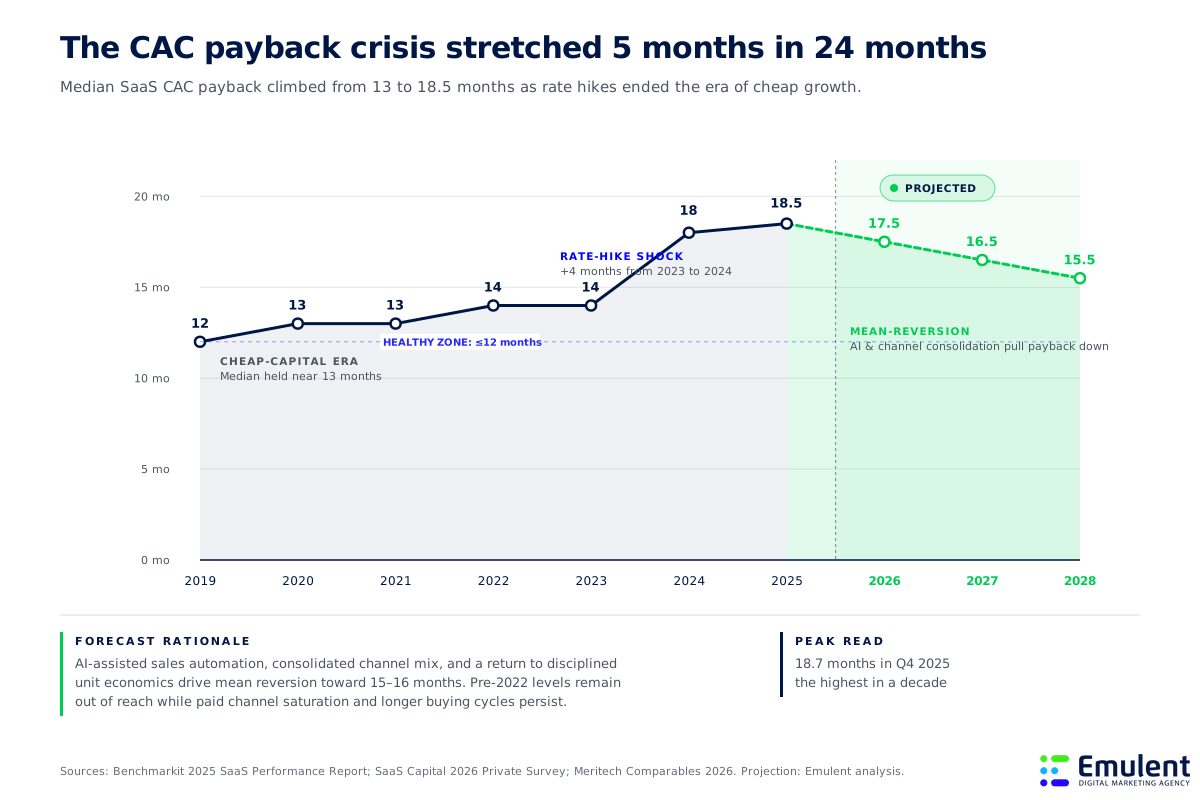
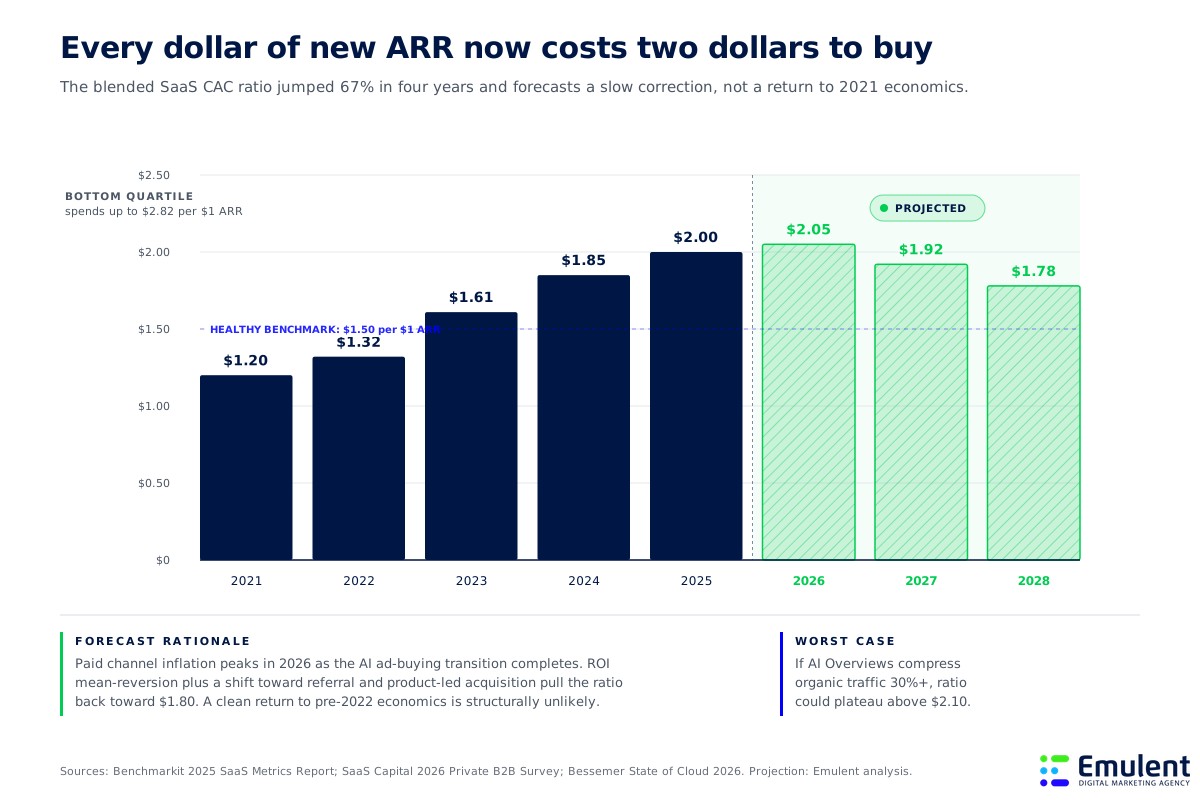
The most important metric in B2B SaaS marketing in 2026 is CAC payback period, and the most important story about it is that it has gotten materially worse in a compressed timeframe. The industry median has moved from approximately 14 months in 2023 to approximately 15 to 18 months in 2026, with the trajectory projected to continue extending through 2028.

01 Cac Payback Crisis Emulent The drivers of this extension are structural rather than cyclical, which is why the projection is for continued deterioration rather than reversion. Four compounding pressures:

  1. Channel cost inflation. LinkedIn CPMs, Google CPCs for SaaS categories, and display CPMs are all rising 10% to 15% annually as more B2B advertisers compete for the same professional audiences.
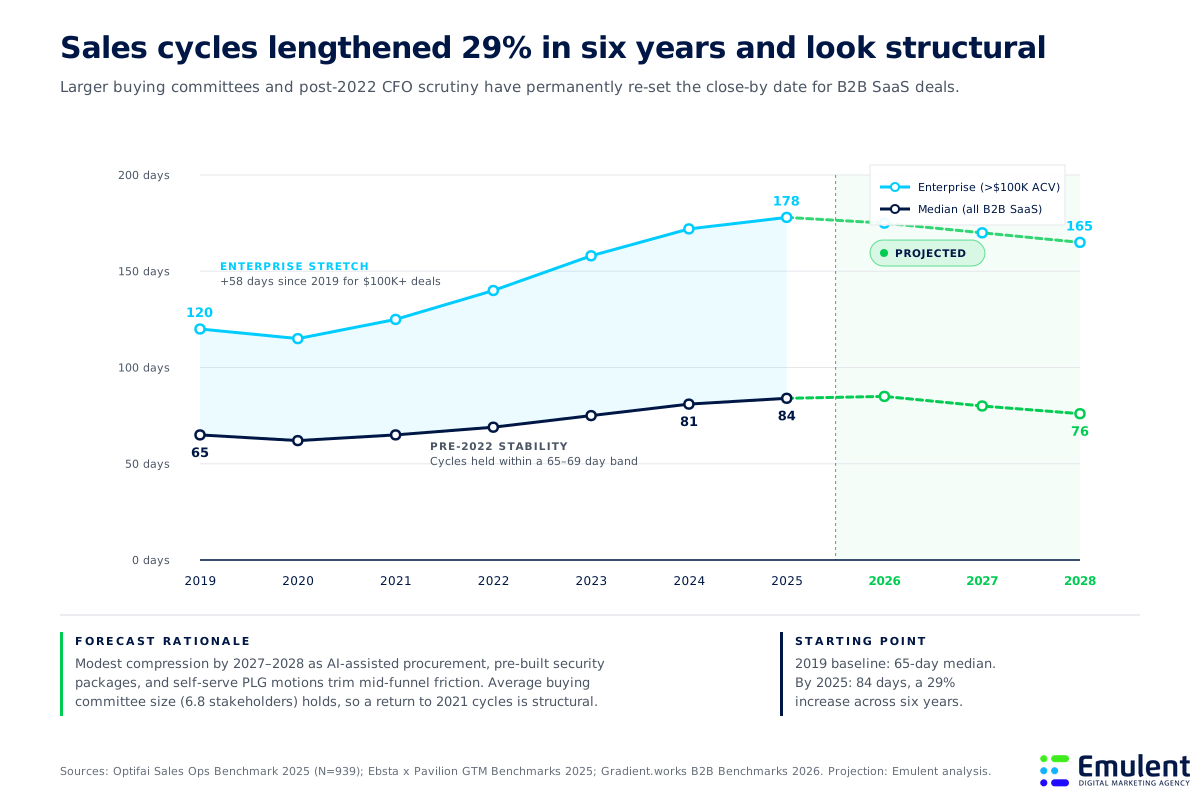
  2. Sales cycle extension. B2B buying committees have grown from 8 to 10 stakeholders in 2022 to 12 to 15 in 2026, with more stakeholders meaning more approvals, more review cycles, and longer cycles from first touch to closed deal.
  3. AI-assisted buyer research. Buyers enter sales conversations later in the process than in 2022, having completed more of their evaluation independently. Longer research phases mean more marketing touches required per conversion.
  4. Content velocity competition. AI-generated content production has flooded most SaaS categories, making organic content less effective per dollar invested and forcing organizations to produce more to achieve the same results.

The implications for the go-to-market strategy are substantial. Organizations running the 2022 playbook at 2026 economics are burning cash faster than they realize. The specific patterns that produce the worst payback extensions:

  • Mid-market SaaS running LinkedIn at low daily budgets. Spending under $100 per day on LinkedIn generates statistically meaningless data. Organizations spending $25 to $75 daily end up spending several thousand dollars to learn nothing and then blaming the channel.
  • Series A companies running Series C playbooks. Brand awareness campaigns with 18-month payback are appropriate for companies with 36+ months of runway and established demand. Series A companies need demand-capture campaigns that produce SQLs in 30 to 60 days.
  • Teams are optimizing for cost-per-lead rather than cost-per-opportunity. A $100 CPL that produces opportunities at $8,000 per opportunity is worse than a $300 CPL that produces opportunities at $3,000. Organizations that have not made this shift in measurement are systematically misallocating their budgets.

The counterweight to the payback extension is that organizations executing well on a specific set of capabilities see payback hold steady or improve:

  • Tight ICP-matched targeting (rather than broad demographic targeting) reduces wasted impressions
  • Expansion revenue and net revenue retention above 105% offset longer new-customer payback
  • Product-led motions with self-serve conversion produce payback periods 40% to 60% shorter than sales-led motions in comparable ACV ranges
  • Annual prepay billing terms compress payback because revenue is recognized upfront

SaaS CAC Payback Period Projections

Segment 2026 (Base) 2027 (Projection) 2028 (Projection)
SMB SaaS (under $15K ACV) 8-12 months 10-14 months 11-15 months
Mid-market SaaS ($15K-$100K ACV) 14-18 months 16-21 months 18-24 months
Enterprise SaaS (over $100K ACV) 18-24 months 21-28 months 24-32 months
Complex verticals (cybersecurity, health IT) 20-26 months 24-30 months 26-34 months
Product-led SaaS 6-10 months 7-11 months 8-12 months
Median across all B2B SaaS 15 months 17-19 months 19-22 months

LinkedIn CPM Inflation and the Paid Social Squeeze

LinkedIn has become both the most effective B2B paid channel and the most structurally expensive one, and the gap is widening. The 2026 baseline shows:

  • Average CPM: $28 to $55 for North American B2B campaigns, with $33 global median
  • Average CPC: $5 to $12 for Sponsored Content, with C-suite targeting pushing above $12 and hitting $15+
  • Average CPL: $75 to $200 for standard campaigns, exceeding $200 for enterprise targeting
  • Lead Gen Forms convert at 6% to 12%, substantially better than landing page conversion at 2% to 4% 02 Linkedin Cpm Inflation Emulent

The cost inflation trajectory is the defining dynamic. LinkedIn CPMs have risen approximately 28% year-over-year in recent periods according to industry data, and the platform itself has indicated the trend continues. For SaaS specifically, which competes in the most saturated audience segments, the rate is higher. The projection is for continued double-digit inflation driven by the following pressures:

  • Advertiser growth. The number of active LinkedIn advertisers has grown 25% to 30% since 2024, with more advertisers bidding on the same professional audiences.
  • Audience scarcity. LinkedIn has roughly one billion members, compared with three billion on Meta, and the B2B-targetable subset is substantially smaller. Supply is effectively fixed while demand keeps rising.
  • C-suite competition. Targeting C-suite executives costs two to three times as much as reaching mid-level professionals. As more SaaS companies compete for the same decision-makers, those auction prices escalate fastest.
  • Creative fatigue acceleration. LinkedIn audiences are smaller than those on Meta or Google, so creative fatigue sets in after three to four weeks. Organizations that do not rotate creative see declining relevance scores and rising costs.

Projections for LinkedIn advertising costs through 2028:

  • CPM (North American B2B): $28 to $55 in 2026, rising to $33 to $65 in 2027 and $38 to $75 in 2028
  • CPC (Sponsored Content): $5 to $12 in 2026, rising to $6 to $14 in 2027 and $7 to $17 in 2028
  • CPC (C-suite targeting): $12 to $18 in 2026, rising to $14 to $22 in 2027, and $17 to $27 in 2028
  • CPL (standard B2B SaaS): $75 to $200 in 2026, rising to $90 to $240 in 2027 and $110 to $290 in 2028

The counterweights that slow individual organizations’ LinkedIn cost inflation:

  • Video and Document Ads are experiencing slower cost inflation (3% to 5% year-over-year) than static formats (10% to 12%) because LinkedIn prioritizes these formats in its feed algorithm. Organizations that don’t test video are paying a format premium for static content.
  • Thought Leader Ads launched in 2023 remain underpriced relative to their performance, with CPCs typically running 20% to 30% below comparable Sponsored Content.
  • Geographic cost arbitrage between North America and EMEA/APAC is shrinking by 5% to 10% annually. Organizations that expanded internationally for cost reasons should expect those savings to diminish through 2028.

LinkedIn’s economic case holds together for B2B SaaS because of output quality rather than input cost. The platform’s 6.1% average conversion rate (versus 3.75% for Google Search and 0.77% for Google Display) and 113% average ROAS for B2B SaaS mean that LinkedIn produces more qualified pipeline per impression than any other paid channel. But the input costs are compounding. Organizations that have not built disciplined LinkedIn operations (creative rotation cadence, tight audience definition, measurement to cost-per-opportunity rather than cost-per-lead) will see payback periods extend faster than competitors who have.

LinkedIn Advertising Cost Trajectory

Metric 2026 (Base) 2027 (Projection) 2028 (Projection)
Average CPM (North American B2B) $28-55 $33-65 $38-75
Average CPC (Sponsored Content) $5-12 $6-14 $7-17
C-suite CPC premium $12-18 $14-22 $17-27
CPL (standard B2B SaaS) $75-200 $90-240 $110-290
CPL (enterprise targeting) $200-400 $240-480 $285-580
Average CTR (Sponsored Content) 0.44-0.65% 0.44-0.65% 0.44-0.65%
LinkedIn conversion rate (US average) 6.1% 6.0-6.3% 6.0-6.3%
LinkedIn’s share of the B2B paid media budget 39% 41-44% 43-47%

Review Platform Consolidation and G2’s Gatekeeper Position

On January 29, 2026, G2 announced its acquisition of Capterra, Software Advice, and GetApp from Gartner, with the deal expected to close in Q1 2026. The combined entity represents approximately six million verified software reviews and reaches more than 200 million software buyers annually. That concentration makes G2 the definitive gatekeeper of B2B software discovery, and the implications for SaaS marketing are substantial.

The scale before the acquisition was already significant. Individually:

  • G2 had over 3 million verified reviews
  • Capterra had over 2.5 million reviews
  • Software Advice and GetApp added additional large inventories

Post-acquisition, G2 controls more than half of the global software review influence by several independent measures. The practical consequences for SaaS vendors:

  • Review generation has become a strategic imperative rather than a reputation hygiene activity. Organizations with thin G2 profiles are now functionally invisible on both search-driven and AI-driven software discovery paths.
  • Review-to-AI-citation correlation is measurable. Research indicates a 10% increase in G2 reviews correlates with approximately 2% increase in AI citations. LLMs trust G2’s verified buyer data and standardized schema, making it a primary source for software recommendations in AI-generated answers.
  • Single-platform optimization becomes more valuable. Organizations that had distributed their review generation across G2, Capterra, Software Advice, and GetApp will see diminishing returns on multi-platform approaches as the data converges.
  • Review velocity becomes a ranking factor. G2 has indicated that more recent reviews are weighted more heavily. Organizations with a consistent review flow will outperform those with static review profiles, even at lower total counts.

03 G2 Review Thresholds Emulent

The projection for review platform dynamics through 2028:

  • G2 review count requirements will rise as competitive thresholds. By the end of 2027, mid-market SaaS categories will require 75+ reviews to be competitively visible. By the end of 2028, 150+ reviews will be the competitive minimum in crowded categories.
  • Review recency requirements will tighten. By the end of 2027, the latest review within 90 days becomes the threshold for “active” status. By the end of 2028, within 60 days.
  • Star rating thresholds will rise as buyers become more discerning. Competitive ranking in 2027 will require 4.4+ average rating, and 4.5+ by 2028.
  • Review quality signals will matter more than raw count. Detailed, comparison-focused reviews with specific use cases and measurable outcomes will be weighted more heavily by both G2’s own ranking and AI citation algorithms.

The operational implications for SaaS marketing teams:

  • Build systematic post-sale and post-success-milestone review request workflows
  • Incentivize detailed, use-case-specific reviews rather than generic positive reviews
  • Monitor G2 ranking positions weekly and respond to negative reviews within 24 hours
  • Participate in G2 Track, Buyer Intent, and emerging G2.ai product features to capture high-intent buyer signals earlier in the funnel
  • Budget for G2 paid products as a standard line item rather than a discretionary investment

Review Platform Dynamics Trajectory

Metric 2026 (Base) 2027 (Projection) 2028 (Projection)
G2 + Capterra + SA + GetApp combined reviews 6M+ 7-8M 8-10M
Minimum competitive review count (mid-market category) 40-60 reviews 75-100 reviews 150+ reviews
Minimum competitive star rating 4.3+ 4.4+ 4.5+
Minimum review recency for “active” status 180 days 90 days 60 days
G2 review correlation with AI citation measurable strengthening primary signal
SaaS orgs with a systematic review generation workflow 35-45% 60-70% 80-88%

The AI Visibility Gap

34% of B2B SaaS companies are actively blocking AI crawlers via robots.txt files in 2026, effectively removing themselves from the consideration sets of the large language models their buyers are increasingly using. That decision, usually made by legal or compliance teams attempting to protect intellectual property, has become one of the single most consequential marketing errors a B2B SaaS company can make.

The reasoning behind the blocking is defensible in isolation. Concerns include:

  • AI models are training on proprietary content without permission
  • Competitive intelligence is being synthesized into aggregated outputs
  • Brand voice is being misrepresented by hallucinated responses
  • Legal exposure around the accuracy of AI-generated claims

The reasoning becomes indefensible when set against the cost of being invisible. Buyers using ChatGPT, Gemini, Perplexity, and Claude to research software vendors are bypassing blocked sites entirely. AI Overviews on Google searches for SaaS categories are citing accessible sources while omitting blocked ones. In 88% of AI Mode sessions, users accept the AI’s recommended shortlist without cross-checking externally, and the AI’s top pick becomes the buyer’s top pick 74% of the time. A blocked site is not appearing in any of those shortlists.

04 Ai Visibility Gap Emulent The projection is that the 34% blocking rate collapses rapidly as the cost of exclusion becomes undeniable:

  • End of 2026: 28% to 32% still blocking, as early movers reopen access
  • End of 2027: 18% to 22% still blocking, as category-leading competitors demonstrate the visibility advantage of allowing crawlers
  • End of 2028: 8% to 12% still blocking, with blocking becoming an exception limited to highly-regulated verticals

The organizations that reopen AI crawler access in 2026 will have substantial compounding advantages over those that delay. AI model training and retrieval both benefit from earlier, more complete access to data. Content available to AI models in early 2026 gets cited back throughout the period as models reference and reinforce prior knowledge.

Beyond the binary blocking decision, the full Generative Engine Optimization (GEO) landscape for B2B SaaS requires specific technical and content investments:

  • Schema markup deployment. An organization schema with SoftwareApplication, Product, and FAQPage markup provides structured data that AI models can reliably ingest.
  • Author credentials. Content with named authors, visible expertise signals, and third-party validation is cited at higher rates than anonymous content.
  • Original data and proprietary research. AI models preferentially cite content that contains unique data points because this content fills gaps in their training data.
  • Brand mention velocity. Mentions of the brand across authoritative third-party platforms (industry publications, podcasts, LinkedIn, Reddit, G2 reviews) correlate more strongly with AI citation than traditional backlink counts.

The GEO-specific projection for B2B SaaS:

  • Only 12% to 18% of B2B SaaS companies currently have comprehensive GEO implementations in 2026
  • The projection is 40% to 50% by the end of 2027 and 65% to 75% by the end of 2028
  • The gap between early GEO adopters and late adopters will determine AI visibility share for the remainder of the decade

AI Visibility and GEO Trajectory for SaaS

Metric 2026 (Base) 2027 (Projection) 2028 (Projection)
B2B SaaS blocking AI crawlers via robots.txt 34% 18-22% 8-12%
B2B SaaS with comprehensive GEO implementation 12-18% 40-50% 65-75%
B2B SaaS with a valid SoftwareApplication schema 22-30% 55-65% 75-85%
Share of B2B software buyers using AI for vendor research 45-55% 65-75% 78-85%
AI citation tracking adoption (enterprise B2B SaaS) 15-25% 45-55% 70-80%

SaaS Content Marketing and Channel Economics

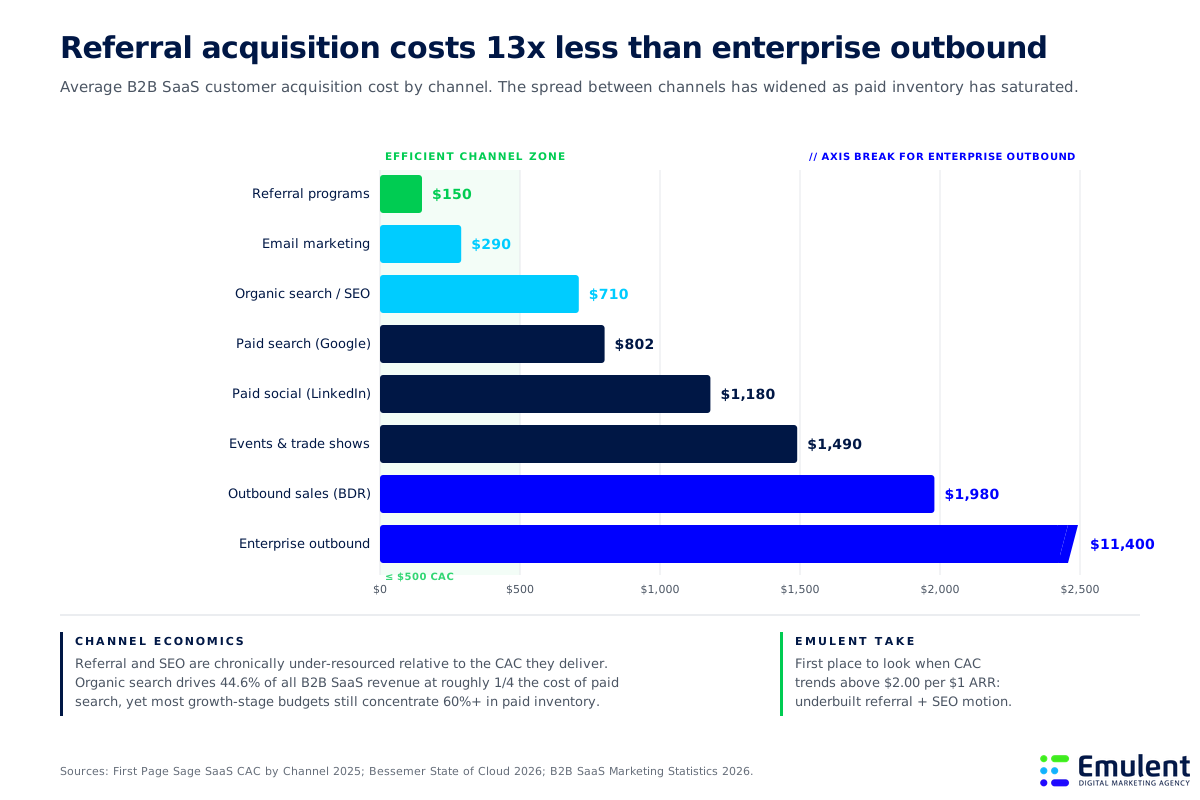
Content marketing remains the most cost-efficient B2B SaaS acquisition channel when executed well, with typical CAC running 40% to 60% below paid channels over 18-month windows. The foundational economics have held steady even as the execution requirements have escalated.

05 Content Channel Economics Emulent The 2026 channel economics for B2B SaaS show clear stratification:

  • Organic search (SEO + GEO) produces the lowest CAC at 18-month maturity, but requires 6 to 12 months of investment before CAC drops meaningfully
  • Brand search produces near-zero CAC on converted traffic, but it depends on demand having been generated by other channels first
  • LinkedIn paid produces high CAC but fastest signal quality, with cost-per-opportunity typically $2,000 to $8,000 depending on ACV
  • Google Ads (non-brand) produces moderate CAC with fast signal quality, particularly effective for categories with high commercial-intent search volume
  • Outbound sales produce widely variable CAC, effective only when targeting is tight and ICP-matched
  • Review platforms (G2/Capterra) produce high-intent leads at moderate cost with the fastest close rates in the funnel

The content marketing playbook has shifted meaningfully. What worked from 2018 through 2022 (high-volume, top-of-funnel content targeting informational queries) has lost most of its economic value in 2026 because AI Overviews intercept those queries before users reach any website. What works in 2026:

  • Comparison of content with proprietary data. “Tool A vs Tool B” articles with firsthand testing and original benchmarks
  • Category definition content. Pieces establishing new problem spaces or approach frameworks that become cited in AI answers
  • Original research and benchmark studies. Publishing proprietary data that becomes the citation source when AI models answer questions in the category
  • Expert-authored technical deep dives. Content with named author expertise (CTO, VP Engineering, specialized consultants) that signals authority to both humans and AI models
  • Video and podcast content. Multi-format content that appears in both traditional and AI search surfaces

The content velocity competition has a specific shape in SaaS:

  • AI-generated content has flooded most SaaS categories, making baseline content less effective per dollar invested
  • Google’s YMYL-equivalent application to software content has tightened quality thresholds, demoting thin or AI-generated content in rankings
  • Organizations that produce less content with more depth and original contribution outperform organizations producing more content without differentiation

SaaS Content Marketing Economics Trajectory

Metric 2026 (Base) 2027 (Projection) 2028 (Projection)
Content marketing share of B2B SaaS marketing budget 22-28% 25-31% 28-34%
Organic search share of qualified pipeline (mid-market SaaS) 28-35% 25-32% 22-30%
AI citation share of qualified pipeline <5% 8-15% 18-28%
Brand search share of qualified pipeline 15-22% 18-25% 22-30%
Time-to-payback on SEO/GEO investment 12-18 months 14-20 months 16-22 months
AI-generated share of competing SaaS content 35-45% 50-60% 55-65%

Outbound Sales and Intent Data

Outbound sales remain a meaningful pipeline channel for B2B SaaS, but the economics have shifted substantially from the 2020-2022 “sales-led everything” era. The 2026 baseline:

  • Cold email response rates have declined to 1% to 3% for most B2B SaaS, down from 3% to 7% in 2022
  • LinkedIn InMail response rates sit at 8% to 15%, meaningfully higher than email but with lower volume ceilings
  • Outbound-sourced opportunities convert at 15% to 25%, comparable to inbound marketing-sourced opportunities
  • Average outbound-sourced deal size is 20% to 40% larger than inbound deals, justifying higher per-opportunity CAC

The intent data market has become a core layer of outbound operations. Platforms including G2 Buyer Intent, Bombora, 6sense, and ZoomInfo provide behavioral signals that allow sales teams to prioritize accounts showing active research behavior. The projection is that intent data usage becomes functionally universal for mid-market-and-above B2B SaaS by 2028:

  • 06 Outbound Intent Data Emulent 2026: approximately 55% to 65% of mid-market-and-above B2B SaaS companies use intent data as a core input
  • 2027: 72% to 80%
  • 2028: 85% to 92%

The organizations building intent data stacks in 2026 capture the strongest pipeline signals from G2’s post-acquisition, expanded buyer-intent network, LinkedIn’s emerging intent products, and third-party intent platforms. Those delaying into 2028 face both higher acquisition costs and lower data quality.

Outbound compliance has also tightened. State-level privacy regulation (California, Colorado, Virginia, Texas) and updated CAN-SPAM enforcement have made list quality and consent documentation more important. Organizations using unverified scraped lists face escalating deliverability penalties and, in some cases, regulatory exposure. The projection is that outbound effectiveness will continue to concentrate among organizations with clean, consented, and enriched data.

Outbound Sales and Intent Data Trajectory

Metric 2026 (Base) 2027 (Projection) 2028 (Projection)
Cold email response rate (B2B SaaS average) 1-3% 1-2.5% 0.8-2%
LinkedIn InMail response rate 8-15% 7-13% 6-11%
Intent data adoption (mid-market+ SaaS) 55-65% 72-80% 85-92%
Outbound-sourced opportunity conversion 15-25% 15-25% 15-25%
Outbound deal size premium vs inbound +20-40% +20-40% +20-40%
Share of B2B SaaS using multi-touch outbound sequences 65-75% 80-88% 90-95%

Product-Led Growth and Self-Serve Conversion

Product-led growth has emerged as the structural counterweight to the extension of CAC payback periods. PLG SaaS companies consistently show payback periods 40% to 60% shorter than sales-led companies in comparable ACV ranges, because self-serve conversion eliminates the sales cost component of CAC entirely for the converted users.

07 Plg Share Growth Emulent The 2026 PLG landscape shows:

  • PLG’s share of new B2B SaaS company formations has grown from approximately 25% in 2020 to approximately 55% in 2026
  • Freemium and free trial offerings are now the default go-to-market motion for SMB-focused SaaS
  • Enterprise PLG (combining self-serve entry with sales-assisted expansion) is the fastest-growing subcategory
  • Atlassian’s R&D-heavy economics ($2.43 on R&D for every $1 on S&M) remain the aspirational model, though few companies replicate it

The projection is that PLG continues gaining share through 2028, but with a more realistic assessment of when it applies:

  • PLG remains most effective for products with immediate individual user value (productivity tools, developer tools, design tools)
  • PLG is less effective for products requiring implementation, integration, or organizational change management
  • Hybrid motions (PLG entry with sales-led expansion) are displacing both pure PLG and pure sales-led approaches in mid-market categories
  • PLG economics depend on activation quality, not just freemium availability. Organizations with poor activation rates see PLG produce worse unit economics than sales-led motions

The marketing implications of PLG-first SaaS are distinct:

  • Content strategy shifts from sales enablement toward product education and community building
  • Performance marketing measures shift from MQL to an activated user
  • Customer advocacy becomes a growth engine through referral, word-of-mouth, and product-led virality
  • Pricing page optimization matters more than traditional landing page optimization

Product-Led Growth Trajectory in B2B SaaS

Metric 2026 (Base) 2027 (Projection) 2028 (Projection)
PLG share of new B2B SaaS company formations 55% 62-68% 68-74%
CAC payback advantage of PLG vs sales-led (comparable ACV) 40-60% shorter 40-60% shorter 40-60% shorter
PLG companies using hybrid motion (PLG + sales) 35-45% 55-65% 70-80%
Free-to-paid conversion rate (product-qualified leads) 3-8% 3-8% 3-8%
Time from signup to first revenue (PLG SaaS median) 18-35 days 15-30 days 12-28 days

B2B SaaS Analytics, Attribution, and Measurement

The measurement problem in B2B SaaS has become more acute as the buyer journey has fragmented. Organizations now see buyers touching 15 to 25 distinct marketing touchpoints before a first sales conversation, spread across:

  • Organic search (traditional and AI)
  • Paid search
  • Paid social (primarily LinkedIn)
  • Content syndication and review platforms
  • Podcast and video content
  • Community discussions (Reddit, Slack communities, Discord)
  • Peer referrals
  • Direct traffic (often mislabeled but actually originating from unattributable prior awareness)

The measurement gap: 87% of B2B SaaS marketers say data-driven attribution is critical, but only 32% trust their attribution data enough to make major budget decisions on it. The gap is driven by:

  • Multi-touch attribution models that weight touches differently with little empirical basis
  • Privacy-driven signal loss from iOS 14, third-party cookie deprecation, and consent-mode analytics
  • Platform walled gardens restricting cross-platform user identification
  • Dark social (sharing via DMs, Slack, email forwards) creates entirely unattributable influence

08 Attribution Measurement Emulent The projection is that attribution quality improves modestly through 2028 as tooling matures and organizations build better infrastructure, but perfect attribution remains impossible:

  • Multi-touch attribution adoption reaches 55% to 65% of mid-market-and-above B2B SaaS by 2028, up from approximately 41% in 2026
  • Marketing mix modeling adoption (Bayesian and open-source approaches) reaches 55% to 75% by 2028, providing aggregate measurement where user-level attribution fails
  • Post-sale buyer surveys asking “how did you hear about us” become a standard attribution supplement for the 30% to 50% of pipeline that is structurally unattributable

The organizations that move fastest on measurement infrastructure capture significant advantages. Gartner projects that organizations integrating MTA, MMM, and AI analytics will outperform single-method peers by 40% on efficiency metrics by 2028. The competitive window for building this capability is 2026-2027, because by 2028, integrated measurement becomes table stakes.

B2B SaaS Measurement and Attribution Trajectory

Metric 2026 (Base) 2027 (Projection) 2028 (Projection)
B2B SaaS marketers trusting their attribution data 32% 38-44% 45-52%
Multi-touch attribution adoption 41% 48-55% 55-65%
Marketing mix modeling adoption (mid-market+) 30-40% 48-58% 65-75%
Post-sale attribution survey adoption 25-35% 45-55% 65-75%
Pipeline influenced (vs sourced) tracking 55-65% 72-82% 82-90%

Retention, Expansion, and NRR Economics

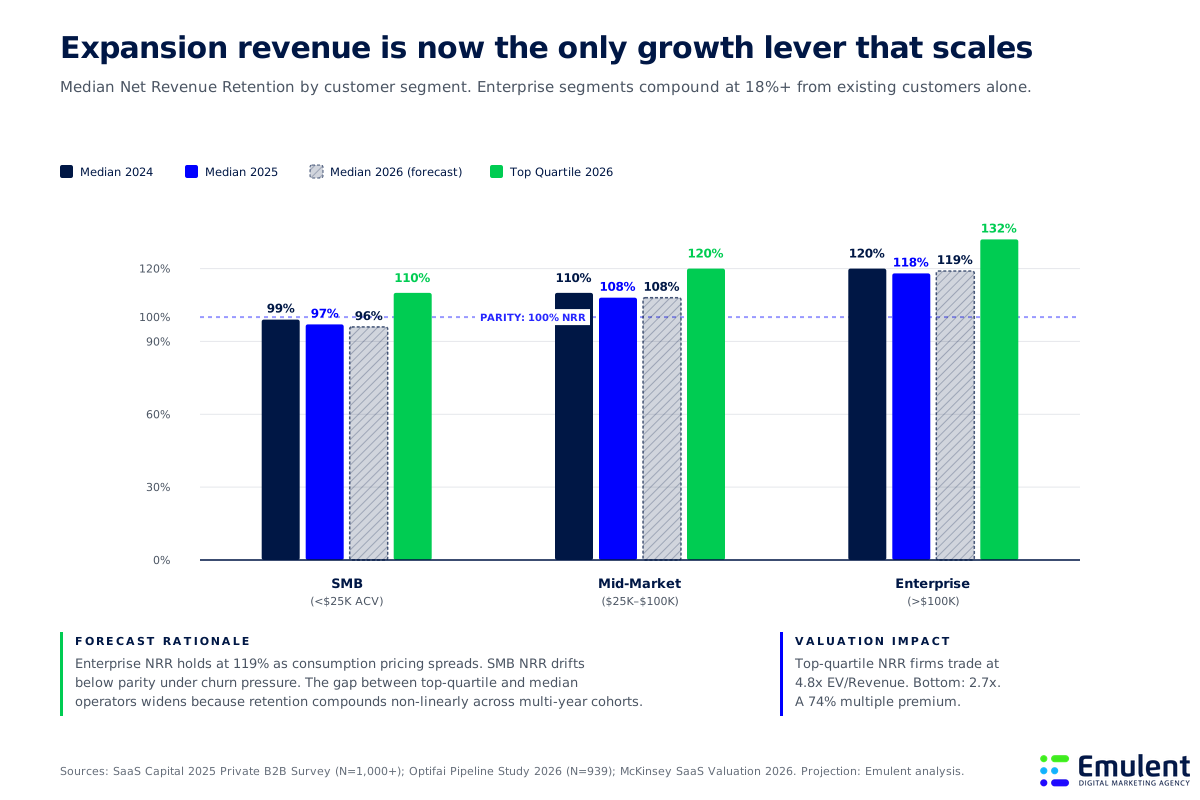
As new-customer CAC payback extends, retention and expansion revenue have become the primary levers organizations can pull to offset growth costs. Net Revenue Retention (NRR) has become the single most important SaaS metric, alongside the payback period, because NRR compounds the value of each acquired customer in ways that can fully offset the impact of extended payback.

09 Nrr Compression Emulent The 2026 NRR landscape:

  • Median B2B SaaS NRR has compressed to approximately 101%, down from 108% to 112% in 2022
  • Top performers (top quartile) maintain 111%+ NRR
  • Elite performers (top decile) maintain 120%+ NRR
  • Organizations with NRR below 100% are functionally contracting regardless of new customer acquisition

The NRR compression reflects broader macro pressure on software budgets. Buyers are consolidating tools, scrutinizing renewals more carefully, and pushing back on price increases. Organizations that built growth models around aggressive expansion are seeing that component erode.

The projection for NRR through 2028 suggests continued compression at the median but increasing differentiation:

  • Median NRR: 101% in 2026, projected to 98% to 102% in 2027 and 95% to 100% in 2028
  • Top quartile NRR: 111%+ in 2026, projected to 109% to 114% in 2027, and 107% to 113% in 2028
  • Top decile NRR: 120%+ in 2026, projected to remain 120%+ throughout the forecast horizon

The marketing implications of NRR compression:

  • Expansion marketing becomes a distinct discipline from acquisition marketing, with different KPIs and different channels
  • Customer marketing teams grow in size and strategic importance
  • Product-led expansion (in-product upsell prompts, feature gating) outperforms sales-led expansion in cost efficiency
  • Community building, customer advocacy, and customer education investments produce outsized returns on both retention and expansion

The math of NRR on CAC payback is substantial. A company with 110% NRR has fundamentally different economics than a company with 100%, even at identical payback periods. The 110% NRR company recovers CAC faster through expansion, while the 100% NRR company is running in place on existing accounts while trying to grow through new acquisitions.

SaaS Retention and Expansion Trajectory

Metric 2026 (Base) 2027 (Projection) 2028 (Projection)
Median B2B SaaS NRR 101% 98-102% 95-100%
Top-quartile NRR 111%+ 109-114% 107-113%
Top-decile NRR 120%+ 120%+ 120%+
Expansion revenue share of new ARR (median) 40% 42-48% 45-52%
Expansion revenue share of new ARR (top quartile) 50%+ 55-62% 58-68%
Customer marketing team size (as % of total marketing) 12-18% 18-24% 22-28%

Community, Advocacy, and Word-of-Mouth

Word-of-mouth has reemerged as a disproportionately effective SaaS acquisition channel precisely because paid channels have become more expensive and less trusted. Buyers who previously clicked through ads now rely heavily on peer recommendations, community discussions, and referrals from trusted sources. The data points:

  • 10 Community Advocacy Emulent 71% of B2B buyers report that peer recommendations influence their purchasing decisions
  • Customers acquired through referrals have approximately 2.5x higher lifetime value than paid-acquired customers
  • Referrals convert at 3 to 5 times the rate of other channels
  • Customer advocacy program participants generate 2 to 4 referrals per year on average

The community-driven acquisition landscape has consolidated around specific platforms:

  • Private communities (Slack groups, Discord servers, Circle communities) are replacing forum-based communities for B2B SaaS
  • Reddit subreddits remain highly influential for specific technical categories
  • LinkedIn functions as both a paid channel and an organic community surface
  • Industry-specific podcasts drive disproportionate influence on purchase decisions despite small audience sizes
  • Peer advisory groups (Pavilion, Chief, industry-specific CRO/CMO groups) influence enterprise SaaS buying

The projection is that community and advocacy investments produce the best blended CAC of any SaaS marketing activity through 2028, but they require a multi-year commitment to produce measurable returns. Organizations launching communities in 2026 expecting ROI in 2026 are setting themselves up for disappointment. Organizations launching communities in 2026 with 3-year horizons are building durable competitive advantages.

SaaS Community and Advocacy Trajectory

Metric 2026 (Base) 2027 (Projection) 2028 (Projection)
B2B SaaS running formal customer advocacy programs 30-40% 48-58% 65-75%
Referral-sourced share of new ARR (median) 12-18% 15-22% 18-25%
Referral-sourced share of new ARR (top quartile) 25-35% 28-38% 32-42%
LTV advantage: referral-acquired vs paid-acquired 2.5x 2.5x 2.5x
SaaS orgs with a dedicated community management role 25-35% 42-52% 60-70%

B2B SaaS Marketing Budget Allocation

The 2026 budget allocation for B2B SaaS marketing shows specific patterns that reflect the economic pressures across channels:

  • Paid media (LinkedIn, Google, display): 30% to 40% of total marketing budget, consistent with historical norms but producing less per dollar
  • Content marketing and SEO/GEO: 18% to 25%, trending up as organizations recognize the long-term value
  • Events and field marketing: 12% to 18%, recovering from 2020-2022 lows but not to pre-COVID levels
  • Customer marketing and advocacy: 8% to 14%, trending up as retention economics become more critical
  • Sales enablement and content production for sales: 8% to 12%
  • Brand and communications: 6% to 10%
  • Marketing operations and technology: 10% to 15%, rising as measurement complexity increases

The projection for budget shifts through 2028:

11 Budget Allocation Emulent The absolute growth in B2B SaaS marketing budgets has slowed. Median marketing spend as a percentage of revenue has shifted from approximately 12% to 15% in 2022 to approximately 9% to 12% in 2026, as efficiency pressures intensify. The projection is for continued compression through 2028, with marketing teams expected to do more with proportionally less.

B2B SaaS Marketing Budget Allocation Trajectory

Budget Category 2026 (Base) 2027 (Projection) 2028 (Projection)
Paid media share of total marketing 30-40% 28-36% 26-34%
Content marketing + SEO/GEO share 18-25% 22-28% 24-32%
Events and field marketing share 12-18% 12-18% 12-18%
Customer marketing and advocacy share 8-14% 11-17% 14-20%
Community and advocacy share (distinct line) emerging 2-5% 4-8%
Marketing ops and technology share 10-15% 12-17% 14-19%
Marketing as % of revenue (median B2B SaaS) 9-12% 8-11% 8-10%

Strategic Implications for SaaS Marketing Leaders

For SaaS marketing leaders navigating 2026 through 2028, the strategic reality is that the economic environment is structurally harder than the one most playbooks were built for. The organizations that survive and thrive will share specific characteristics:

  1. Payback discipline. Treating CAC payback as the primary operating metric rather than MQL volume, lead velocity, or pipeline generation in isolation.
  2. Channel mix rebalancing. Reducing dependence on the most-inflated channels (LinkedIn C-suite targeting, broad Google Ads) in favor of more efficient paths (brand search capture, community, review platform optimization, GEO).
  3. Review platform commitment. Operating G2 as a strategic platform with dedicated investment, not as a reputation hygiene activity.
  4. AI crawler access and GEO investment. Opening access to AI crawlers and building the schema, author credentials, and original research that earn AI citations.
  5. Retention economics. Investing disproportionately in NRR improvement because a 5-point NRR improvement can offset a 6-month payback extension.
  6. Attribution realism. Moving from “every dollar measurable” aspirations to “aggregate measurement plus post-sale survey” realism.

The organizations most at risk through 2028 share a different profile:

  • Continued blocking of AI crawlers on the assumption that IP protection justifies invisibility
  • Optimizing to lead volume metrics rather than pipeline quality metrics
  • Running Series C playbooks at Series A runway levels
  • Treating reviews as discretionary rather than strategic
  • Operating customer marketing as an afterthought rather than a core function

The risks in the forecast are concentrated in several areas:

  • Macro conditions. A meaningful recession would compress software budgets further, accelerating NRR compression and extending payback beyond the projections
  • LinkedIn competitive dynamics. Emergence of a credible competitor to LinkedIn for B2B paid social could reset CPM trajectories, though no such competitor is currently visible
  • AI platform policy changes. Major changes to how LLMs handle B2B software recommendations could reshape GEO economics
  • Review platform regulatory scrutiny. Antitrust scrutiny of the G2 acquisition could constrain how the combined entity monetizes its gatekeeper position

Capability Investment Priorities for B2B SaaS (2026-2027)

Priority Focus Area Key Action
Highest AI crawler access and GEO Unblock AI crawlers, deploy SoftwareApplication schema, build author credential signals
Highest G2 strategic investment Systematic review generation, paid G2 products, and buyer intent data integration
High LinkedIn operational discipline Creative rotation cadence, ICP-tight targeting, cost-per-opportunity measurement
High NRR and customer marketing Expansion motion development, customer advocacy programs, retention marketing
High Multi-touch attribution + MMM Integrated measurement infrastructure, post-sale attribution surveys
Medium Community and advocacy Private community launch, advocacy program formalization
Medium PLG motion (where applicable) Freemium/trial optimization, activation quality improvement
Medium Intent data integration G2 + Bombora/6sense/ZoomInfo stack for outbound prioritization

Conclusion

B2B SaaS marketing in 2026 through 2028 is not undergoing a single transformation but a convergence of simultaneous pressures:

  • CAC payback periods extend across every segment
  • LinkedIn CPM inflation compounding year-over-year
  • Review platform consolidation, concentrating gatekeeper power with G2
  • AI-driven buyer research bypasses blocked or invisible vendors
  • NRR compression is eroding the retention cushion that previously offset acquisition costs
  • Content velocity flooding most categories and diluting per-unit effectiveness

Any one of these would be consequential enough to merit significant strategic attention. Their convergence creates both the difficulty and the opportunity of the period. The complexity of executing across all of them simultaneously is substantial. The competitive advantage available to organizations that execute well is correspondingly large.

The strongest recommendation for SaaS marketing leaders is the simplest: treat capability building as the primary investment of the period, and treat tactical campaign optimization as secondary. The campaigns run in 2026 matter less than the infrastructure, data assets, AI visibility, and retention economics built during 2026 and 2027. Those investments compound. Those tactical campaigns do not. The SaaS organizations that understand this distinction and act on it will define the competitive landscape through 2028 and beyond.