
Most suspended Google Business Profiles come back, and the ones that don’t usually die from the owner’s first 48 hours of panic, not from the suspension itself. A machine flagged your profile, a machine will read your appeal, and the entire game is giving that machine documents it can match. This guide walks through what kind of suspension you have, why Google’s filters caught you, the exact appeal process with its real timelines, and what the downtime costs while you wait. We will also make the argument nobody else on this topic makes: the suspension is rarely the disease. It is the bill for routing most of your lead flow through one free profile you never owned.
First, Confirm What Kind of Suspension You Have
Not every visibility drop is a suspension, and the type you have decides your next move. Businesses regularly mistake a ranking decline, a re-verification request, or a Maps glitch for a suspension and start “fixing” a profile that was never broken, which creates the exact edit activity that triggers a real one. Check the dashboard first. If you can log in and see a “Suspended” label, you have your answer. If the profile simply ranks lower than last month, you have a different problem.
There are three flavors, and they get worse in order.
- A soft suspension unverifies your profile: the listing still appears on Search and Maps, but you lose the ability to manage it, respond to reviews, or see performance data, and the public can suggest edits you can’t control.
- A hard suspension removes the listing from Search and Maps entirely, so a customer searching your exact business name finds nothing.
- An account-level restriction is the most serious: Google restricts your Google account itself, which suspends every profile that account manages and blocks it from creating or claiming new ones. Google’s own documentation on fixing suspended or disabled profiles confirms the order of operations for that last case: you must appeal the account restriction first, and only after it lifts can you appeal the profile suspension.
Why Google Suspended You (It Wasn’t a Person)
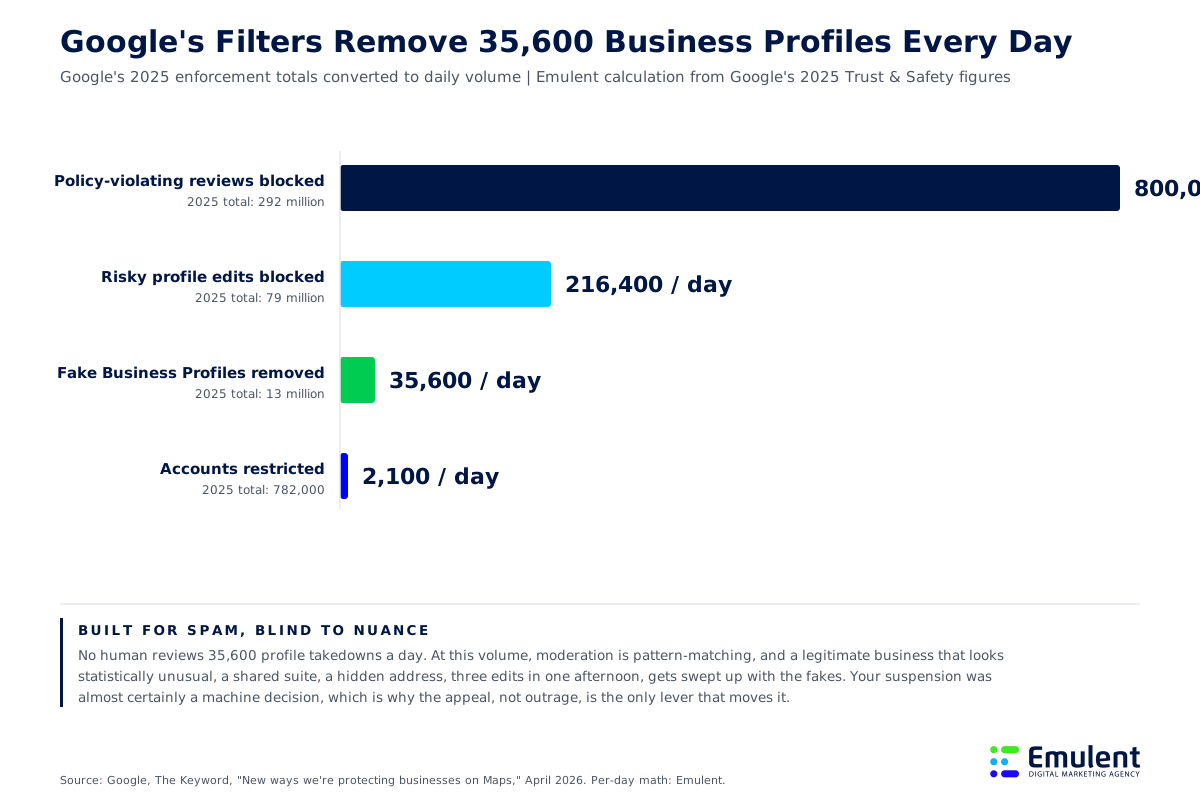
Your profile was almost certainly suspended by a statistical model, and understanding that changes how you respond. In 2025, Google reported blocking or removing more than 292 million policy-violating reviews, blocking 79 million inaccurate or unverified edits, removing over 13 million fake Business Profiles, and restricting more than 782,000 accounts. Divide those by 365, and the picture sharpens: roughly 800,000 reviews, 216,400 edits, and 35,600 business profiles removed every single day. No human team reviews that volume. Moderation at that scale is pattern-matching, and a legitimate business that looks statistically unusual, a shared office suite, a hidden service-area address, three profile edits in one afternoon, gets swept up with the fakes.
The enforcement machine is also accelerating, not cooling off. Google blocked or removed more than 170 million policy-violating reviews in 2023, then more than 240 million in 2024, then 292 million in 2025. We project that number reaches roughly 330 million in 2026 and 355 million in 2027 before bending toward a ceiling near 360 million, because the growth rate is already decaying (41% in 2024, 21% in 2025) as detection moves in front of publication and the pool of catchable spam saturates. The behavioral driver is loss aversion at platform scale: Google’s local ad revenue sits on consumer trust in Maps, and companies defend an asset they already hold far more aggressively than attackers pursue an asset they don’t. For a business owner, the takeaway is blunt. Enforcement will get more aggressive every year you operate, so profile hygiene is now a permanent operating cost, not a one-time setup task.
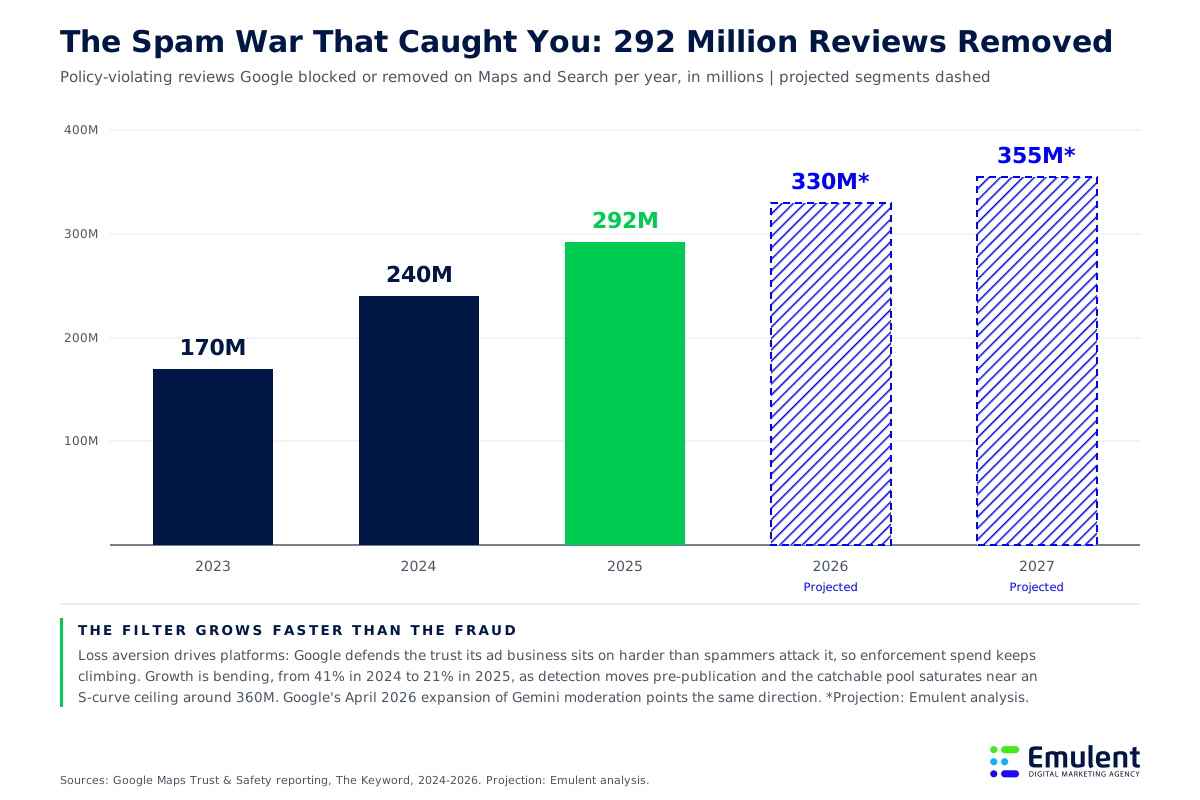
Projection: Emulent analysis based on loss aversion (Google defending the trust asset its local ad revenue depends on), assuming an S-curve ceiling near 360 million as detection moves pre-publication and year-over-year growth decays, cross-checked against Google’s April 2026 expansion of Gemini-based moderation on Maps.
The specific triggers are consistent across the thousands of cases discussed in Google’s own support community. Keyword stuffing in the business name (“Smith Plumbing | Best Emergency Plumber Raleigh”) remains the most common self-inflicted one, and it deserves a hard word: stuffing the name was an attempt to write for the algorithm instead of the buyer, and the algorithm is precisely what caught it. The rest of the list: virtual offices, PO boxes, and rented mailboxes used as addresses; a visible address on a service-area business that should hide it; several core fields (name, address, phone, category) edited in one session; duplicate listings for one location; a co-working or shared-suite address that looks like a fake-listing farm; and a manager or agency account with its own violation history, which can take your profile down through no action of yours. That last one means every user with access to your profile is a liability you chose. Audit the access list before an algorithm audits it for you.
“When a client gets suspended, the first thing we pull up isn’t the profile. It’s the list of who has access to it. Half the time there’s a freelancer from 2022 or an old agency login still sitting there with management rights, and nobody can tell us whose Gmail it is.” – The Strategy Team at Emulent
The First 48 Hours: What Not to Do
The actions that feel most productive in the first two days after a suspension are the ones that do the most damage. Ranked by how much recovery time they cost you:
Do not create a new profile for the same business. Google’s appeal documentation warns against this directly, and it is the single fastest way to convert a recoverable suspension into a duplicate-listing violation with an evasion flavor. The new profile gets caught, the original appeal gets tainted, and your reviews stay attached to a listing you have now made harder to recover.
Do not fire off the appeal from the suspension email while angry. Once you start the evidence step, a 60-minute timer runs, and it does not pause while you dig through a drawer for your business license. An appeal submitted without evidence is a wasted appeal, and you only get two.
Do not keep editing the profile after you appeal. Fix violations before you submit, then stop. Continued edits during review read as instability to a system already suspicious of you.
Do not pay a reinstatement service before you have filed your own first appeal. This advice costs us nothing to give and costs you nothing to take: the first appeal is a document-matching exercise you can do yourself in an afternoon, and Google only accepts reinstatement requests from the profile owner anyway. Paid help earns its fee on complex cases, multi-location suspensions, account-level restrictions, second appeals, not on round one.
The Reinstatement Process, Step by Step
The process rewards preparation and punishes speed. Run it in this order.
Step 1: Audit the profile against the guidelines before touching the appeal tool. Give this a day or two. Your business name must match your signage and your legal documents, with no bolted-on keywords or city names. Categories must describe what you actually sell. A storefront needs a real, staffed address with permanent signage; a service-area business needs its address hidden and its service areas kept honest. Remove duplicate listings. Remove every profile manager you cannot vouch for. Fix what you find now, because fixing it after submission looks like evidence tampering.
Step 2: Gather evidence before opening the form. The strongest packets contain two or three current documents where the business name and address match the profile exactly: a business license, a utility bill, business registration, an IRS document, plus photos of your exterior signage. Exact match is the whole game. “Smith Plumbing LLC” on the license and “Smith Plumbing” on the profile is a mismatch a pattern-matching reviewer will not forgive, and this is where costly signaling works in your favor: documents that are annoying to fake are exactly what a trust system counts.
Step 3: Submit the appeal, then attach evidence inside the 60-minute window. Sign in with the Google account that owns the profile, select it in the appeals tool, submit, and then attach your prepared files. Per Google’s appeal documentation, once you open the evidence form you must submit it within 60 minutes or it is not attached to your appeal at all.
Step 4: Wait, and only wait. Google states appeal reviews can take up to 5 business days. Do not submit a second appeal while the first is pending; duplicate requests extend the queue, they don’t jump it.
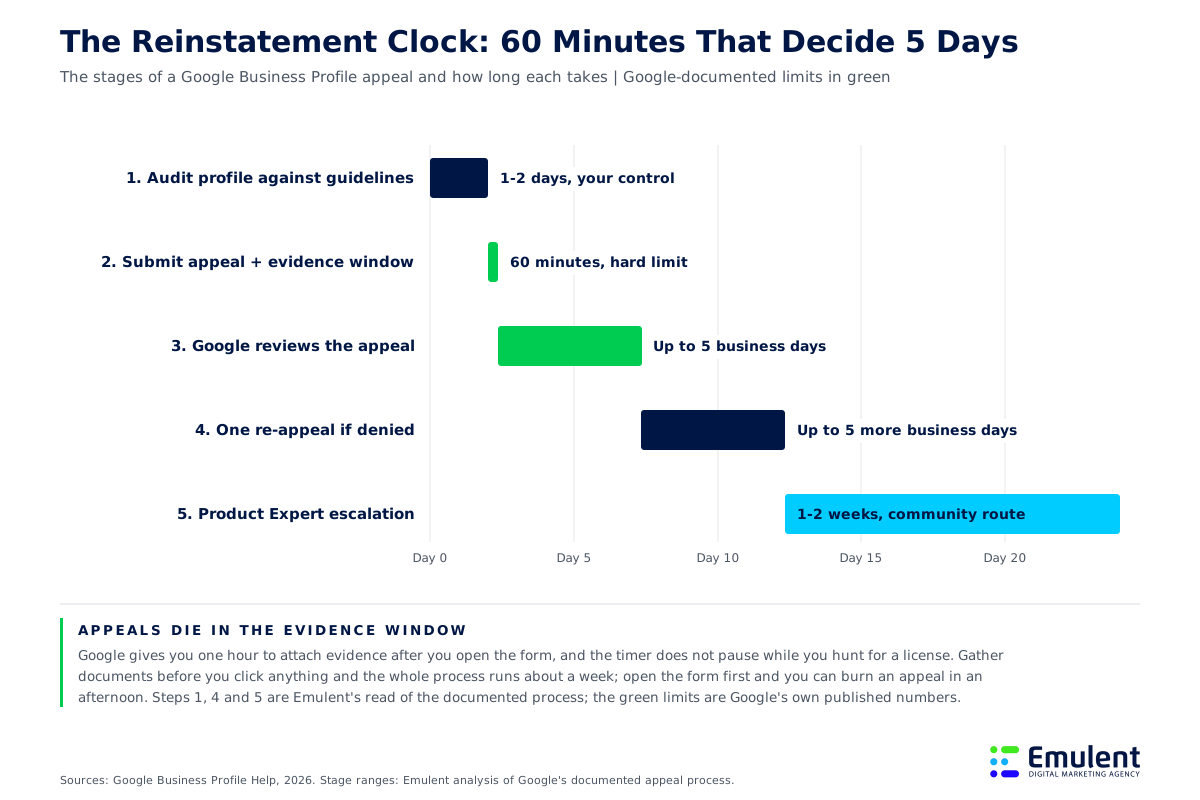
Run cleanly, the whole cycle is about a week. Run badly, with a burned evidence window, a mid-review edit spree, or a panic duplicate listing, it stretches into months, and every day of that stretch is a day your competitors collect the calls that used to be yours.
If Your Appeal Is Denied
A denial is not the end, but your margin for error just shrank. Google allows one re-appeal, and community norms treat it as your last self-service shot, so treat the second submission as a different appeal, not a resend. Re-read the denial, re-audit the profile, and swap in stronger documents: if you sent a lease the first time, send the business license and a current utility bill the second. Explain in plain language what was wrong and what you changed. Reusing the first appeal’s packet on the second attempt is how businesses talk themselves into a permanent removal.
After two denials, the remaining route runs through the Google Business Profile community forum, where Product Experts can review your case and escalate it to Google’s team when the documentation supports you. That route typically adds one to two weeks. And if you operate 10 or more locations, the appeals tool has a bulk path: you appeal one profile and attach a spreadsheet of evidence and profile IDs for the rest. Multi-location suspensions are also where profile management stops being an intern task; our breakdown of local SEO pricing for multi location brands covers what that oversight should cost and why cheap listing management is how six locations go dark at once.
One honest caveat: some suspensions should not be appealed, because the business model itself is ineligible. If the “location” is a lead-generation address, a virtual office with no staff, or a category Google excludes, no document packet fixes that, and the right move is to build visibility on assets you actually qualify for.
What the Downtime Actually Costs
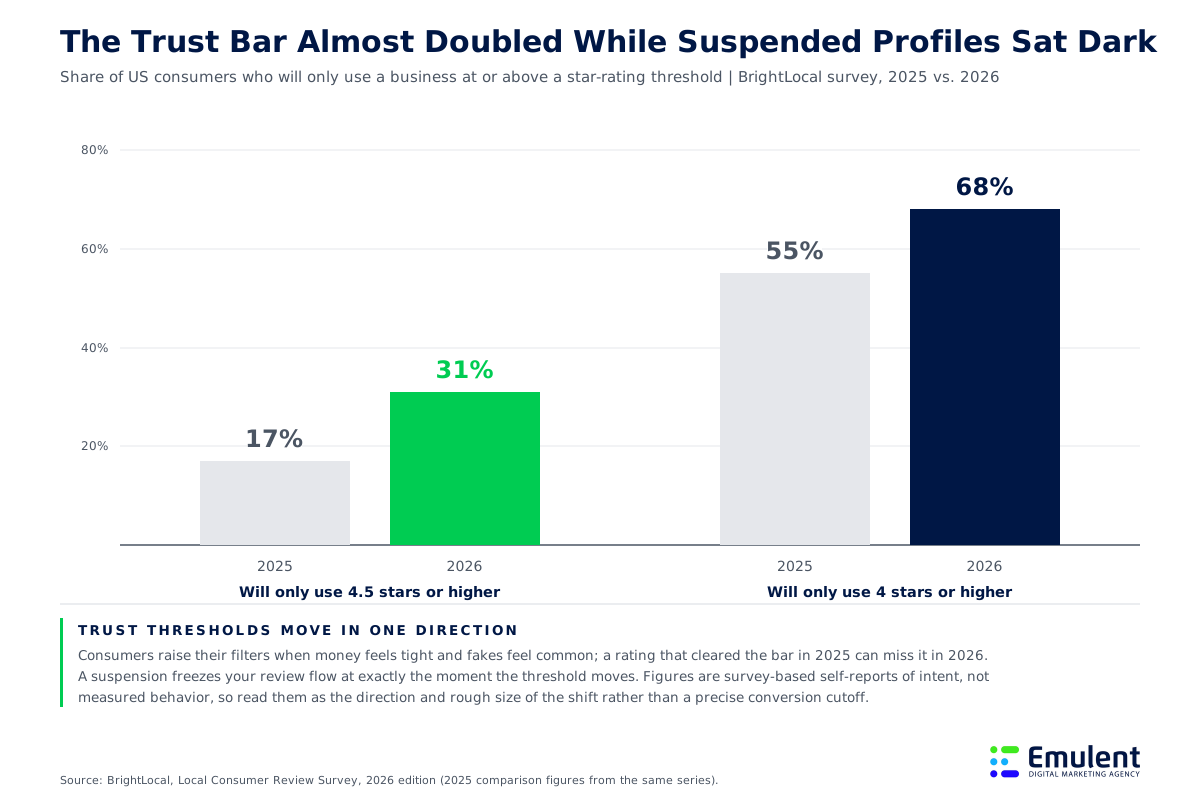
A suspension freezes your review flow at the exact moment consumer standards are climbing. In BrightLocal’s 2026 Local Consumer Review Survey, 31% of US consumers said they will only use a business rated 4.5 stars or higher, up from 17% a year earlier, and 68% now require at least 4 stars, up from 55%. The share who always read reviews before choosing a business jumped from 29% to 41% in the same window. Those are survey-based self-reports of intent rather than measured behavior, so treat the exact percentages loosely, but the direction is one-way: trust thresholds ratchet up when money feels tight and fakes feel common, and they do not ratchet back down. A profile that spends six weeks dark isn’t paused. It is falling behind a bar that moved while it slept, which is the same compounding problem we documented in what happens if you pause SEO: visibility decays against competitors who kept moving, not against your own past.
The second cost is newer and mostly invisible: your suspended profile also disappears from the data that feeds AI recommendations. The same 2026 BrightLocal survey found 45% of consumers now use ChatGPT or other generative AI tools for local business recommendations, up from 6% a year earlier. A jump that size is a social proof cascade, the pattern where adoption accelerates once the behavior becomes visible in everyday life, and it tracks the classic diffusion S-curve. We project adoption reaches roughly 58% in 2027 and 65% in 2028, bending toward a ceiling near 70%, because a status-quo-bias segment of consumers keeps its Google habit and never converts. Gartner’s 2024 forecast that traditional search engine volume would fall 25% by 2026 points the same direction. AI assistants lean heavily on your Google reviews and profile data when they decide whom to recommend, a dependency we mapped in our research on how reviews affect AI search. When your profile goes dark, you vanish from those answers too, and there is no appeals tool for ChatGPT.
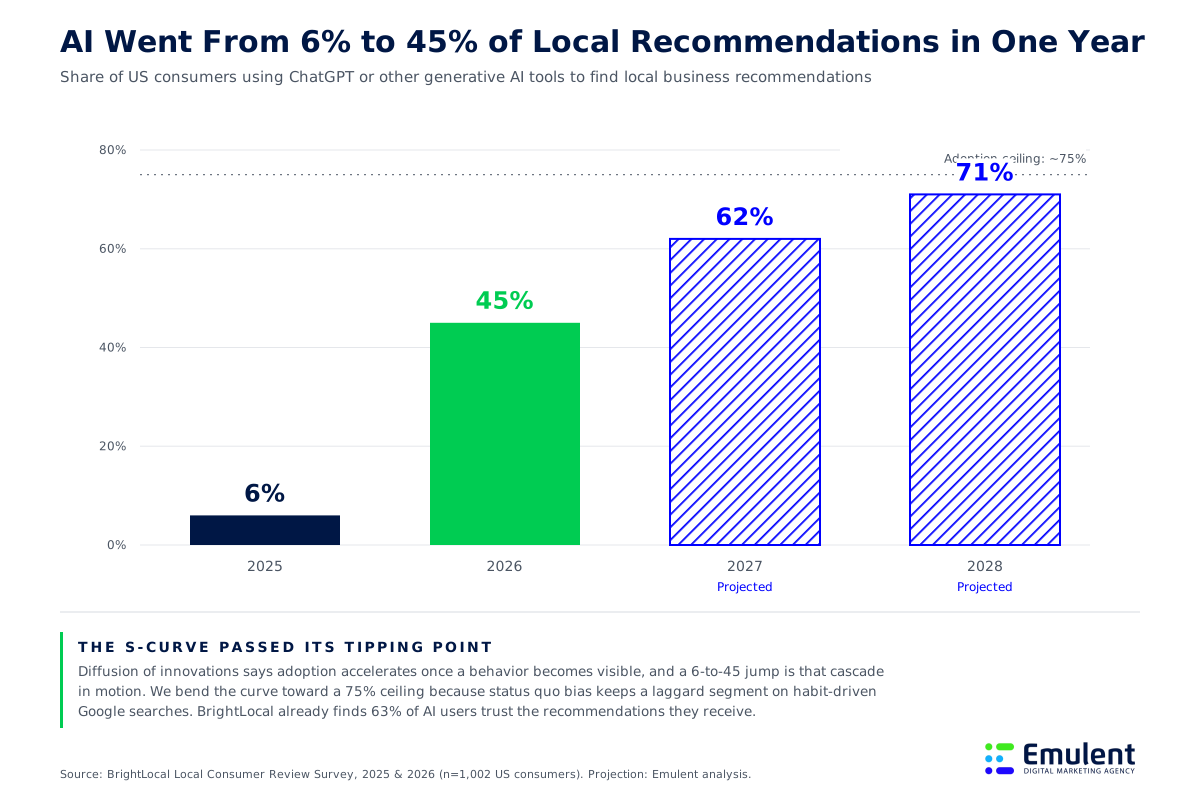
Projection: Emulent analysis based on a social proof cascade and diffusion-of-innovations S-curve, assuming a ceiling near 70% because a status-quo-bias segment never leaves established search habits, cross-checked against Gartner’s 2024 forecast of a 25% drop in traditional search volume by 2026.
Notice what is missing from this cost accounting: rankings. A reinstated profile with recovered rankings and no recovered call volume is not a win, it is a decoration. When you come back online, measure recovery in calls, direction requests, and booked jobs against your pre-suspension baseline, and treat the ranking report as the means, never the scoreboard. The inputs that rebuild those numbers fastest are the same ones that drive local visibility generally; our reference on local SEO ranking factors ranks them, and fresh reviews sit near the top.
Prevention: The Position Nobody Else Will Take
Here is the argument the rest of page one avoids: if a single free profile going dark can cut your lead flow in half, the suspension was never your real problem. It was the invoice for a single point of failure you built on rented land. Google can suspend, re-verify, redesign, or algorithmically demote your profile at any time, for any reason, with a vague email and a two-appeal limit, and you agreed to all of it. The businesses that shrug off a suspension are the ones where the profile is one strong channel among several: a website that converts, an email list they own, referral relationships, and a review base spread across more than one platform. That is the architecture we build in our small business marketing services work, and the reasoning starts with ownership, not with any one channel. Your website design is the only piece of your local presence no platform can take away, which is exactly why it should be the asset your profile feeds, not the afterthought behind it.
“Google’s suspension system treats you as guilty until documented otherwise, and business owners are shocked by that every time. They shouldn’t be. Trust is asymmetric: it is expensive to grant and cheap to revoke, and any platform running on trust at Google’s scale will always err toward revoking yours. Plan your business like that email is coming, because statistically, one day it is.” – Bill Ross, Founder, Emulent
Day to day, prevention is unglamorous discipline. Keep your name, address, and phone identical across your profile, website, and directories. Make profile changes one at a time, spaced out, from the owner’s account. Photograph your signage and keep current copies of your license and a utility bill in one folder, so an appeal packet takes ten minutes to assemble instead of a frantic hour. Review your manager list quarterly and remove anyone you can’t name. Our 20 point local SEO checklist builds these checks into a repeatable routine, and if you would rather have a team watch the profile, the appeals tooling, and the quarterly documentation for you, that is the unexciting, compounding work a local SEO service is actually for. Where the whole environment is heading, tighter enforcement, AI answers pulling from profile data, rising review thresholds, is the subject of our state of local SEO projections.
Get the appeal right, get reinstated, and then treat the scare as the audit it was. The profile came back. Next time, make sure your revenue never left with it.