
Most teams shopping for an enterprise SEO platform should not buy one. Unless your site clears specific thresholds- roughly 500,000 crawlable URLs, multiple international markets, or a genuine need for automated on-page execution- the $6,000-a-year self-serve tier does the same research work as the $36,000 contract, and the custom quotes and 12-month minimums at the top of the market are pricing psychology, not product. We compared seven platforms- BrightEdge, Conductor, seoClarity, Semrush, Botify, Lumar, and Ahrefs- on what they publish, what they hide, and where the extra money actually buys something. Here is what a buyer needs to know before the first demo call.
The Price You See Assumes You Work Alone
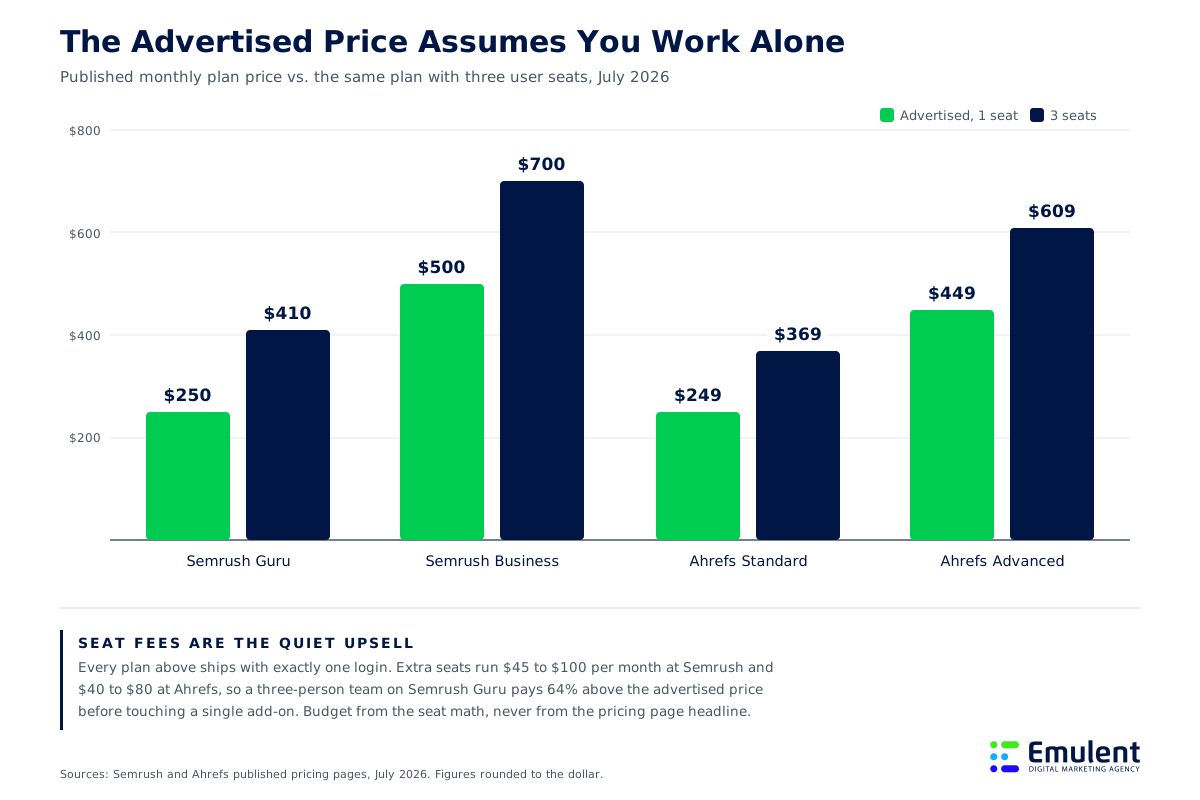
Every published price in this category is a single-seat price, and almost no SEO program runs on a single seat. Semrush’s published pricing lists Pro at $139.95 per month, Guru at $249.95, and Business at $499.95, and each plan includes exactly one login. Extra seats run $45 per month on Pro, $80 on Guru, and $100 on Business as of July 2026. A three-person team on Guru pays $409.95 per month, 64% above the number on the pricing page, before touching a single add-on.
Ahrefs works the same way. Ahrefs’ published pricing runs from Lite at $129 per month through Standard at $249, Advanced at $449, and Enterprise from $1,499 per month on a required annual commitment, with extra seats at $40 to $80 per month on the self-serve tiers. Three people on Standard cost $369 a month, not $249. Neither vendor buries this math out of malice; they bury it because the advertised number sells better. Your budget should start from the seat math, never from the headline.
Add-ons stack on top of the seats. Semrush gates its API behind the Business tier, sells local SEO management per location, and prices its Trends toolkit as a separate line item. Ahrefs bills overage automatically when crawl credits or export rows run past plan limits. None of this is hidden, exactly. It is simply arranged so the comparison you make at the pricing page is not the comparison your invoice reflects three months later.
Four of the Seven Platforms Will Not Print a Price
Semrush, Ahrefs, and seoClarity publish what their top tiers cost. BrightEdge, Conductor, Botify, and Lumar do not, and that is a sales strategy, not an oversight. seoClarity’s published pricing starts its core platform near $3,000 per month, which annualizes to $36,000, six times Semrush Business and double Ahrefs Enterprise. The four custom-quote vendors sit somewhere above, behind a discovery call, a demo, and a proposal shaped by what the salesperson learns about your budget along the way.
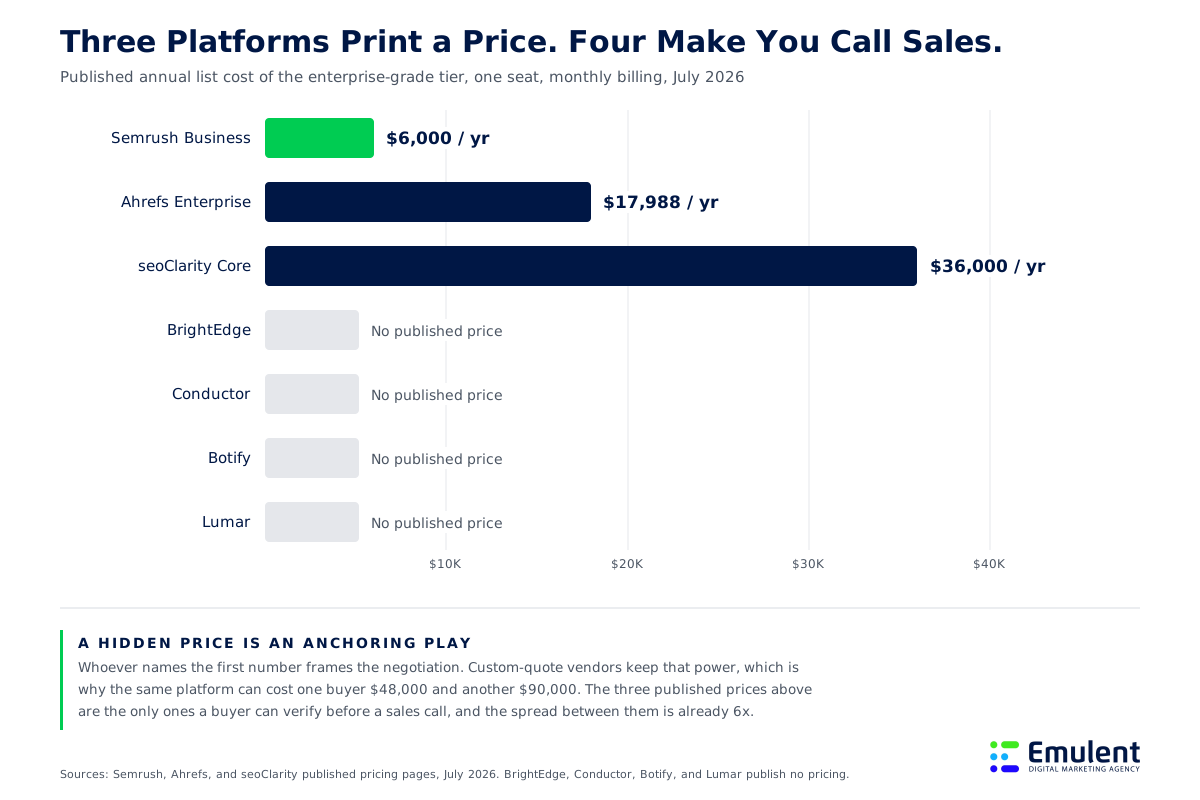
The psychology here matters more than the spreadsheet. A hidden price hands the vendor the anchor: once the salesperson names $60,000, a $48,000 counter feels like a win, whatever the software is worth to you. The 12-month minimums that come standard on these contracts do the same work from the other side, converting a software decision you could revisit monthly into a sunk cost you will defend at renewal. We wrote up the math on why agencies love long-term commitments in we refuse long-term contracts, and the logic transfers to software wholesale: a lock-in exists because the seller doubts the product will earn the renewal on its own.
“A hidden price is not a pricing model, it is a negotiation tactic. The vendor wants to hear your budget before naming a number, because whoever anchors first wins. We tell clients to write down the price they would happily pay before the demo starts, and to say it out loud first.” – Bill Ross, Founder, Emulent
The Feature Grid, Read the Way a Buyer Should Read It
Spec sheets in this category lead with index sizes: billions of keywords, tens of trillions of backlinks, 140-plus country databases. Those numbers are vanity specs for most buyers. Past a certain scale, every major index contains the keywords your buyers actually type, and no ranking meeting in your company will ever hinge on whether the database held 26 billion terms or 30 billion. The specs that decide whether the enterprise label earns its premium are duller and more consequential. The four tables below hold the datapoints; the judgments after them tell you which rows matter.
Pricing and contract terms
| Datapoint | BrightEdge | Conductor | seoClarity | Semrush | Botify | Lumar | Ahrefs |
|---|---|---|---|---|---|---|---|
| Published entry price | No (custom quote) | No (custom quote) | Yes: Core from $3,000/mo | Yes: Pro $139.95/mo, Guru $249.95/mo, Business $499.95/mo | No (custom quote) | No (custom quote) | Yes: from $129/mo; Enterprise $1,499/mo, annual commitment |
| Typical enterprise contract (market-reported, not published) | $48K–$60K+/yr | $25K–$75K/yr | $48K–$60K/yr | Enterprise is custom; self-serve tops out at $6,000/yr published | $75K+/yr territory | $40K–$100K+/yr | $17,988/yr published |
| Pricing basis | Keywords, pages, modules | Keywords, markets, seats | Keywords and domains | Seats + limits + add-ons | URLs crawled and analyzed | URLs crawled, crawl frequency | Seats + credits |
| Minimum commitment | 12 months | 12 months | 12 months | Monthly (self-serve) / annual (Enterprise) | 12 months | 12 months | Monthly or annual |
| Hidden cost to watch | Module add-ons | Managed services tier | Breadth you will not use | Per-seat fees and add-ons (a 3-person Guru team pays $410/mo, not $250/mo) | Requires a dedicated technical owner | Crawl frequency upgrades | Extra credits and export rows |
Data index and freshness
| Datapoint | BrightEdge | Conductor | seoClarity | Semrush | Botify | Lumar | Ahrefs |
|---|---|---|---|---|---|---|---|
| Keyword database (vendor-stated) | Data Cube: billions of results, updated monthly | Licenses third-party data (Semrush partnership) | 30B+ keywords, 170+ countries | ~26B keywords, 142 geo databases | N/A (uses your site data) | N/A | 28.7B keywords |
| Backlink index (vendor-stated) | Partner data | Partner data | 100B+ links (Link Clarity) | ~43T backlinks | None (crawler, not an index) | None (crawler, not an index) | ~35T live links |
| Rank refresh frequency | Weekly (daily add-on) | Daily or weekly by plan | Daily standard | Daily (Position Tracking) | Daily (RealKeywords from GSC) | N/A | Daily to weekly by plan |
| SERP feature tracking | Yes, incl. AI Overviews | Yes, incl. AI Overviews | Yes, 40+ SERP features | Yes, 30+ features incl. AI Overviews | Partial | Not offered | Yes, ~15 features |
| Historical data retention | Multi-year | Multi-year | Full history, unlimited | Since 2012 (Guru and up) | Contract-dependent | Contract-dependent | Since 2015+ index |
Usage limits
| Datapoint | BrightEdge | Conductor | seoClarity | Semrush | Botify | Lumar | Ahrefs |
|---|---|---|---|---|---|---|---|
| Tracked keywords | Contract-based blocks | Contract-based | Unlimited competitive comparisons; keywords per contract | Pro 500 / Guru 1,500 / Business 5,000; Enterprise custom | GSC-driven (effectively unlimited queries) | N/A | 750–10,000+ by plan; Enterprise custom |
| Crawl capacity | ContentIQ: millions of pages | ~Hundreds of thousands | No limits on crawlable pages | Pro 100K / Guru 300K / Business 1M pages per month | 50M+ URLs per crawl, JS rendering included | 450 URLs/second, up to 100M URLs | 100K–5M+ credits by plan |
| User seats | Contract-based | Contract-based | No limits on user seats | 1 included; extra seats $45–$100/mo each; Enterprise custom | Contract-based | Contract-based | 1 included; extra seats $40–$80/mo on self-serve tiers |
| Projects / domains | Contract-based | Contract-based | Per-domain pricing | Pro 5 / Guru 15 / Business 40 | Per-property contract | Per-project contract | 5–100+ by plan |
| API access | Full API (enterprise tiers) | Full API | Full APIs: domain research, ranking data, keyword research, content analysis | Business tier and up; unit-metered | Full API standard | Full API standard | Enterprise plan; row-metered |
| Log file analysis | Not offered | Not offered | Built in | Limited (Log File Analyzer tool) | Core strength: continuous ingestion at scale | Continuous | Not offered |
Feature depth
| Datapoint | BrightEdge | Conductor | seoClarity | Semrush | Botify | Lumar | Ahrefs |
|---|---|---|---|---|---|---|---|
| AI visibility scope | Copilot + AI Overviews tracking | AI search tracking | AI visibility across engines (Clarity ArcAI) | AI Copilot plus AI Overviews tracking; Semrush One bundle includes the AI Visibility Toolkit | Partial (AI agent crawl analysis) | Partial | Brand Radar (AI mentions) |
| Content optimization engine | ContentIQ audits + StoryBuilder dashboards | Content workflows and briefs built for marketers | Automation + AI writing (Content Fusion) | ContentShake + SEO Writing Assistant | Not offered | Not offered | Content gap only |
| SEO execution / automation | Autopilot (auto-changes) | Limited | ClarityAutomate: page changes, schema, and internal links without the dev team | Limited | Botify Activation (auto-optimization at the edge) | Not offered | Not offered |
| Anomaly detection and alerts | Built in | Yes | Yes | Yes | Yes | Yes, real-time site health | Partial |
| BI integrations | Deep custom BI integrations | Looker, Tableau, GA4 | Snowflake, BigQuery, any BI via API | GA4, HubSpot, Looker | BigQuery, Snowflake, Looker | BigQuery, Data Studio | API-based only |
| Onboarding time | Commonly ~6 weeks at this tier | ~4–6 weeks | Rapid setup is a selling point | Same-day (self-serve) | Log and crawl integrations add setup time | ~2–4 weeks | Same-day |
| Dedicated support model | CSM + professional services | CSM + managed services | CSM + free managed services layer | CSM at Enterprise only | CSM + technical consultants | CSM | Email and chat; CSM at Enterprise |
Execution, not just reporting. The genuine enterprise differentiator of the last few years is deploying fixes without a dev sprint. seoClarity’s ClarityAutomate pushes page changes, schema, and internal links at the edge; BrightEdge Autopilot and Botify Activation make the same wager, that the bottleneck at large companies is not knowing what to fix but getting it shipped. This is the one capability worth paying five figures for, because it attacks the place enterprise SEO programs actually die: the engineering backlog. Sound keyword research tells you what to build; at enterprise scale, the platform that can also ship the change is doing work the cheaper tier structurally cannot.
Seats and limits. seoClarity sells unlimited user seats; Semrush and Ahrefs meter every additional login. For a two-person team that difference is trivia. For a 40-person content, dev, and marketing organization, metered seats quietly become a five-figure annual line of their own, and the unlimited-seat model starts paying for itself in a way no feature demo will show you.
Support model. BrightEdge, Conductor, seoClarity, Botify, and Lumar bundle a dedicated customer success manager and services layer into every contract; Semrush reserves that for Enterprise, and Ahrefs runs on email and chat. Buyers routinely undervalue this until onboarding, which commonly runs four to six weeks on the sales-led platforms. You are not just buying software at this tier. You are buying someone paid to make sure your team still uses it in month nine.
“If you cannot name the workflow that breaks in your current tool, you are not buying an enterprise platform, you are buying a demo that impressed a VP. Write the broken workflow down first. The platform either fixes it or it does not, and that answer takes one sentence, not a proposal.” – The Strategy Team at Emulent
AI Visibility Went From Differentiator to Table Stakes in 18 Months
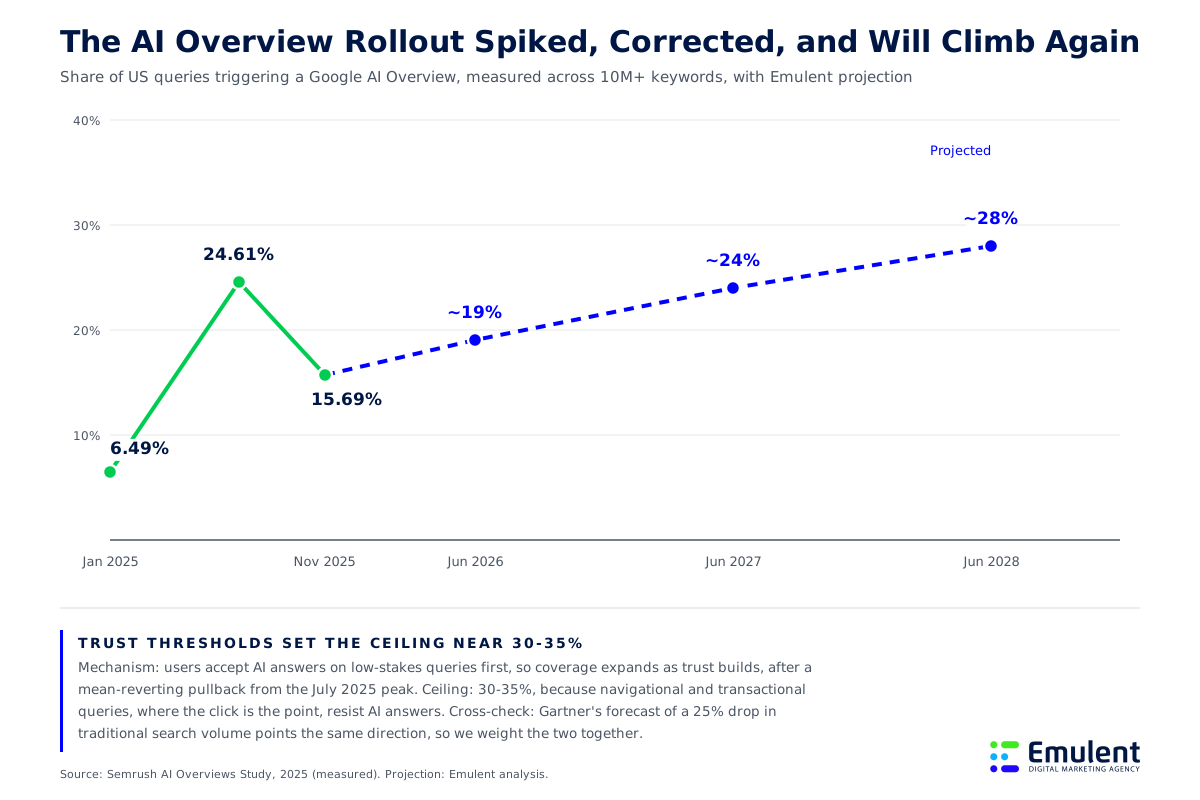
Every platform in this comparison now sells some form of AI search tracking, and the data explains the rush. The Semrush AI Overviews Study, built on more than 10 million tracked keywords, measured AI Overviews on 6.49% of US queries in January 2025, a peak of 24.61% in July 2025, and a settled 15.69% by November 2025. That spike-and-correction pattern is Google calibrating where AI answers belong, not retreating from them. Our projection has coverage climbing back toward roughly 28% by mid-2028, bending under a 30-35% ceiling, because navigational and transactional queries, where the searcher wants the click itself, resist AI answers. Gartner’s forecast that traditional search engine volume will drop 25% points the same direction from a different angle, so we weight the two together. We track the rollout itself in our running coverage of the Google AI Overviews update.
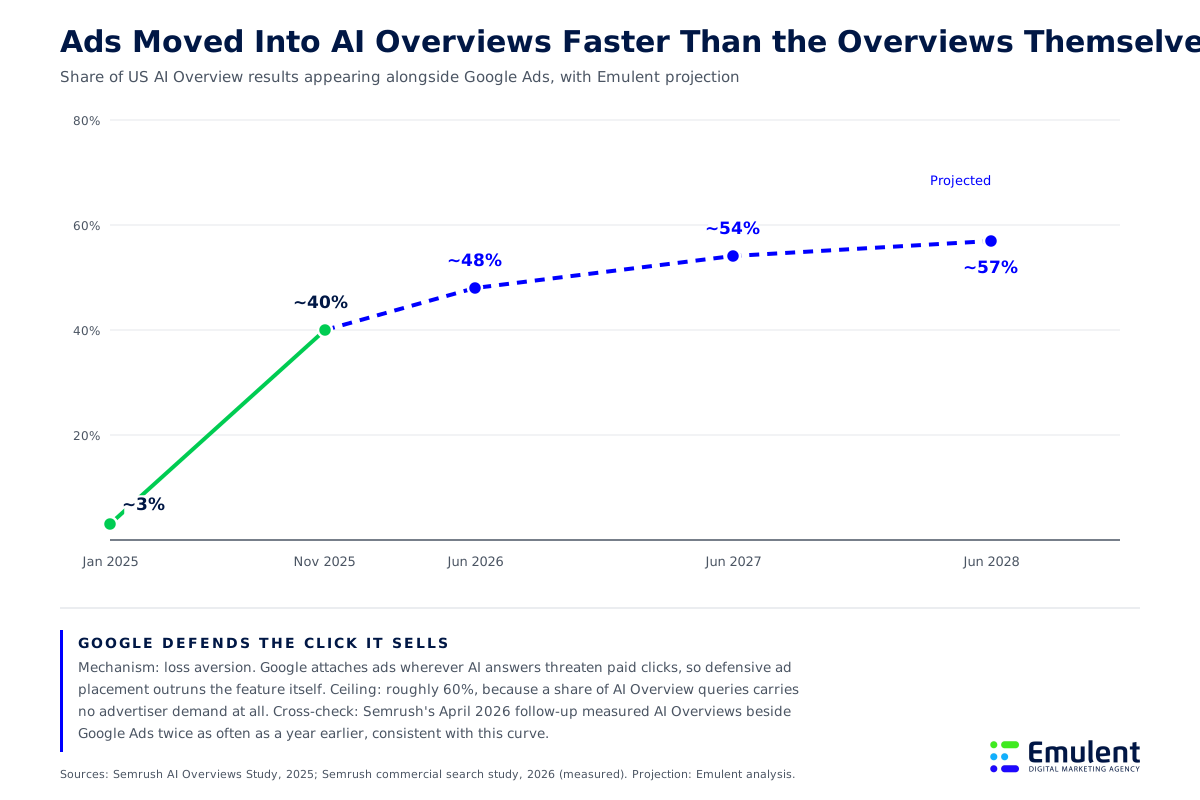
The sharper signal is where the money went. The same Semrush study measured Google Ads appearing alongside AI Overviews on roughly 3% of those results in January 2025 and roughly 40% by November 2025. Google is not letting its AI answer cannibalize the click it sells; it is wrapping ads around it, a textbook loss-aversion move where defending existing ad revenue outruns the feature rollout itself. Semrush’s April 2026 commercial search study found AI Overviews beside ads roughly twice as often as a year earlier, and commercial-intent triggers up 71% while transactional triggers fell 5%. AI answers are now a commercial surface, which means visibility inside them is a revenue question, not a curiosity.
Here is the buying implication the vendors will not volunteer: AI visibility tracking no longer justifies an enterprise contract on its own. Semrush bundles an AI Visibility Toolkit into its self-serve lineup, Ahrefs ships Brand Radar for AI mentions, and seoClarity, BrightEdge, and Conductor all track AI Overviews at their respective tiers. The capability went from differentiator to table stakes in about 18 months. What still separates the tiers is what you do with the data, which is a strategy problem. Our AI SEO work exists because being cited by an AI answer takes different content decisions than ranking under one, and search everywhere optimization exists because Google’s AI Overviews are only one of the answer engines your buyers now ask.
The Thresholds That Justify an Enterprise Contract
Buy the enterprise platform when at least one of these is true, and be honest about the count. First, your site holds roughly 500,000 or more crawlable URLs, or crawl budget and log-file analysis are live constraints on your traffic; that is Botify and Lumar territory, and nothing cheaper substitutes. Second, ten or more people across content, dev, and marketing need daily access, which flips the economics toward seoClarity’s unlimited-seat model. Third, you need changes shipped without an engineering sprint, the ClarityAutomate and Autopilot class of capability, because your backlog, not your insight, is the bottleneck. Fourth, you run SEO across many markets and languages with an executive audience that requires standardized reporting, which is the honest core of the BrightEdge and Conductor pitch.
Clear none of those bars and the self-serve tier is not the budget option, it is the correct option. A $6,000-a-year Semrush Business or a $4,400-a-year three-seat Ahrefs Standard covers rank tracking, competitive research, million-page audits, and AI visibility for the majority of mid-market sites, and it does so on monthly terms you can walk away from. That last part matters more than teams admit: the 12-month minimum on an enterprise contract does not just cost money, it removes your power to walk away for a year, and the fear of having wasted the spend keeps weak platforms installed long past the point a monthly tool would have been cut. Sunk costs keep bad software alive the same way they keep bad campaigns alive.
One caution cuts the other way. Choosing the cheaper platform is not the same as pausing the work, and teams sometimes confuse the two during a tooling change. Rankings decay while you renegotiate; we documented the mechanics in what happens if you pause SEO. If you migrate platforms, migrate the program with it intact, and keep an eye on Google algorithm updates during the transition window, because a volatility swing you cannot attribute is how tool decisions get blamed for strategy problems.
The platform question also sits downstream of a harder one: whether anyone in the building has time to act on what any of these tools reports. Software surfaces the work; it does not do the strategy, and at enterprise scale the strategy is where programs are won. That is the work our enterprise SEO services exist for, and it is why we will tell a 40,000-page client to keep their $250-a-month subscription and spend the difference on execution.
The Bottom Line
The enterprise SEO platform market runs on two prices: the one three vendors print and the one four vendors make you negotiate blind. The printed prices tell you the honest range, $6,000 to $36,000 a year, and the feature grid tells you the honest thresholds: crawl scale, shipped execution, unlimited seats, and multi-market reporting. If your program clears those bars, the contract can earn its keep, and you should walk into the negotiation with your own anchor already written down. If it does not, and for most teams reading a comparison article it does not, the self-serve tier plus a strategist who knows what to do with the data beats the five-figure platform plus an empty seat where the strategy was supposed to go. The scoreboard is customers and revenue. No platform invoice, at any tier, moves it on its own.