
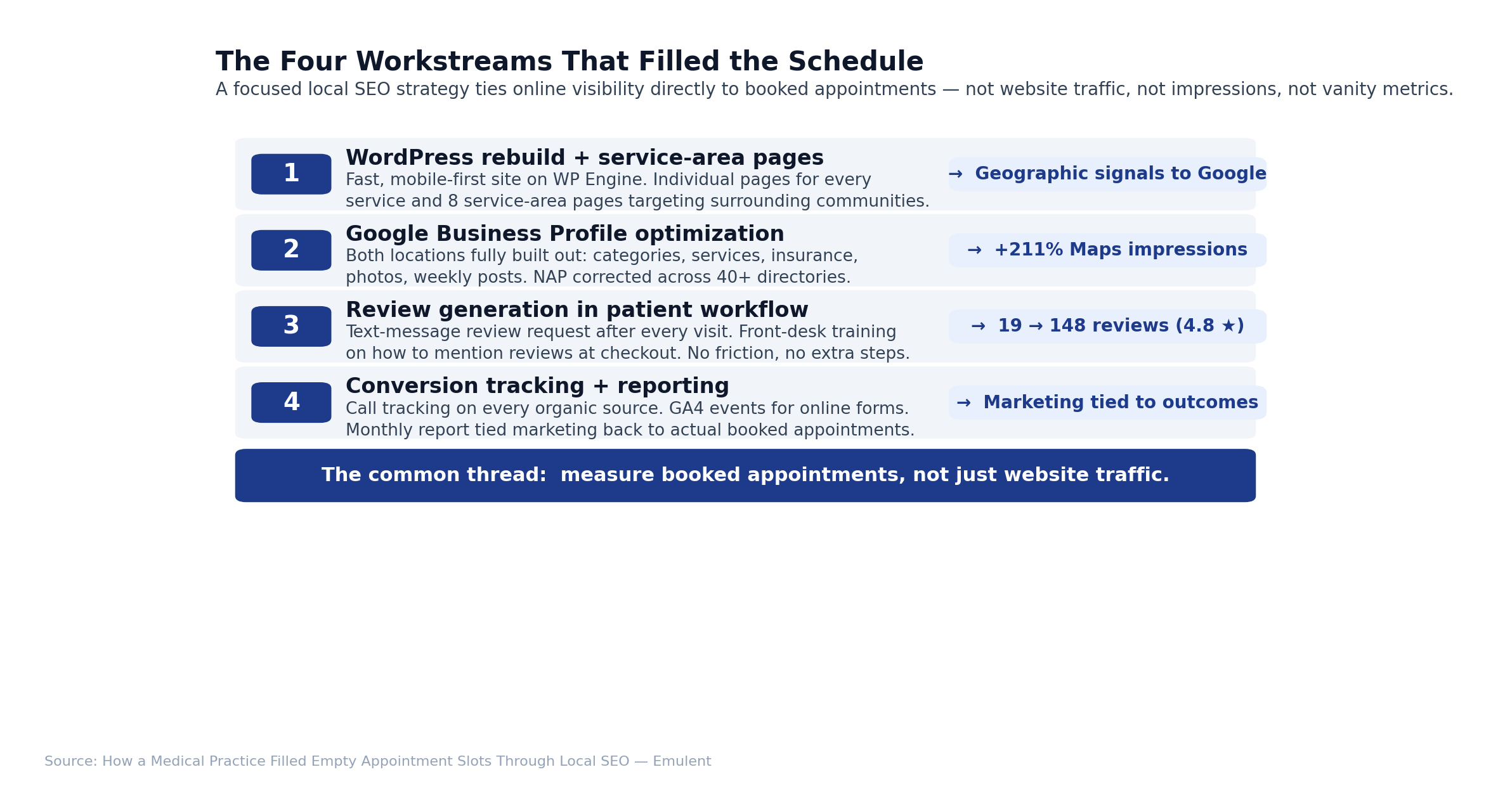
Author: Bill Ross | Reading Time: 5 minutes | Published: April 21, 2026 | Updated: April 28, 2026 A regional medical practice was losing patients to larger health systems with bigger digital budgets. Targeted local SEO changed that by putting them in front of the right patients at the right time. When a medical practice has open appointment slots day after day, revenue drops, staff hours get cut, and growth stalls. That was the reality for this client: a well-run practice with strong patient satisfaction scores, sitting at just 52% schedule utilization because new patients could not find them online. The fix was not more advertising spend. It was a focused local SEO strategy that connected the practice with patients already searching for care in their area. Most patients today start their search for a new doctor, specialist, or clinic on Google. They type something like “primary care doctor near me” or “dermatologist accepting new patients in [city].” If your practice does not appear in those results, especially in the Google Maps 3-pack, you are invisible to the people most likely to book an appointment. Larger hospital systems and franchise urgent care centers dominate these results because they consistently invest in local SEO. Smaller and mid-sized practices can compete, but only with a deliberate, well-executed strategy. Five takeaways from this client story: The client is a multi-provider medical practice in the Southeast offering primary care, preventive wellness exams, and several specialty services. They operate out of two locations and serve patients across a metro area with roughly 400,000 residents. The practice had been open for more than a decade, had built a loyal patient base through word of mouth, and had maintained high satisfaction ratings from existing patients. Their clinical reputation was strong. Their online presence was not. The core problem was straightforward: the practice was nearly invisible in local search. Their website had not been updated in several years and ran on an outdated platform with slow load times and no mobile optimization. There were no dedicated pages for the individual services they offered or the cities they served. Their Google Business Profile was claimed but only partially filled out, with fewer than 20 reviews across both locations. Meanwhile, two large hospital systems and a growing urgent care chain were spending aggressively on digital marketing in the same market. Those competitors appeared in the top three Google Maps results for nearly every relevant search term. The practice’s own data showed that new patient volume had declined 18% over the prior year, and their schedule utilization hovered around 52%, well below the 80%+ target that most practice management consultants recommend. The practice had tried running Google Ads on their own, but without proper conversion tracking, they had no idea which clicks led to booked appointments. They were spending money without any clear return. We started with a full audit of the practice’s online presence: website, Google Business Profile, citation accuracy, review profile, and competitor positioning. That audit revealed the gaps and gave us a clear priority list. The first step was to build a new website on WordPress, hosted on WP Engine for speed and reliability. We created individual pages for every service the practice offers, from annual wellness visits to specific specialty consultations. Each page was written to answer the questions patients actually ask when searching for that type of care, and each included clear calls to action to book an appointment online or call the office directly. We also built service-area pages for the eight surrounding cities and communities where the practice draws patients. These pages were not thin, keyword-stuffed filler. Each one included specific details about the community, driving directions, accepted insurance plans for that area, and the providers available at the nearest location. Google needs geographic signals to rank a practice in local results, and these pages provided exactly that. We treated each location’s Google Business Profile as a separate project. We completed every available field: business categories (primary and secondary), service lists, insurance networks, appointment links, photos of the office and staff, and a posting schedule for weekly updates. We also corrected inconsistent name, address, and phone number (NAP) data across more than 40 online directories and citation sources. Inconsistent NAP data confuses Google and weakens local rankings, so getting this right was a high priority.
“Local SEO for medical practices is not about tricking an algorithm. It is about making accurate, helpful information easy for Google to find and easy for patients to trust. When a practice shows up with a complete profile, recent reviews, and a fast website, patients notice.” — Strategy Team at Emulent Marketing
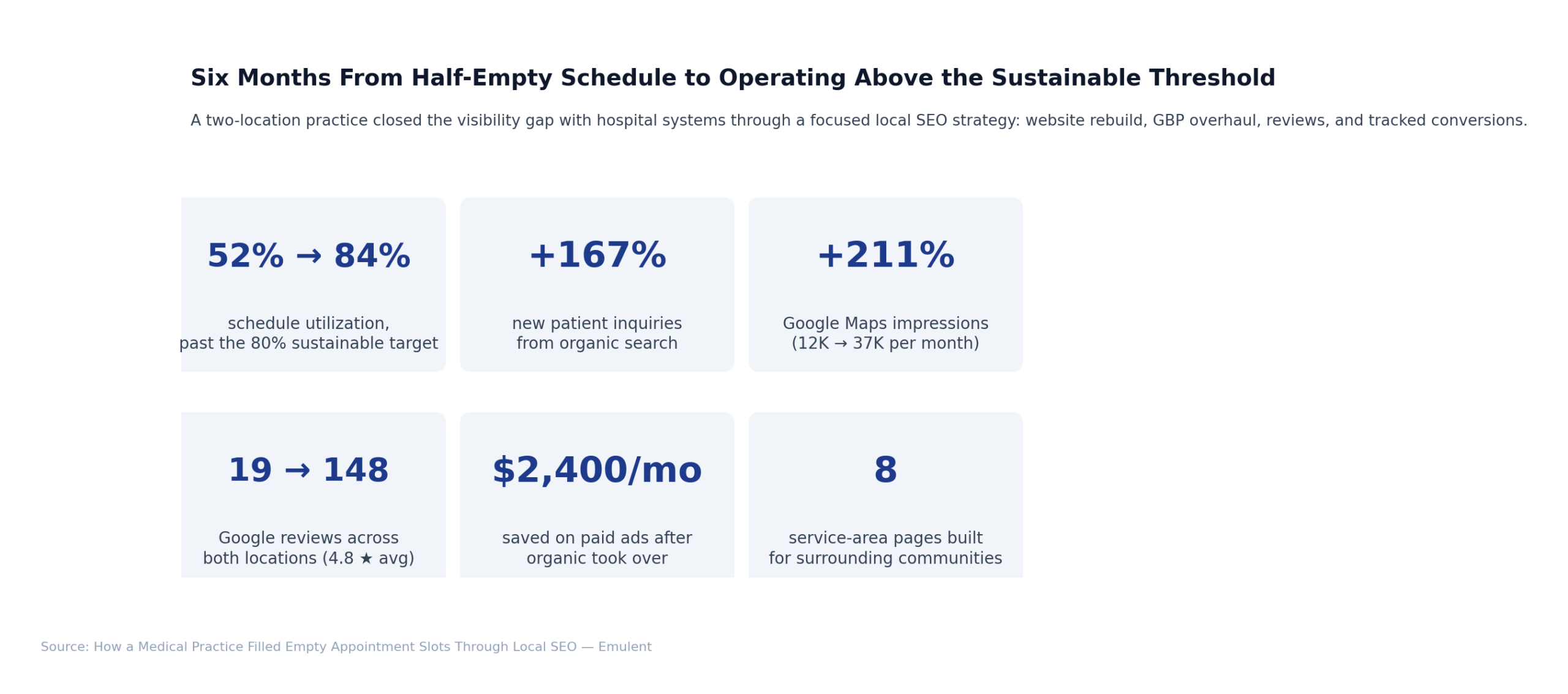
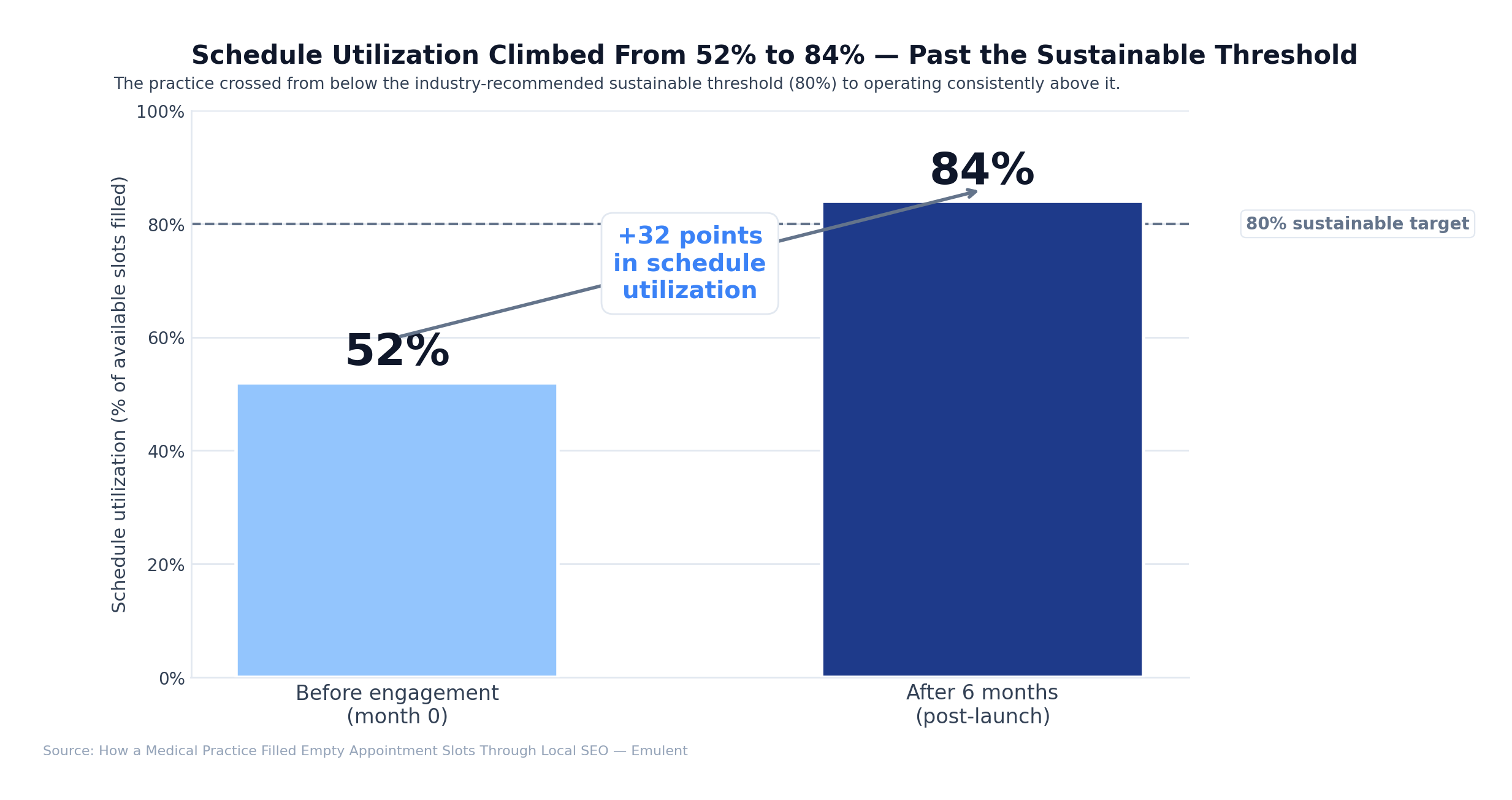
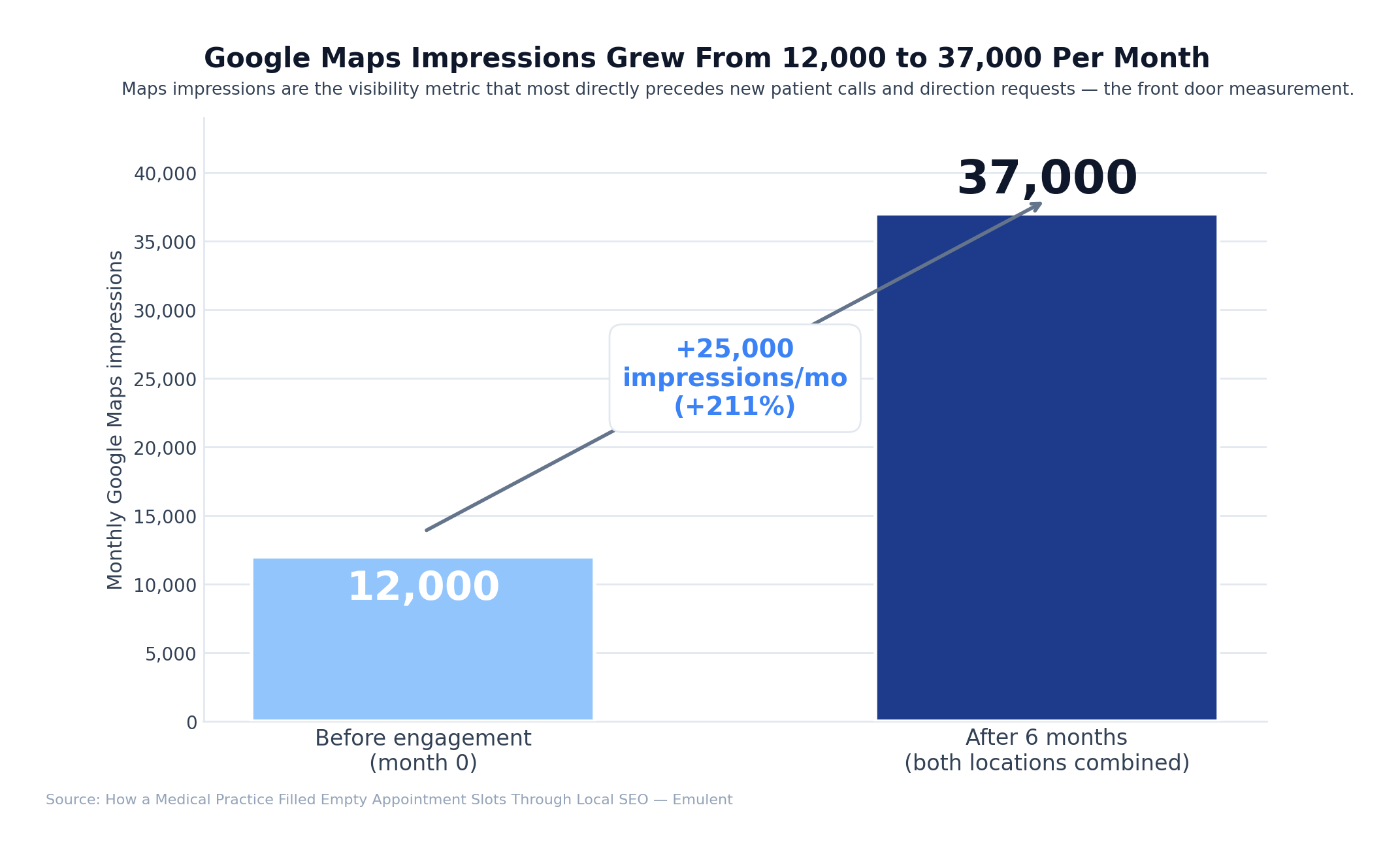
We set up a simple review request process integrated into the practice’s existing patient communication workflow. After each visit, patients received a short text message thanking them and asking for a Google review. The message is linked directly to the review form. No friction, no extra steps. The front desk staff also received a short training session on how to mention reviews at checkout without feeling awkward. We installed call tracking on the website so that every phone call from an organic search visit or a Google Business Profile click could be properly attributed. We also set up Google Analytics 4 event tracking for online appointment form submissions. Every month, the practice received a report showing not just traffic and rankings, but actual appointment-related conversions broken down by source. This meant the practice could see exactly how many new patients came from local search. Schedule utilization: 52% → 84% The practice went from just over half its available slots filled to consistently operating above 80% utilization, the threshold most practice consultants consider healthy and sustainable. Google Maps impressions: up 211% The combined Maps impressions for both locations grew from roughly 12,000 per month to over 37,000 per month within six months. New patient inquiries from organic search: up 167% Tracked phone calls and form submissions from organic and local search sources nearly tripled compared to the same period the prior year. Google reviews: 19 → 148 Across both locations, the practice went from 19 total Google reviews to 148, with an average rating of 4.8 stars. This volume of recent, positive reviews gave the practice a visible trust advantage over nearby competitors. Cost savings on paid ads: $2,400/month Because organic visibility now drove consistent new patient volume, the practice was able to pause its poorly performing Google Ads campaigns, saving $2,400 per month that had been producing little measurable return. The challenges this practice faced are common across healthcare. Many medical offices rely on physician referrals and word of mouth and underinvest in their digital presence. That approach worked ten years ago. Today, patients research providers online before calling, and they often choose whoever appears first with strong reviews and a professional-looking website. A few patterns we see repeatedly with medical practices: Common gaps that cost practices new patients: Most practices have a Google Business Profile, but few keep it fully up to date. Fewer still have service-area pages on their websites, and almost none track whether their online visibility actually results in booked appointments. Closing these gaps does not require a massive budget. It requires consistent execution and a clear plan. Another frequent mistake is treating the website as a digital brochure that gets built once and forgotten. Search engines favor websites that regularly add new, relevant content. For a medical practice, that can be as simple as adding a new FAQ page each month addressing a common patient question, or updating insurance and provider information as it changes.
“The practices that win in local search are not always the biggest or the ones with the most locations. They are the ones that treat their online presence with the same attention they give patient care. Accurate information, timely responses, and a willingness to ask for feedback go a long way.” — Strategy Team at Emulent Marketing
One more point worth stressing: do not run paid ads without conversion tracking in place. We see this frequently with medical practices. They spend $1,500 to $3,000 per month on Google Ads, but no one has set up call-tracking or form-submission goals, so there is no way to know whether that money is generating patients or just clicks. Fix the tracking first, then decide whether paid ads make sense alongside your organic strategy. If your practice is struggling with empty schedules and low visibility in local search, the path forward starts with understanding where you stand today and identifying the gaps. We work with medical practices and healthcare businesses to build local SEO strategies that produce measurable patient growth, not just website traffic. Contact the Emulent Team to talk about how local SEO can work for your practice. How We Helped a Medical Practice Go from 52% to 84% Schedule Utilization Using Local SEO

Why Local Search Visibility Matters for Medical Practice Growth
Who Was the Client?
What Was Holding the Practice Back?
How Did We Build a Local SEO Strategy That Filled Appointment Slots?
Rebuilding the Website on WordPress
Google Business Profile Optimization
Review Generation That Felt Natural
Conversion Tracking and Reporting
What Were the Results After Six Months?
What Can Other Medical Practices Learn from This?
Ready to Fill More Appointment Slots?
- Our Story
- What We Do
Website Optimization
What's Your Situation
- What We’ve Done
- Resource Center
- Let’s Talk!