Author: Bill Ross | Reading Time: 5 minutes | Published: March 7, 2026 | Updated: April 28, 2026 A community arts organization with no internal tech team found a WordPress support partner that kept their site secure, up to date, and true to their brand every single month. Running a cultural center means juggling programming, fundraising, community engagement, and a dozen other priorities. The website should be one less thing to worry about. For this Chicago-based arts organization, the opposite was true. Their WordPress site had become a source of stress, not strength. Outdated plugins, stale content, and growing security risks left the team spending hours on problems they were never hired to solve. That changed when they brought Emulent on as their ongoing WordPress support partner. For cultural organizations and nonprofits, the website often serves as the first (and sometimes only) point of contact with the community. It is where visitors check event schedules, buy tickets, learn about programs, and decide whether to donate. When that site loads slowly, shows outdated information, or goes down entirely during a fundraising push, the damage goes beyond a technical hiccup. It erodes trust with the exact audience the organization works hardest to serve. Many small organizations treat their website like a one-time project: build it, launch it, and move on. But WordPress is a living platform. Plugins need updates. PHP versions change. Security vulnerabilities appear weekly. Without someone actively maintaining the site, small issues become big ones, and the organization only finds out when something breaks publicly. Five takeaways from this client’s experience with ongoing WordPress support: This organization is a mid-sized cultural center in Chicago that hosts visual art exhibitions, live performances, youth workshops, and community gatherings. Their programming reflects the neighborhoods they serve, and their audience includes families, local artists, school groups, and donors ranging from individual supporters to corporate sponsors. They operate with a lean staff of fewer than fifteen people, and none of those roles focus on web development or IT. Their WordPress site was originally built by a freelance developer several years earlier. The design was solid at launch, but the developer had moved on, and no one on staff had the skills or time to take over the technical side. The site still looked decent on the surface, but under the hood, things were falling apart. The problems did not arrive all at once. They built up slowly, then started compounding. Plugin update notifications piled up for months. A contact form stopped working, and the team did not notice until a potential sponsor mentioned it. Page load times crept past six seconds. The SSL certificate lapsed for two days during a grant application period, triggering browser security warnings for anyone trying to visit the site. Staff members tried to make content updates themselves, but without training on WordPress or their theme’s page builder, simple changes (swapping a banner image, editing an event listing) took hours and sometimes broke the layout entirely. The executive director described the situation this way: every time they touched the website, they held their breath. The real cost was not just time. The organization ran a year-end giving campaign that drove most of its online donations, and a site outage during that window in a prior year resulted in lost contributions they could not recover. That incident made website reliability a board-level concern.
“The first step with any support engagement is to stop guessing. You audit everything, document what you find, and then build a prioritized plan. Skipping that step means you are fixing symptoms instead of causes.” – Strategy Team at Emulent Marketing
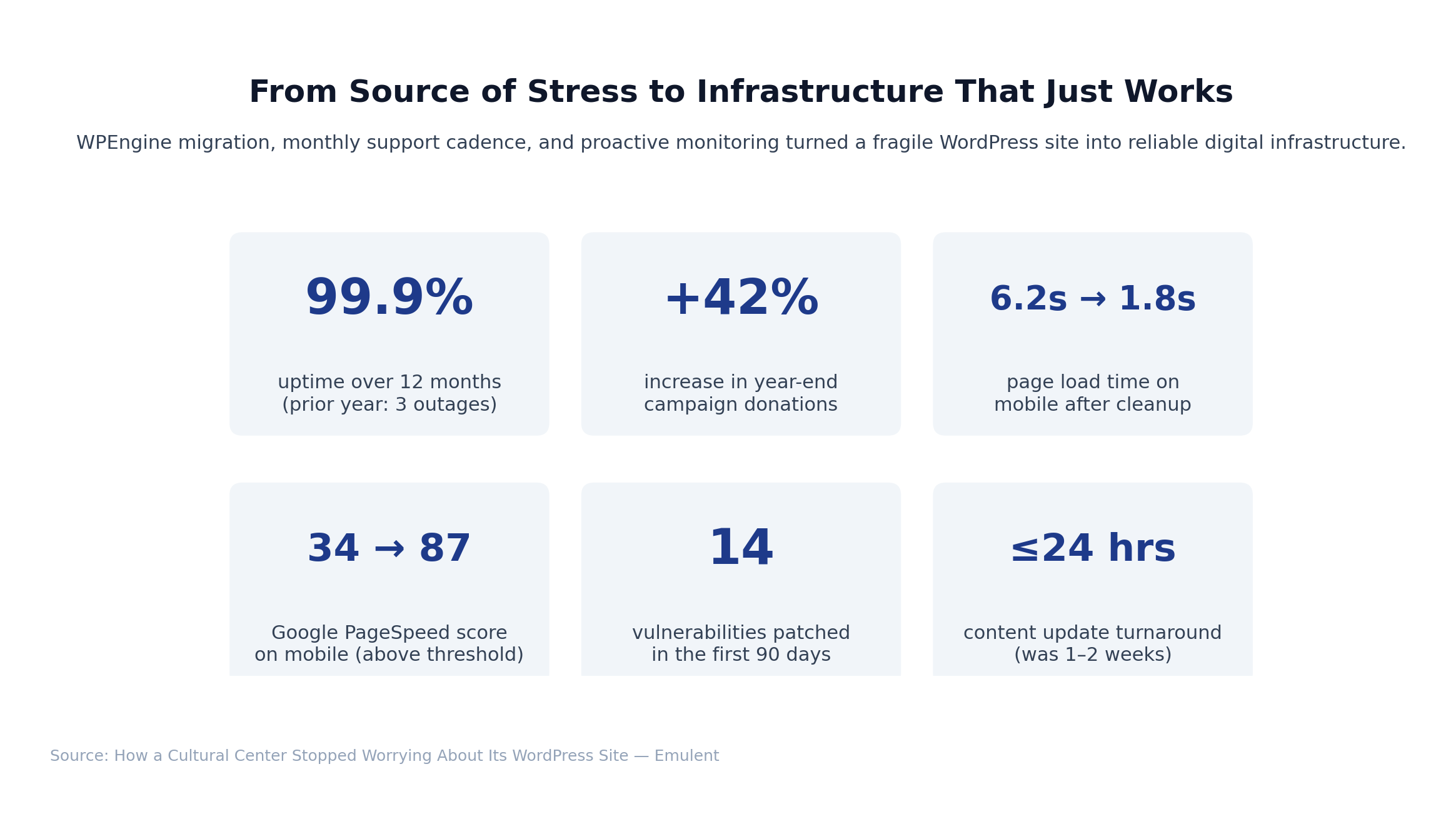
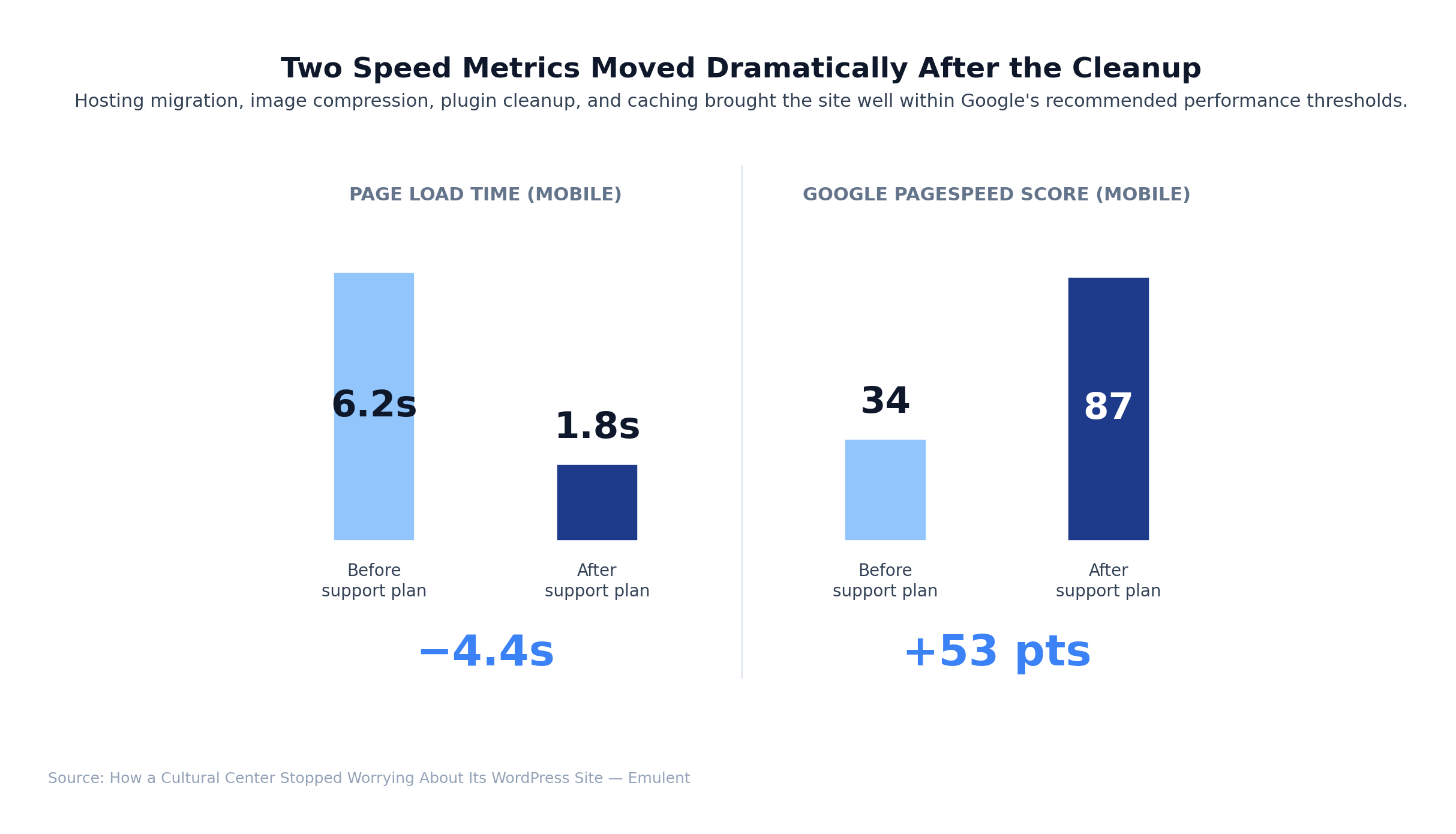
After the audit, we moved the site to WPEngine, a managed WordPress hosting platform built for performance and security. WPEngine provides automatic daily backups, server-level caching, built-in CDN support, and proactive threat detection. That single move eliminated several of the organization’s biggest vulnerabilities overnight. From there, we established a monthly support plan that included core and plugin updates tested in a staging environment before going live, uptime monitoring with real-time alerts, monthly speed and security scans, content updates requested by staff through a simple shared task list, and quarterly performance reviews covering analytics data from Google Analytics and Google Search Console. We also trained two staff members on basic content tasks (publishing blog posts, adding events, uploading images) so they could handle day-to-day updates without worrying about breaking something structural. For anything beyond those basics, our team handled it directly. Within the first six months of the engagement, the organization saw measurable improvements across the board. After the WPEngine migration and our monitoring setup, the site experienced zero unplanned outages during the busiest season of the year, including their year-end giving campaign. The prior year had seen [three] outages in the same period. Hosting migration, image compression, plugin cleanup, and caching brought the site well within Google’s recommended performance thresholds. Mobile speed scores improved from [34] to [87] on Google PageSpeed Insights. With a reliable, fast site and a working donation form, the year-end campaign outperformed the previous year by a significant margin. Staff attributed part of that lift to donor confidence: no one encountered a broken page or security warning this time. Staff requests for content changes (new events, program updates, homepage banner swaps) were completed within one business day. Previously, these updates had taken [one to two weeks] or did not happen at all. The initial audit uncovered outdated plugins with known security flaws, an abandoned theme still installed on the server, and admin accounts with weak passwords. All were resolved before any incident occurred. This story is not unique to one cultural center in Chicago. Across the nonprofit and arts sector, organizations share a common pattern: they invest in a website build, launch it, and then watch it slowly degrade because there is no plan (or budget) for ongoing care.
“Cultural organizations put enormous care into their programming and their physical spaces. The website deserves that same care. It is the digital front door, and for a growing share of your audience, it is the only door.” – Strategy Team at Emulent Marketing
Organizations that get this right tend to share a few habits. They treat website hosting as a strategic decision, not a commodity purchase. They keep plugins to a minimum and update them on a schedule. They assign one person (internal or external) as the owner of site health. And they review analytics quarterly to understand how the site is actually performing, not just how it looks. If your organization is spending too much time putting out website fires, or worse, ignoring problems because no one on staff knows how to fix them, it may be time to bring in a dedicated WordPress support partner. The Emulent team works with organizations of all sizes to keep WordPress sites secure, fast, and aligned with the brand they have worked so hard to build. Contact the Emulent Team to talk about WordPress support and maintenance for your organization. How Providing Reliable Website Support Helped a Chicago Cultural Organization Stay Online and On-Brand

 Why Reliable Website Support Matters More Than Most Organizations Realize
Who Is This Client?
What Was Going Wrong?
How Did Emulent Approach the Problem?
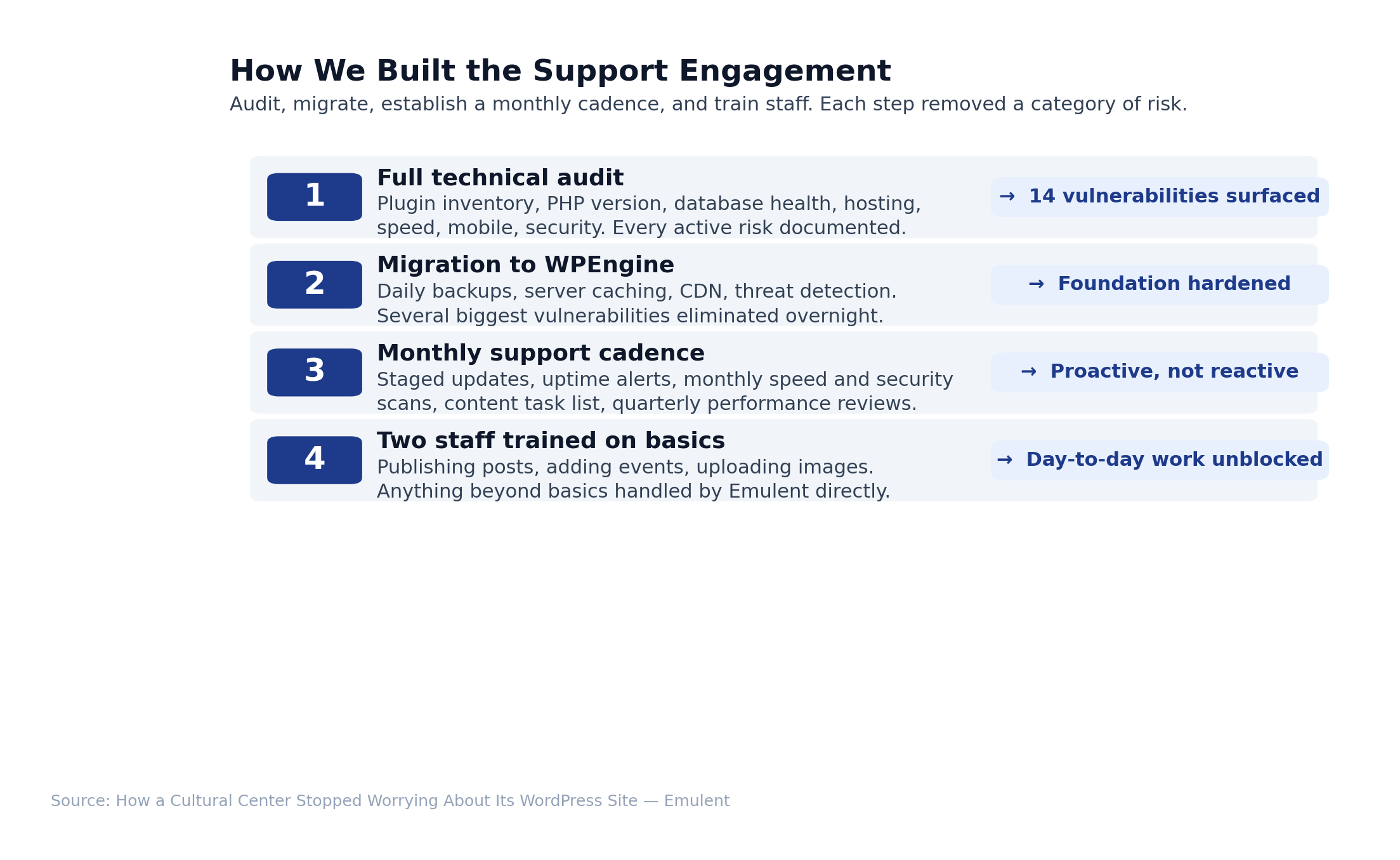 We started with a full technical audit of the WordPress installation. That audit covered plugin inventory and compatibility, PHP version, database health, hosting environment, page speed, mobile responsiveness, and security posture. The goal was to understand every active risk before making changes.
What Results Did the Support Plan Produce?
 99.9% Uptime Over 12 Months
Page Load Time Dropped from [6.2] Seconds to [1.8] Seconds
42% Increase in Online Donations During Year-End Campaign
Content Update Turnaround: [24] Hours or Less
14 Vulnerabilities Identified and Patched in the First 90 Days
What Can Other Cultural Organizations and Nonprofits Learn from This?
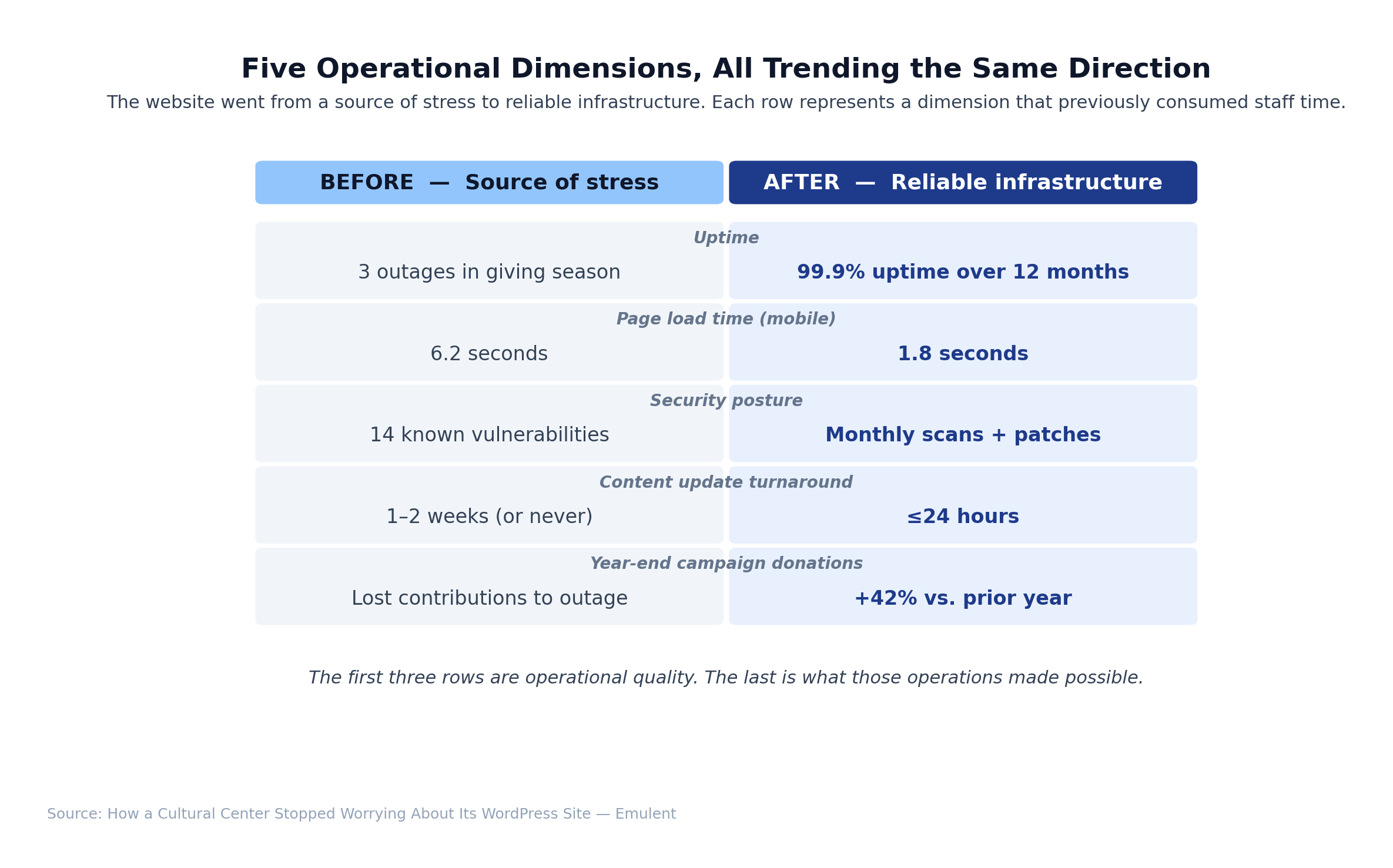 The lesson is straightforward. A website is infrastructure, not a project. It needs regular attention, just like a physical building needs maintenance. The difference is that a leaky roof is visible. A vulnerable plugin or a broken contact form can go unnoticed for months, quietly costing the organization donors, visitors, and credibility.
Ready to Stop Worrying About Your Website?
- Our Story
- What We Do
Website Optimization
What's Your Situation
- What We’ve Done
- Resource Center
- Let’s Talk!