
Author: Bill Ross | Reading Time: 5 minutes | Published: April 15, 2026 | Updated: April 29, 2026 When a well-run childcare center struggles to fill spots, the problem is rarely the care itself. It is almost always a visibility problem. This is the story of how we helped one center go from buried in local search to fully enrolled, with a waitlist forming within six months. Parents searching for childcare today start on Google. They type “daycare near me” or “preschool in [city name],” scan the top three results in the Google Maps local pack, and often decide before scrolling any further. If your center does not appear in those results, you are invisible to the families actively looking for what you offer. No flyer, yard sign, or word-of-mouth recommendation can compete with a parent who has already chosen a competitor because your center never showed up. Five takeaways from this client story worth remembering: The client is a family-owned childcare center in the Raleigh, N,C metro area that has served the community for over a decade. They offer infant care, toddler programs, and preschool, with a curriculum that blends structured learning and creative play. Their staff retention is strong, their parent satisfaction is high, and their facility is clean and well-maintained. By every measure that matters inside the building, they were doing things right. The challenge was that almost nobody knew how to find them online. When we first connected with this client, enrollment had plateaued at around 70% of capacity. Open spots sat unfilled month after month, and the director was relying almost entirely on parent referrals and a small Facebook following to attract new families. Their website, built years earlier on a basic template, had no location-specific content, no clear calls to action, and loaded slowly on mobile devices. Their Google Business Profile was incomplete. Hours were outdated, photos were sparse, and they had fewer than 20 reviews total, many of which were over two years old. In the local pack for searches like “daycare near me” and “childcare in [their city],” they were nowhere to be found. Competing centers with stronger digital footprints filled those top spots instead. To make things worse, their business name, address, and phone number (known as NAP data) were listed inconsistently across online directories. Some listings showed an old phone number. Others had a slightly different business name. That kind of inconsistency signals unreliability to Google’s algorithm, pushing the center further down in local results. The center had a great reputation among parents who already knew them. The problem was that families searching for childcare in the area never got the chance to learn about them. The first step was to replace the outdated website with a WordPress site optimized for both parents and search engines. We created dedicated pages for each program (infant care, toddler, preschool) and built service-area pages targeting the surrounding cities and neighborhoods where prospective families live. Each page included details about the program, enrollment information, and a clear call to action to schedule a tour. We also added structured data markup (schema) to help Google understand the business type, location, operating hours, and age ranges served. Page speed was a priority, so we compressed images, implemented caching, and chose a hosting environment that kept mobile load times under 2 seconds. A half-filled Google Business Profile is a missed opportunity. We updated every field: accurate hours, a thorough business description with natural keyword usage, high-quality interior and exterior photos, and service categories that matched what parents search for. We added posts to the profile on a regular schedule, highlighting enrollment openings, seasonal programs, and parent testimonials.
“A Google Business Profile is not a ‘set it and forget it’ listing. It is a living storefront that Google rewards when you keep it active, accurate, and full of recent parent feedback.” – Strategy Team at Emulent Marketing
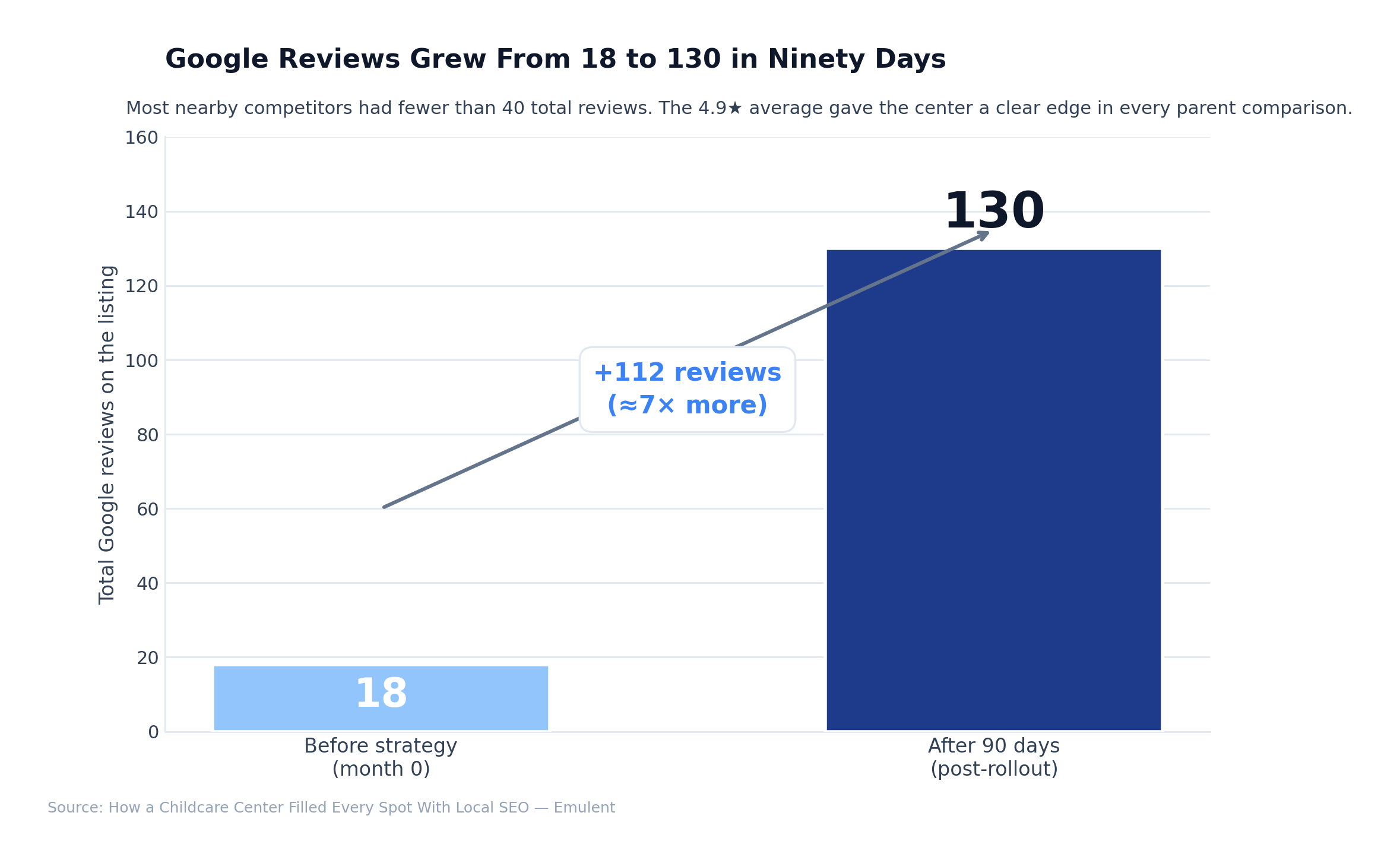
We audited over 60 online directories, including Yelp, Facebook, Apple Maps, Care.com, and Winnie, and corrected every instance of mismatched NAP data. Consistent citations across the web tell Google that your business information is trustworthy, which directly affects how you rank in local search results. Online reviews are among the top ranking factors in local search, and they are the first thing parents read when comparing childcare options. We set up a simple, low-friction review request process for the front desk staff to use during pickup. Parents received a short text or email with a direct link to leave a Google review – no pressure, no awkward asks, just a quick prompt sent at the right moment. We developed blog posts and resource pages that spoke to the specific concerns parents in the Raleigh area care about: choosing the right childcare for a toddler, understanding NC licensing requirements, and comparing preschool curricula. This content served two purposes. It gave parents useful information that positioned the center as a trustworthy resource and built topical authority with Google for childcare-related searches in the local market. The center went from 70% capacity to full enrollment, with a waitlist forming by month seven. Every new spot that opened filled within two weeks. Monthly impressions on Google Maps grew from roughly 1,800 to over 5,400 within five months, placing the center consistently in the local pack for high-intent searches. The center’s review count jumped from 18 to 130, with an average rating of 4.9 stars. That volume and recency gave them a clear edge over nearby competitors, most of whom had fewer than 40 reviews. Organic sessions grew steadily each month, driven by the new service-area pages and locally focused content. The tour request form saw a 91% increase in submissions compared to the same period the year before. The childcare industry is competitive in growing metro areas, and most independent centers are up against large franchise operations with dedicated marketing budgets. The good news is that local search rewards relevance and proximity over spending power. A single-location center that invests in its Google Business Profile, earns consistent reviews, and builds a fast, informative website can outperform a franchise in its own neighborhood. One pattern we see across the childcare industry is that owners and directors invest heavily in their programs, staff, and facilities but treat their online presence as an afterthought. That creates a gap between the quality of care inside the building and the impression a searching parent forms online. Closing that gap does not require a massive budget. It requires consistency, attention, and a clear plan.
“Parents trust what other parents say. A childcare center with 100 recent five-star reviews will almost always win the enrollment over a center with five reviews, regardless of which one actually provides better care. That is why reputation management belongs at the center of every childcare marketing strategy.” – Strategy Team at Emulent Marketing
If your center has open spots and a strong program but struggles to reach new families, the issue is likely not your care. It is your visibility. And visibility is a solvable problem. If your childcare center isn’t showing up where parents search, we can help change that. Contact the Emulent Team to discuss how a local SEO strategy tailored to your market, your families, and your programs can put your center in front of the parents who need you most. How We Grew Enrollment 45% for a Childcare Center by Owning the Local Search Experience

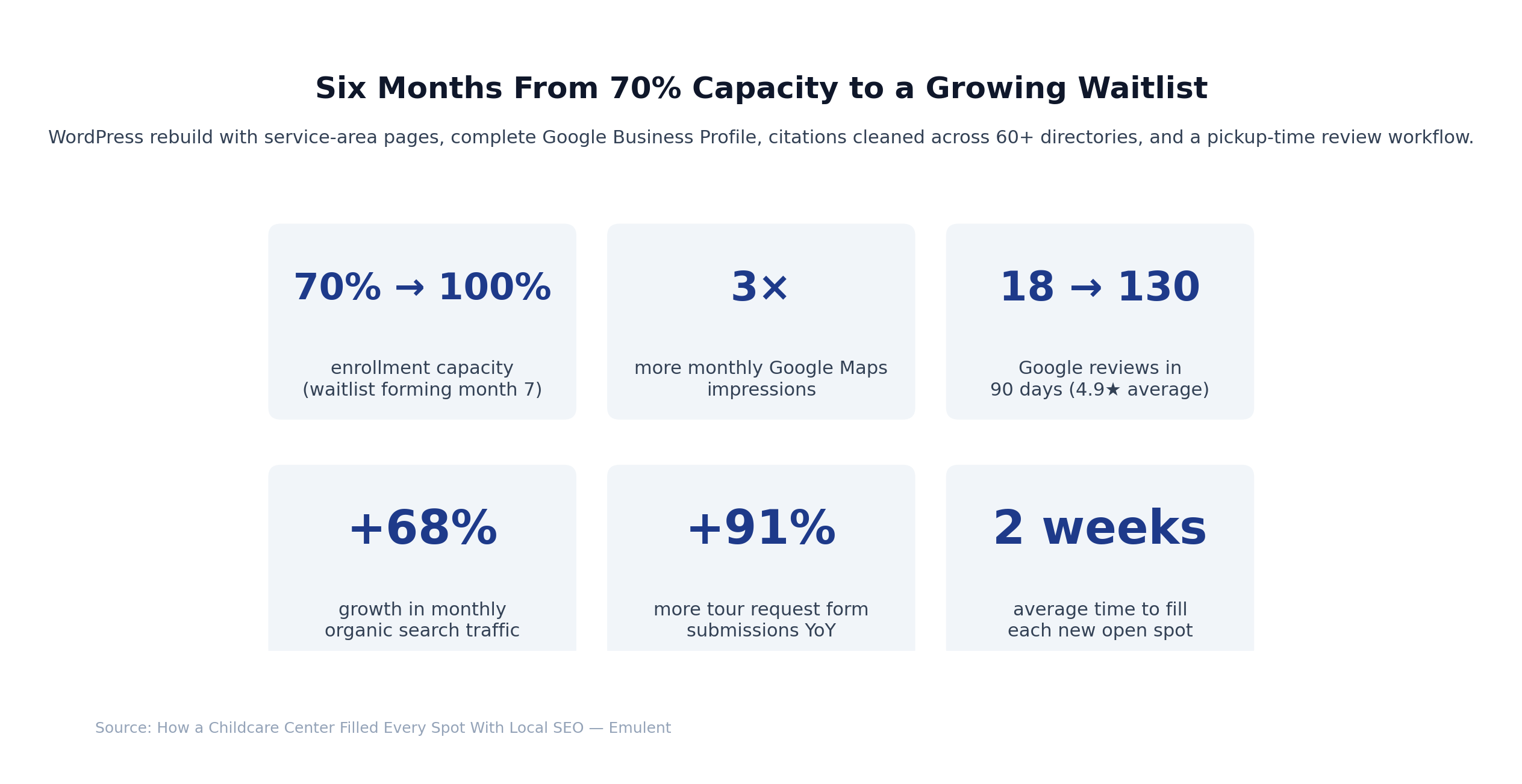 That reality makes local SEO one of the highest-return investments a childcare business can make. It is not about tricks or technical gimmicks. It is about making sure Google understands who you are, where you are, and why you are the right choice for families nearby.
Who Was the Client?
What Was Holding This Center Back from Full Enrollment?
How Did We Build a Local Search Strategy That Filled Every Spot?
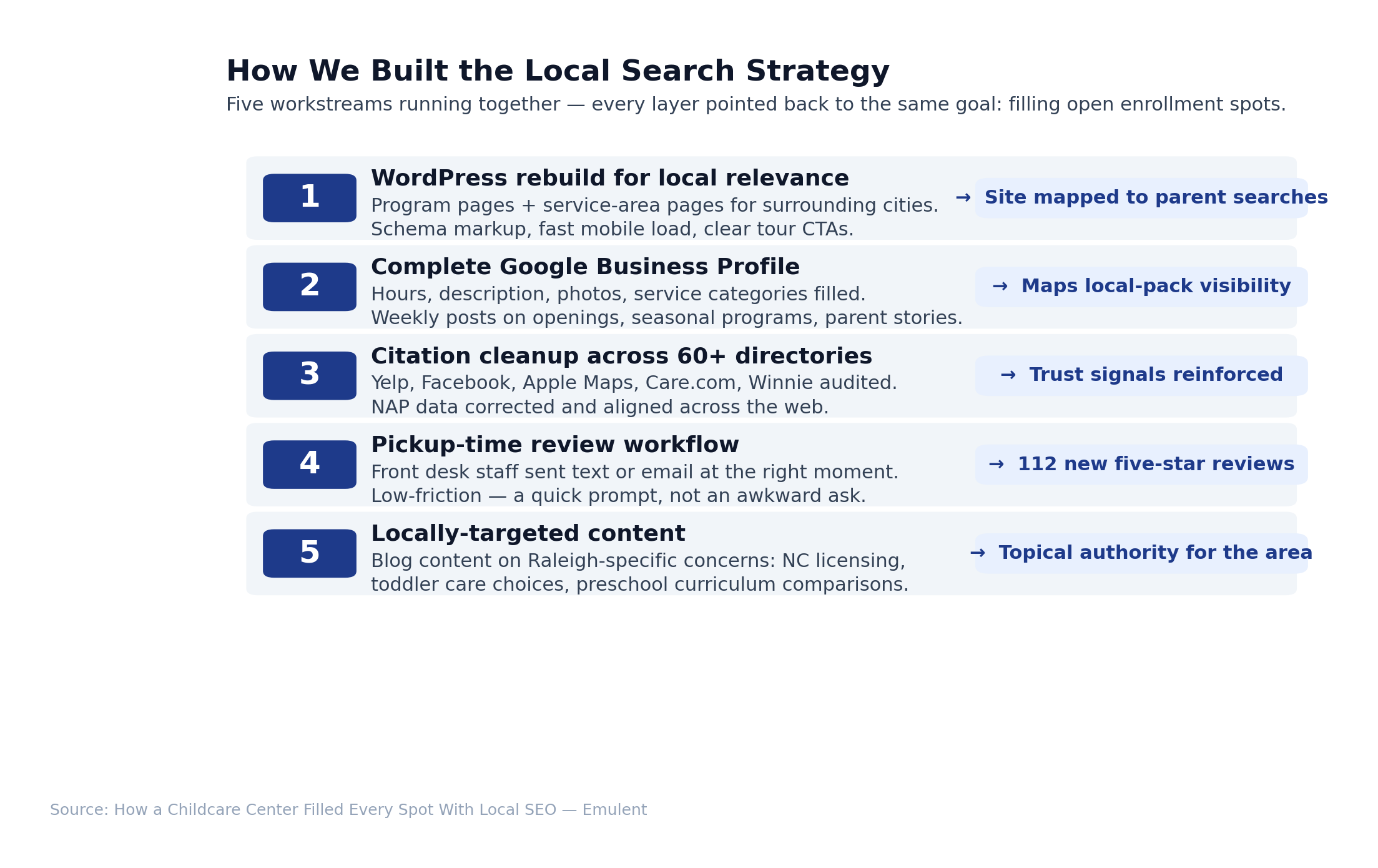 We started with the foundation: a complete audit of the center’s local search presence. That meant reviewing their website, Google Business Profile, directory listings, review history, and competitor positioning. The audit revealed clear gaps and provided us with a prioritized plan.
Rebuilding the Website on WordPress for Speed and Local Relevance
Claiming and Completing the Google Business Profile
Fixing Citation Inconsistencies Across Directories
Launching a Review Generation Campaign
Creating Locally Targeted Content
What Were the Measurable Results?
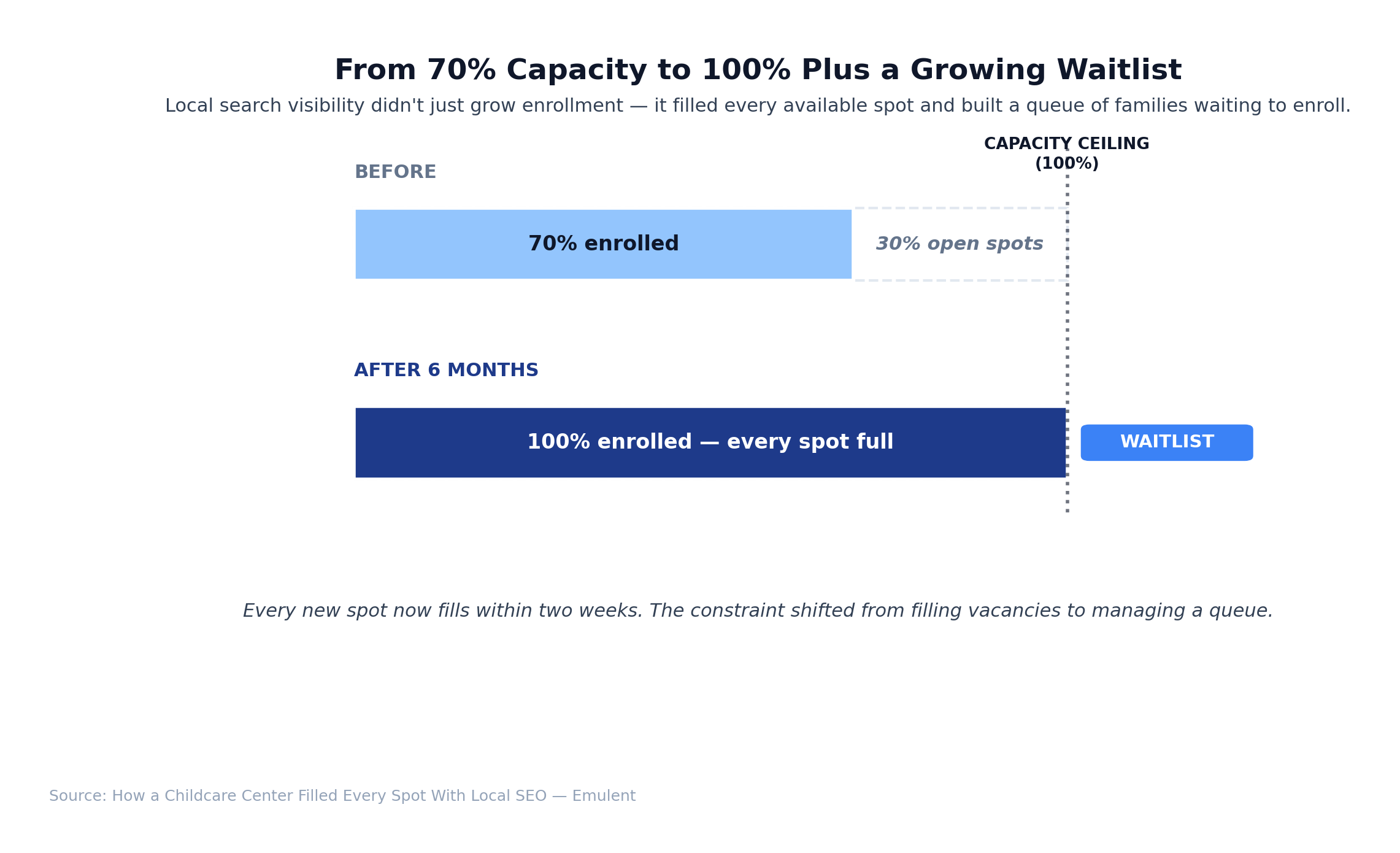
 45% Enrollment Increase in Six Months
3x More Google Maps Impressions
112 New Google Reviews in 90 Days
68% Increase in Website Traffic from Organic Search
What Can Other Childcare Businesses Learn from This?
Ready to Fill Every Spot in Your Center?
- Our Story
- What We Do
Website Optimization
What's Your Situation
- What We’ve Done
- Resource Center
- Let’s Talk!