
Higher education marketing faces structural change between 2026 and 2028 that previous downturns did not contain. The U.S. high school graduating class peaked in 2025, AI-assisted search has moved from novelty to default behavior, paid-channel costs keep climbing, and the strategic playbook that worked from 2015 through 2022 no longer matches the math. We pulled together ten data points that every higher-ed CMO, enrollment director, and agency partner should review before finalizing a 2026 plan.
Key takeaways from this higher education marketing projections report
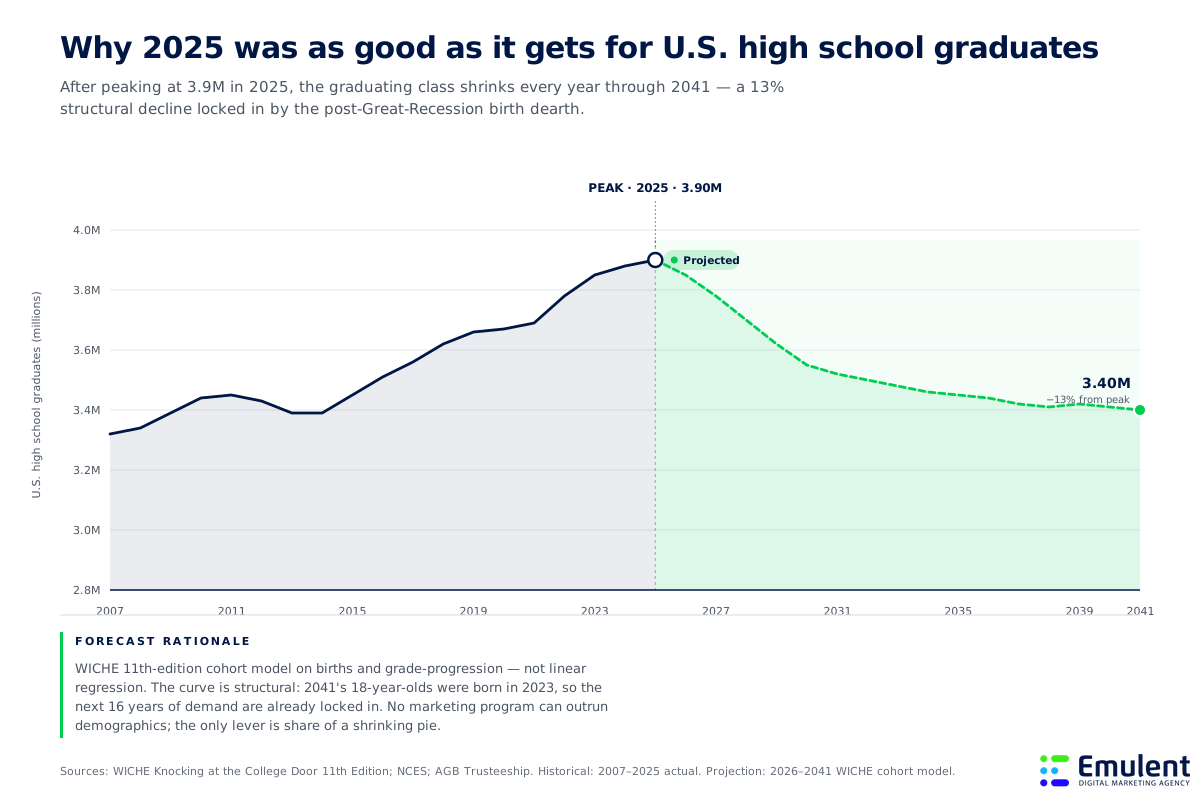
- The traditional college pool shrinks every year from 2026 forward, dropping roughly 13% by 2041 based on WICHE cohort projections.
- AI-assisted college search doubled in ten months, rising from 26% to 46% of high schoolers and tracking toward 80% adoption by 2028.
- Cost per inquiry climbs about 30% across paid channels through 2028 as smaller pools meet AI-eroded click volume.
- Adult learners reach near parity with traditional enrollment by 2028, supplying the offset for declining 18-22 year-old volume.
- Selective public yield has fallen 14 points since 2019, putting post-admit marketing ahead of acquisition for ROI.
- Fewer than half of higher-ed marketers track CPI or CPE, which is the measurement gap that decides which institutions optimize through the cost increases and which stay blind.
Why was 2025 the last year of growth in the traditional college pool?
The math is locked. The 18-year-olds of 2030 were born in 2012, and the 18-year-olds of 2041 were born in 2023. WICHE’s 11th edition of Knocking at the College Door places the 2025 graduating class at about 3.9 million, the high-water mark for this generation. From 2026 forward, the graduating class shrinks each year through 2041, ending roughly 13% smaller than the 2025 peak.
 Regional pressure is uneven. California loses about 16% of its college-age population, New York around 14%, and the Northeast and Midwest face the steepest reductions. The Southeast and parts of the Mountain West see smaller declines or modest growth.
“Demographic math does not respond to marketing. The institutions that come through 2028 strongest are the ones that accepted by 2025 that they were competing for share of a shrinking pool, not chasing volume in a growing one.” Emulent Strategy TeamThree priorities to put into the 2026 plan
- Audit geographic concentration. If 60% of enrollment comes from regions losing graduates fastest, that exposure shows up in 2027 and 2028 even if 2026 holds.
- Build multi-year enrollment forecasts as a band, not a point. The demographic floor is fixed; recruitment performance varies inside that floor.
- Pull adult and graduate enrollment forward in the plan rather than treating them as separate small initiatives.
The bigger shift sits inside how those remaining prospects research schools, which is where AI has rewritten behavior in under a year.
How is AI-assisted college search reshaping the funnel?
In spring 2025, EAB research showed 26% of high school students using AI tools as part of their college search. By fall 2025, that figure had jumped to 46%. A doubling in two seasons is not a survey artifact. It is a textbook diffusion curve, with the metric past the 16% innovator threshold and moving through the early-majority phase.
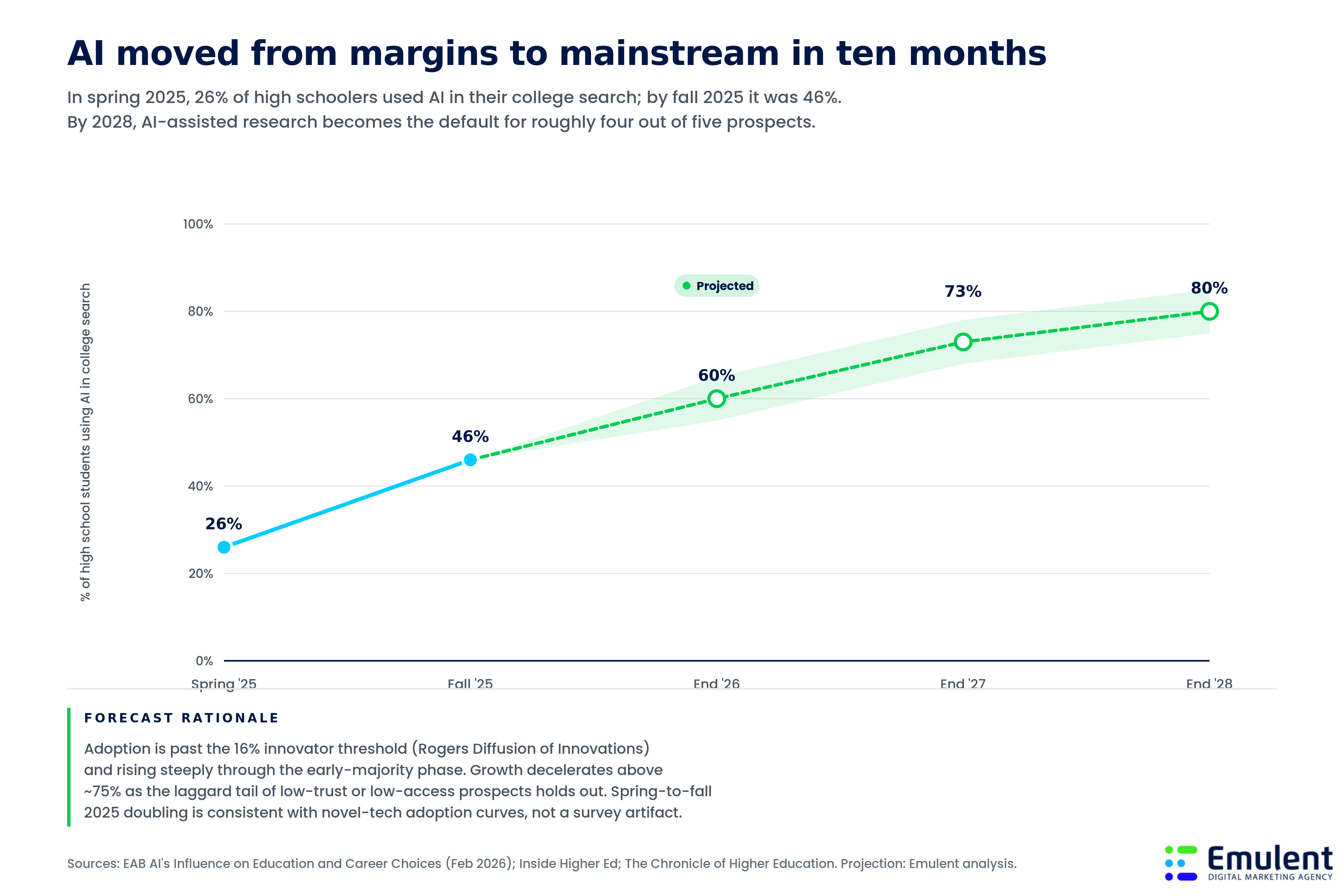
Projecting forward with diffusion theory rather than linear regression, AI-assisted college search becomes the default for roughly four out of five prospects by 2028. Growth slows past 75% as a laggard tail of low-trust or low-access users holds out, but the central path is clear. The answers ChatGPT, Claude, Gemini, and Perplexity give about your programs are now part of your funnel whether or not your team is optimizing for them. That is why generative engine optimization, sometimes called search everywhere optimization, stops being a future concern and becomes a 2026 work-stream.
“By 2028 the answer ChatGPT gives a high schooler about your program matters more than the answer your admissions team gives. That is the part of the funnel most institutions still treat as someone else’s problem.” Emulent Strategy Team
AI changes who asks the question. The platforms themselves changed how the answer arrives.
What is breaking the click economy for higher-ed SEO?
For two decades, the foundation of higher-ed SEO was the assumption that ranking well in Google sent prospects to your site. That assumption has broken. Similarweb’s 2025 zero-click study put the share of Google searches ending without a single click at roughly 65%. BrightEdge’s February 2026 AI Overview tracker showed AI Overviews appearing on 48% of all searches and 83% of education-sector searches.
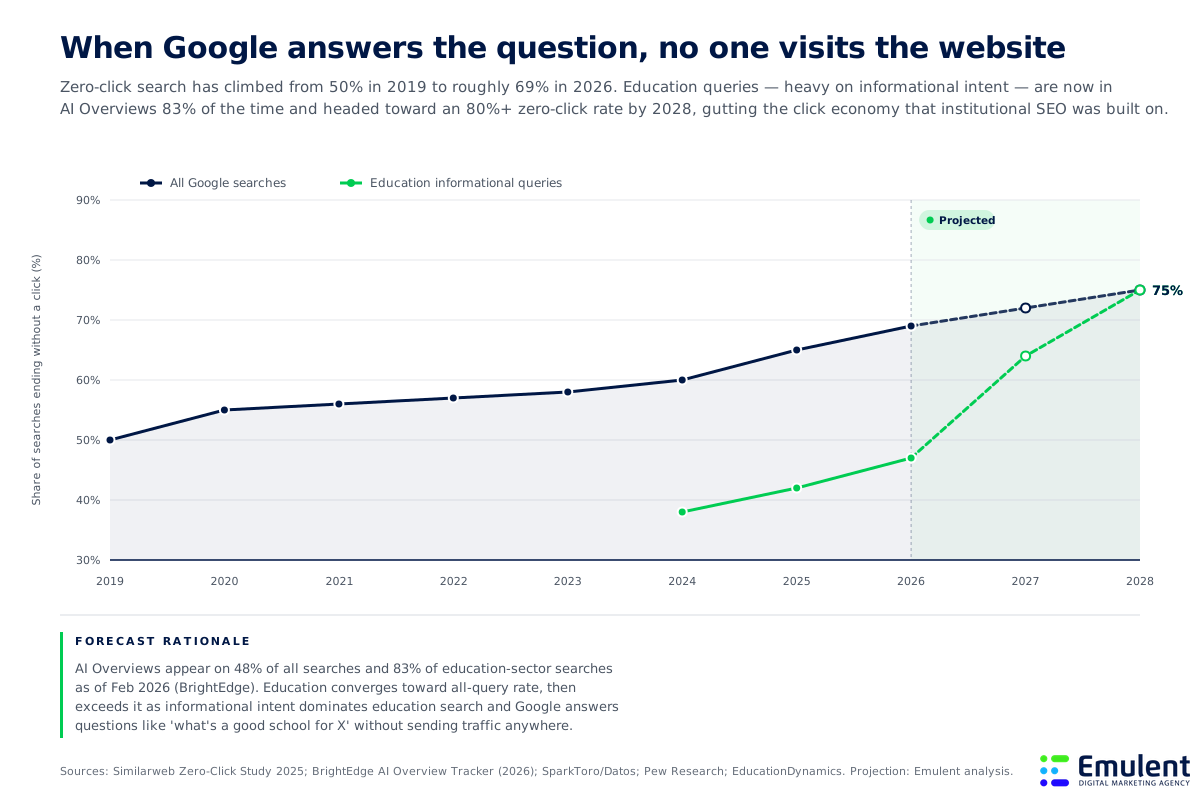 Education queries skew heavily toward informational intent (what is a good school for nursing, is an MBA worth it, how much does X program cost), which is exactly the query type Google answers inside the result page. The structural advantage institutional content held during the 2010s has reversed. By 2028, both curves converge above 80%, with education running slightly higher than the all-query average.
What that requires of an institutional content program
- Citations inside AI answers become a primary KPI, replacing position-tracking for informational queries.
- Structured data on every program page so AI engines can ingest tuition, length, outcomes, and prerequisites without guessing.
- Named-faculty authorship on thought leadership, which earns citations at higher rates than marketing-written content.
Less click volume meets more advertiser demand, which leads to the next number CMOs need to internalize.
Why does every inquiry now cost more?
The UPCEA and Search Influence What Gets Measured Gets Managed benchmark put the 2024 cost per inquiry at $140 across higher-ed, with graduate programs at $157, undergraduate at $128, and non-credit at $51. Two years later in 2026, those numbers are already higher. By 2028, our projection puts graduate CPI at roughly $215, undergraduate at $170, and non-credit at $70.
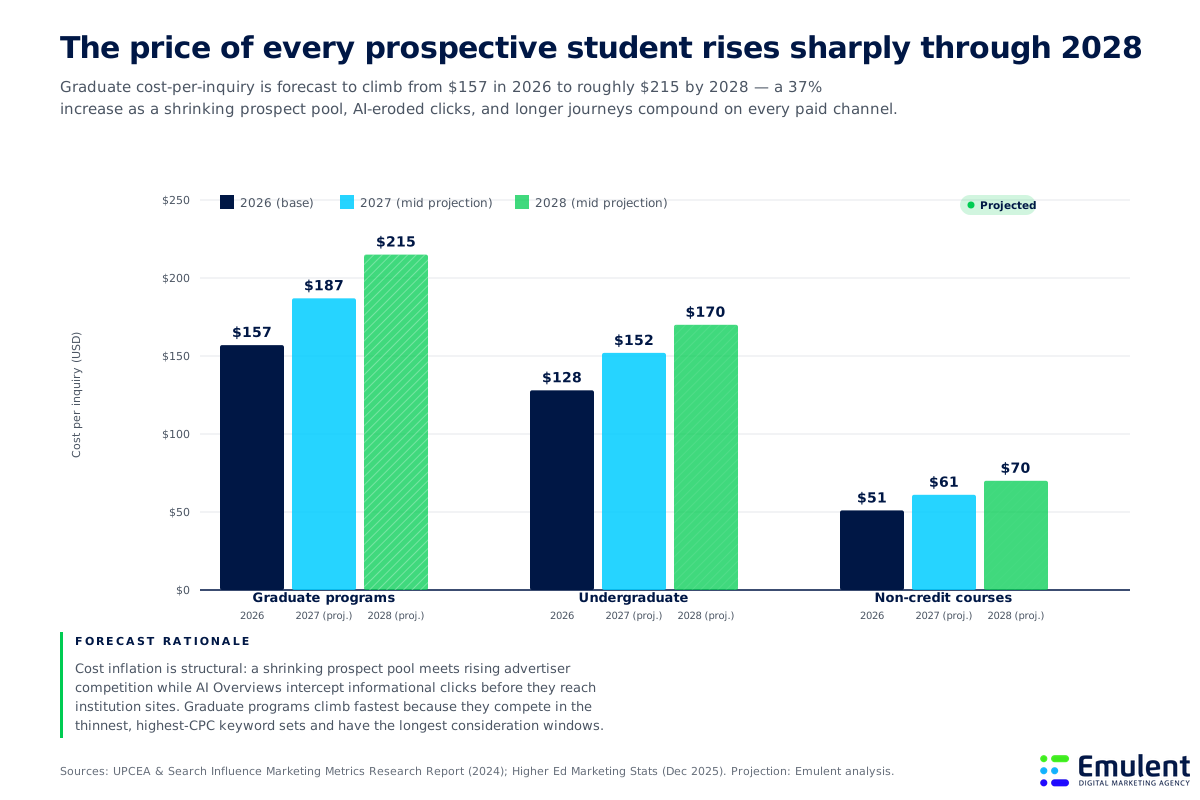 This inflation is structural, not cyclical. A shrinking prospect pool meets rising advertiser competition while AI Overviews intercept informational clicks before they reach institution sites. Graduate programs climb fastest because they compete in the thinnest, highest-CPC keyword sets and have the longest consideration windows. Plan paid-media budgets assuming roughly 30% unit-cost inflation through 2028 and reweight toward channels with better economics, which usually means owned content strategy and brand-authority work that compounds.
Costs go up nearly everywhere. Institutions had counted on international students to offset some of the domestic compression.
How should you plan for international enrollment uncertainty?
Per the Institute of International Education’s 2025 Open Doors report, U.S. institutions hit a record 1.18 million international students in 2024, then saw new enrollment drop 17% in fall 2025 and graduate enrollment fall 12%. These were the first non-pandemic declines in five years, driven primarily by visa-processing capacity and policy uncertainty.
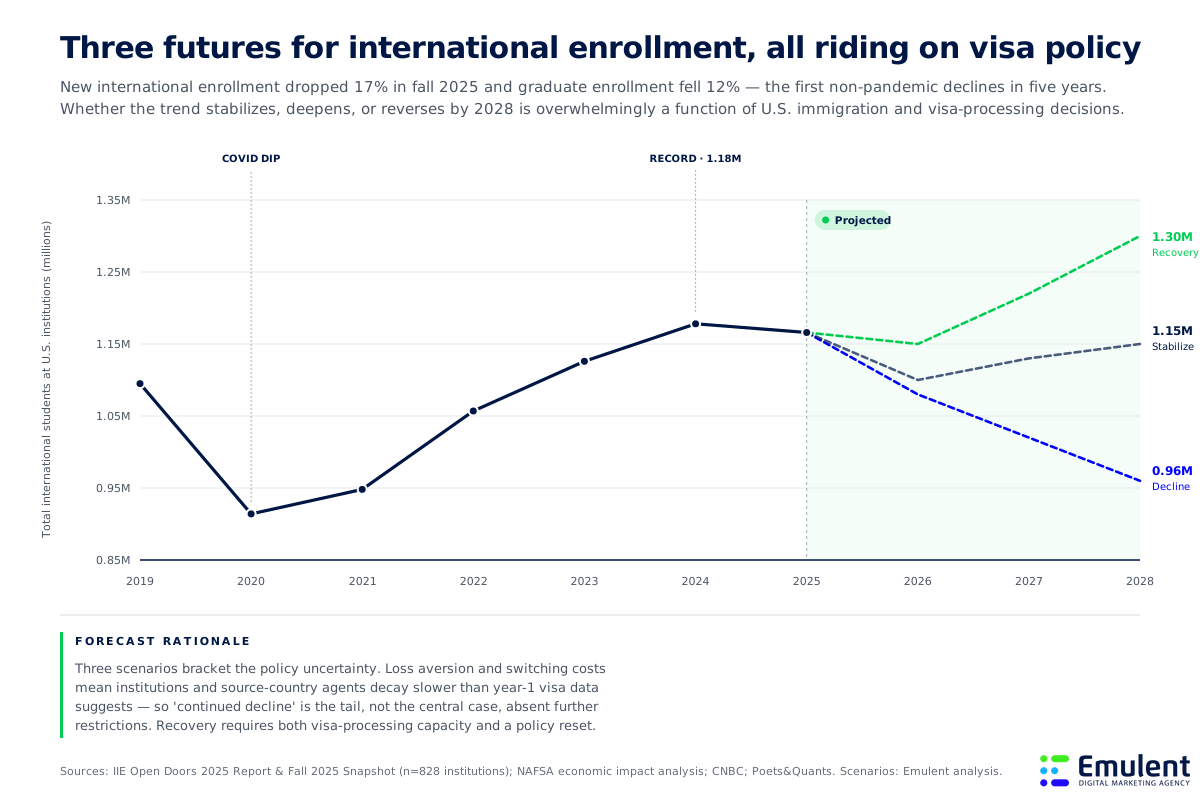 Forecasting this metric requires scenario planning, not point estimation. Three credible paths fan out through 2028: continued decline to roughly 0.96 million, stabilization near 1.15 million, or recovery to 1.30 million. Loss aversion and switching costs at institutions and source-country agents mean the steep decline scenario is the tail, not the central case, absent further restrictions.
How to plan when the input is policy, not market
- Model 2026-2028 enrollment under all three scenarios and lock the operating budget to the central case while flagging triggers for the others.
- Diversify source countries. Programs with 60%+ concentration in any single country carry the highest variance.
- Build AI-citation visibility in source-market languages because international prospects use AI heavily and early.
If international is a scenario, adult learners are a certainty.
Where does the real enrollment growth actually live?
While the traditional 18-24 pool contracts, the 25+ adult-learner segment is where the growth lives. Adult learners already account for roughly 42% of total higher-ed revenue in 2026 per NSC Research Center and UPCEA data. The total addressable market sits at 242 million-plus U.S. adults without a degree.
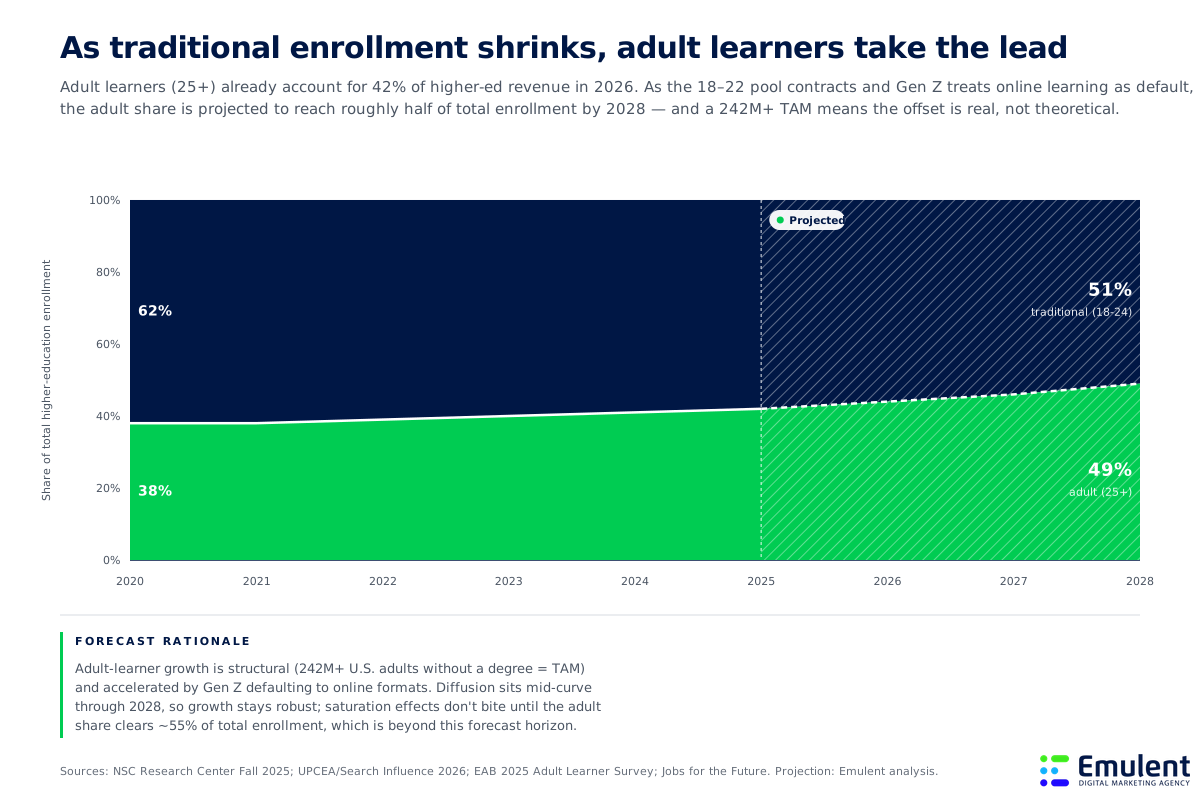 The structural drivers reinforce each other. Traditional cohorts shrink. Employers continue paying premiums for credentials. Online and hybrid formats remove geographic friction. Gen Z increasingly defaults to online formats by preference rather than necessity. Our projection: by 2028, adult learners reach 49% of total enrollment, roughly parity with traditional students.
The channel mix, message, and proof points that work for an 18-year-old and her parents do not translate to a 34-year-old returning learner. LinkedIn outperforms Instagram. Career outcomes outweigh campus culture. Time-to-completion beats prestige messaging for most adult programs. Institutions still running one playbook for both audiences leave demand on the table.
Acquiring more prospects matters less if fewer of them say yes once admitted.
Why is yield the highest-ROI marketing investment now?
Selective public institutions have watched yield rates, the percentage of admitted students who actually enroll, fall from roughly 45% in 2019 to about 35% in 2026. NACAC’s annual State of College Admission report attributes this to two reinforcing trends. Students keep applying to more schools, raising the denominator. Test-optional policies removed an evaluation filter that previously narrowed the field.
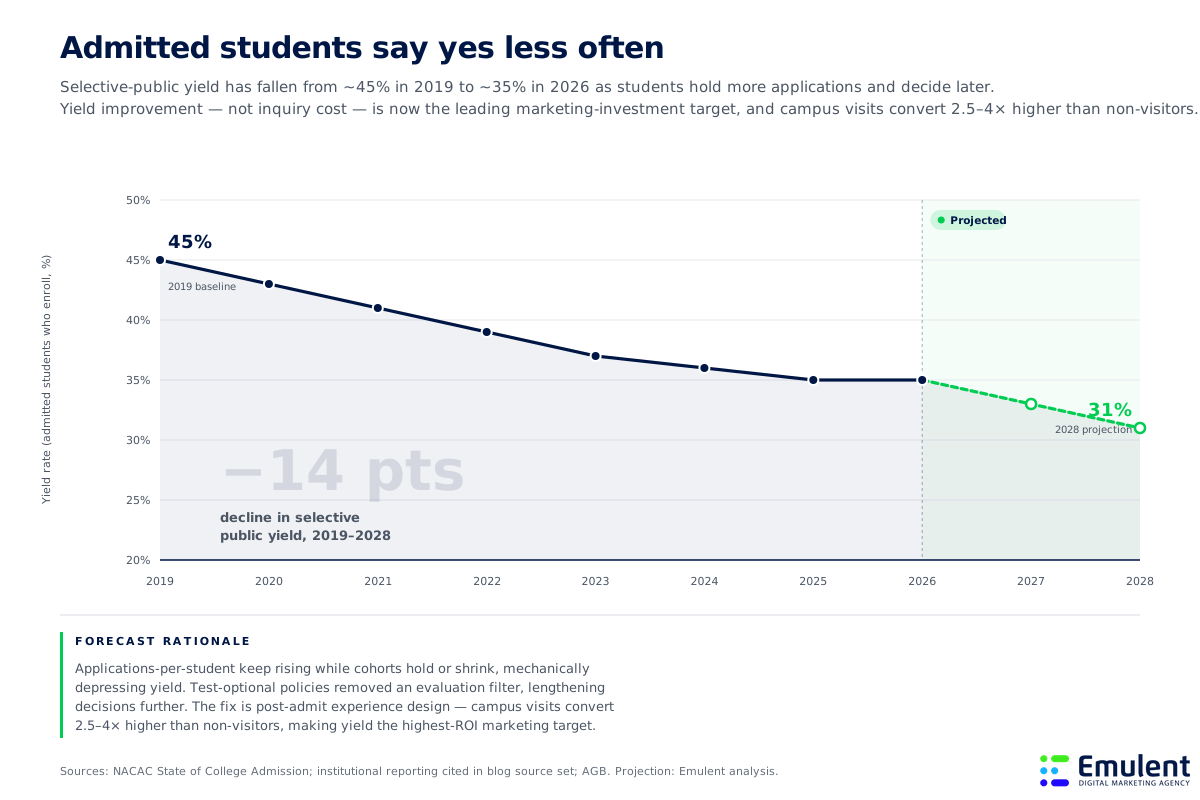 Without aggressive yield investment, the trajectory continues. Our 2028 projection puts selective public yield at roughly 31%, a 14-point decline from the 2019 baseline. The good news is that yield is the highest-ROI marketing investment most institutions are not funding. Campus visits convert at 2.5 to 4 times the rate of non-visitors. Faculty calls, personalized scholarship clarity, and parent communication move yield measurably. Brand video built for the post-admit window outperforms the same content used for top-funnel awareness.
“The marketing dollar that moves a student from admitted to enrolled is worth more than the dollar that moves a prospect to inquiry. Most institutional budgets still do not reflect that.” Emulent Strategy Team
Yield is the ROI lever. For some institutions, the next lever is survival.
Which institutions face the highest closure risk through 2028?
Closures of nonprofit institutions averaged 3 per year in 2020. By 2024, the annual rate was 17. The Hechinger Report identified 442 at-moderate-risk institutions in 2025, and the Federal Reserve Bank of Philadelphia’s worst-case model, assuming a 15% enrollment shock, produces 80 closures annually. Our central projection puts 2028 closures in the 25 to 40 range, with 80 as the upper bound.
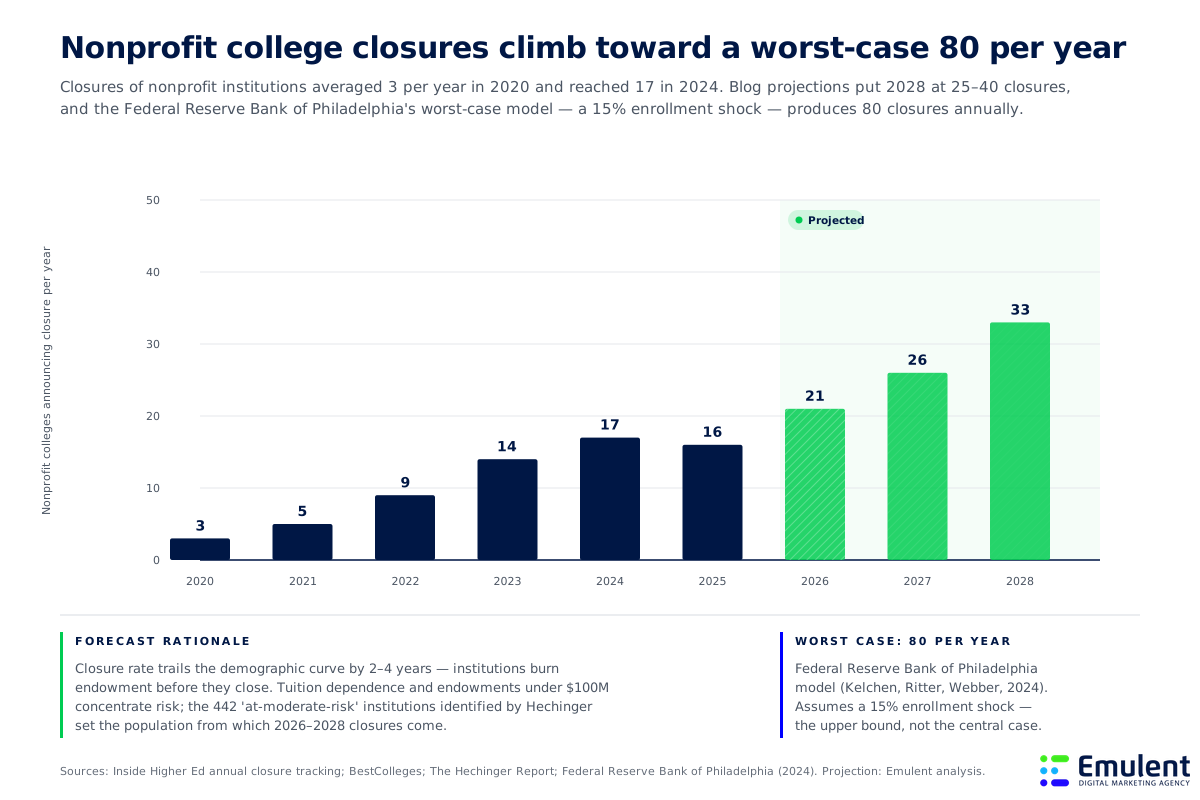 The institutions most at risk share three characteristics: tuition dependence above 80%, endowments under $100 million, and a regional 18-year-old pool projected to decline more than 15%. Closure rate trails the demographic curve by two to four years because institutions burn down endowment before they close their doors. For schools in this risk band, brand strategy and differentiation are not growth levers. They are the survival lever.
Whatever the institution’s risk band, the budget that delivered 2024 outcomes will not deliver 2028 outcomes.
Where should higher-ed marketing dollars move next?
Add the previous eight trends together and the budget implication sharpens. Paid media gives ground. Content, generative engine optimization, video, and retention pick it up. By 2028, roughly half of the marketing budget shifts from acquisition channels with declining unit economics into capabilities that compound. AI-citation visibility, faculty-authored content libraries, video-first program pages, and pre-enrollment nurture all build authority that AI engines actually cite.
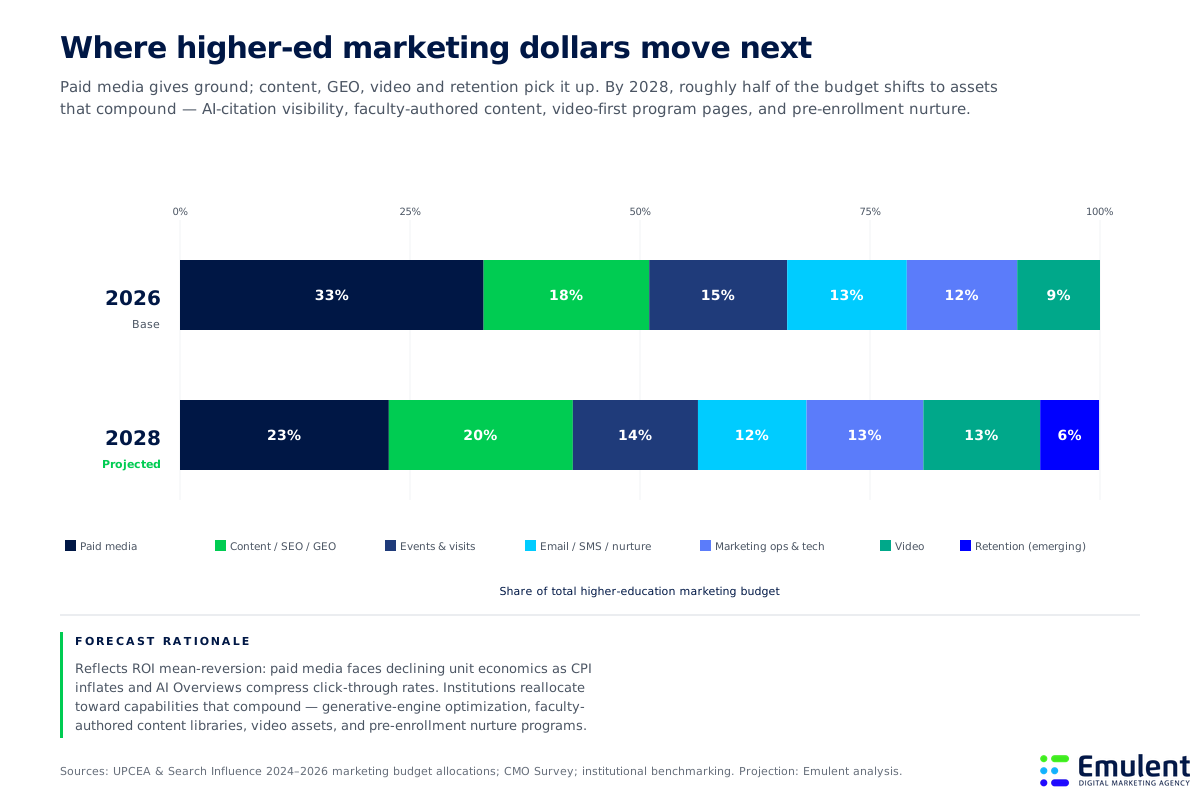 The shift reflects ROI mean-reversion. Paid channels face rising CPIs and AI Overviews compressing click-through rates while owned media and brand investment build authority that AI engines actually cite. Institutions still allocating 35% or more of budget to paid media in 2026 are over-indexed on the channel facing the worst unit economics through 2028.
Where the dollar moves through 2028
- Out of paid search and social as unit economics decay.
- Into AI search visibility and AI SEO as the new top of funnel.
- Into video and faculty-authored content as the assets AI engines cite.
- Into retention marketing as a distinct line item rather than an afterthought.
Every budget shift needs measurement infrastructure under it. That brings us to the gap that decides which institutions optimize and which stay blind.
Why does the measurement gap decide who wins?
Despite everything above, less than half of higher-ed marketers track the two metrics that matter most. Per the UPCEA and Search Influence benchmark, 46% of institutions track cost per inquiry in 2026 and 43% track cost per enrolled student. Seventeen percent track neither, meaning they have no way to price an inquiry or an enrolled student in any channel.
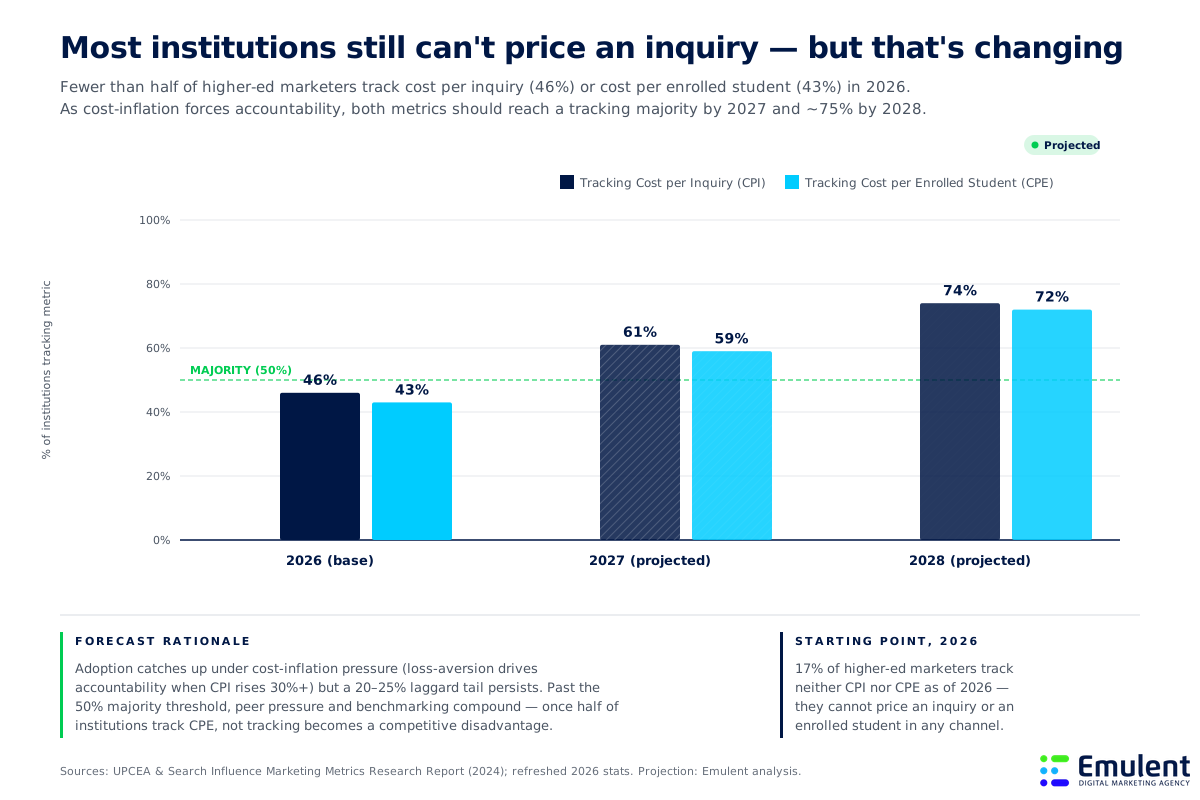 As cost inflation mounts through 2027, accountability stops being optional. Loss aversion drives adoption: once CPI rises another 30%, institutions cannot afford to fly blind in any paid channel. Our projection puts CPI tracking at 74% and CPE tracking at 72% by 2028, a tracking majority that crosses the 50% threshold in 2027 and accelerates past it.
“You cannot price an inquiry in a channel you do not measure. Once cost per inquiry climbs another 30%, that becomes a fireable problem.” Emulent Strategy Team
If a CMO takes one action from this entire report, it should be standing up CPI and CPE tracking before the 2026 budget is finalized. Every other recommendation in this report depends on knowing what an inquiry and an enrolled student actually cost in your environment.
How Emulent helps higher-education institutions through 2028
We work with colleges, universities, and online programs on the capabilities this report points to: generative engine and AI search visibility, content strategy built for both human and AI readers, marketing measurement infrastructure (CPI, CPE, multi-touch attribution), brand strategy for adult-learner and graduate programs, and website redesigns built for the 2026-2028 landscape. Our founder Bill Ross leads every engagement directly. There is no junior swap-in, no outsourced delivery, and no long-term contract requirement.
Services include:
- Education Brand Photography
- Education Branding
- Education Web Design
- Education PPC
- Education SEO
- Education Marketing Agency
- Higher Education Branding
- Higher Education Content Marketing
- Higher Education Web Design
- Higher Education SEO
- Higher Education Marketing Agency
If you want a direct conversation about what any of this looks like in your institution’s environment, contact our team for a higher education marketing strategy conversation.